

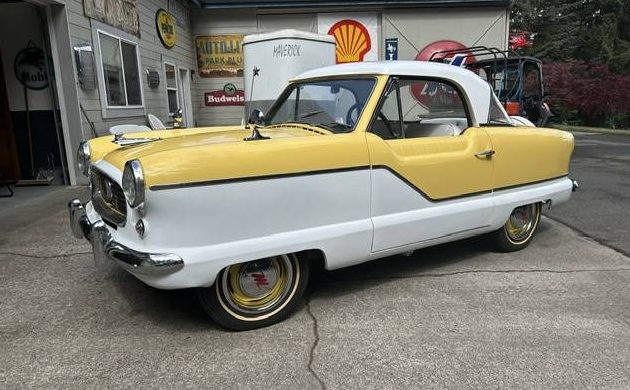
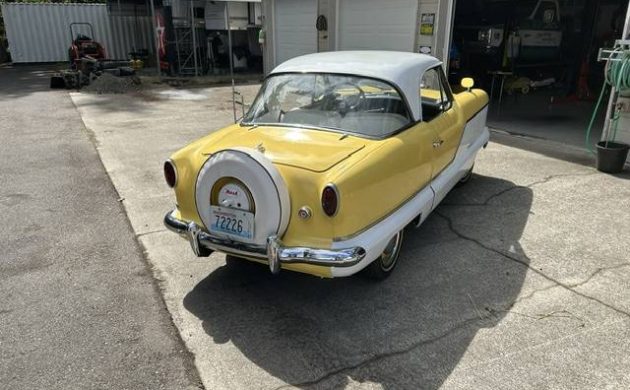
Hubby doesn’t share much information or ownership history about the Met he found for his wife, other than, “I found this one for her and redid the interior in the original colors and print!” Based on the few photos supplied, this looks like a good driver-quality Metropolitan. The two-toned Autumn Yellow and Frost White paint is presentable, and the chrome bumpers, trim, and glass look good, too. 1959 was the first year of the Series IV Met, with upgrades that included access to the trunk via an exterior trunk lid (instead of the inconvenient access through the folding rear seatback), and front vent windows. This one has the classic “Flying Lady” chrome hood ornament, dual outside mirrors, and wheel trim rings. And speaking of wheels, the only thing I’d change on this Met are the tires. Metropolitans always look sharper with the period-correct whitewalls.
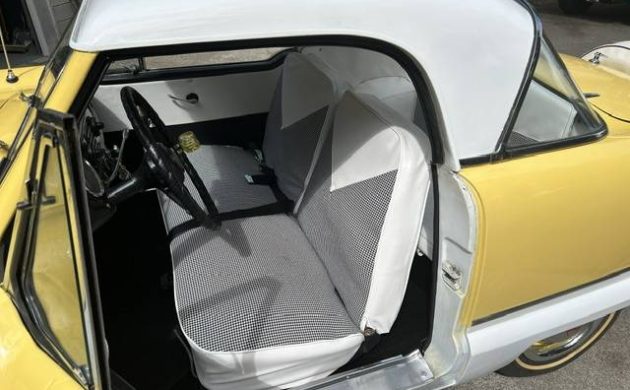
Starting with the Series III for the 1956 model year, the Metropolitan’s seat upholstery changed to a diamond-patterned black-and-white “houndstooth” checked material trimmed in white vinyl. It gave the Met’s cabin a stylish, modern feel that helped support its “Big Car in Miniature” positioning. Aftermarket black seat belts have been added. The black carpet appears to be in very good shape, as do the instrument panel, door panels, and rear shelf (you can really call that a seat). I’m assuming the headliner looks good as well.
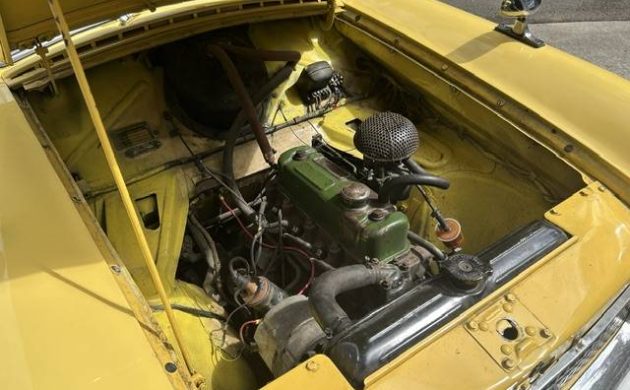
The Met’s durable Austin 1500cc inline-4 is easily found under the front “bonnet.” It was rated at 55 horsepower at 4600 RPM with a top speed of approximately 80 mph. Gas mileage was advertised at 40 mpg back in the day of huge, heavy gas guzzlers. Mileage is listed at “100,000,” but there’s no mention of how it runs and, most importantly, stops. The ’59 Met would be its highest sales year here in the States with 22,209 units sold (which was second the VW Beetle). Although the collectability of cars from the ’50s has softened, I think the unique “charm and cuteness” of the Metropolitan will continue to make it a collectible for some time to come. It was the first small car marketed to women as a second car and, based on my experience as a former Met owner, the restored ones had their fair share of female owners and admirers. I hope this one finds a new home sooner rather than later.
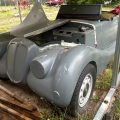

Thankfully, another “cute as heck” Met that my wife would fall for, like the recent purple one, but without the upgraded engine and auto trans, but still on the Wrong Coast.
I like the husband’s comment, “I honestly can’t even get in this little car,”…. I’m 6’3″ and it’d be tight. Neat little car and very unique. I like unique cars
Wow brings back 2 memories. My dad bought the exact car to go back and forth to work and in 1967 my brother thinking it would be good to use for his drivers test like easy to parallel park….but going around a corner it popped out of 2nd gear and the guy failed him.Oh,our neighbor had red/white one.
When I turned 16, and was looking for my first car, two choices were available. A 1954 Corvette, or this Metro. Guess which one the folks liked?
Looks like a decent price…
West coast… ugh
Nice car. Being up to my gills in BMC engines I’ll never understand why the Brits kept using that military green paint on their engines.
WWII’s ending, perhaps, in some way, shape, or form, or not.
I have two sad stories concerning these little cars. 1) my oldest sister Betty (RIP) bought one new in 1955. After a week of work at Ma Bell she was heading to a gas station when she ran out and the car came to a stop on a busy street. She walked to a phone booth ( no cells in those days) where she called our dad for help. Upon arriving the car was found to have 4 flat tires with knife punctures in each sidewall. Here was her little red and white car with 4 flat tires and no gas.
2) The sister of a sister in law was married to a bozo who owned a Metropolitan convertible in 1967. After work while heading home he came upon road construction closure of a bridge. Him not being to bright attempted to go around the closed road and rolled the little car over killing himself.
No this is in no way intended to impute these cars, just facts known to me.
God Bless America
My friend restored one of these for his wife and ironically only lives a few miles from Marysville, but different color.
Actually the one piece rear window and glove box lid started with the 1958 model.
The Metropolitan doesn’t sell very well out here in Oregon, last guy to sell one was asking $6000, he finally sold it for $4000, it seems that the convertibles are the most popular version, these hard tops not so much. In fact, there were people cutting off the hard tops, just so they could increase the cars value. The real problem is that the people who might want to own these are all dying off. My buddy owns a metropolitan and he’s 72 years old, so it’ll probably be sold off at auction when he passes away. He has no children and no wife, so he left his house to the city. So maybe the city will also get his cars as well?