

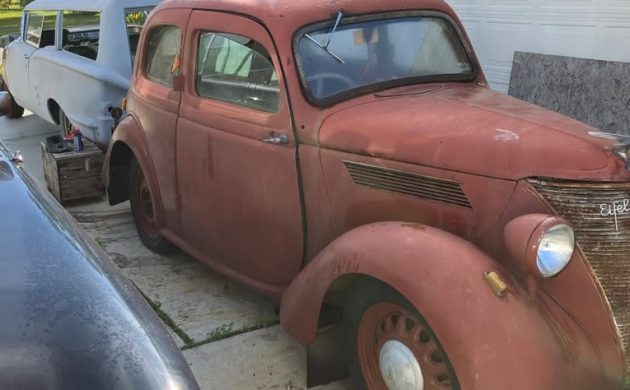
Ford Germany (aka Ford-Werke GmbH) recently celebrated its 100th anniversary. One of its products was the Ford Eifel which was produced between 1935 and 1940. It was never imported into the U.S., and the car fell victim to the turmoil of what would become WW2. The Eifel was a smaller family car whose production exceeded 61,000 units over six years. How this 2-door sedan found its way to Orlando, Florida isn’t known, and it has the customary right-hand-drive. Available here on Facebook Marketplace, this seemingly complete project is offered for $5,500.
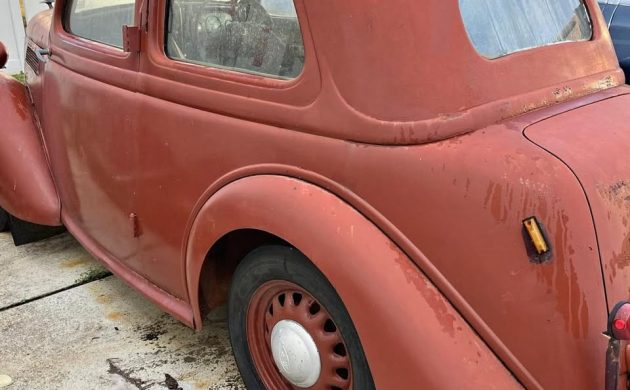
The Eifel was based on Ford’s Model C (European version) and got its name from a mountain range in Western Germany (not the tower in France). A full range of body styles were offered so buyers had ample choices. Only one engine was available, a 1172-cc 4-cylinder motor that was only good for about 34 horses. A 3-speed manual transmission was also applied.
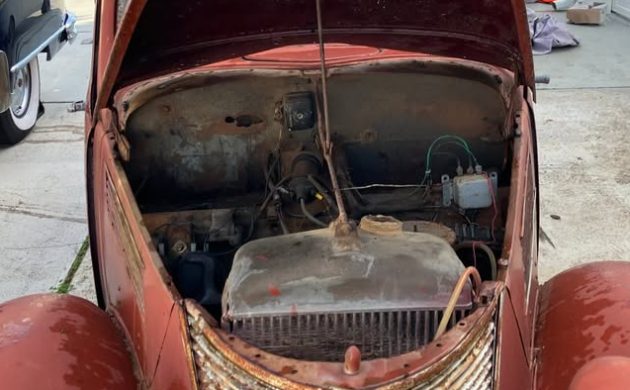
We don’t know the history of this rare Ford (try to find another one in the U.S.). Speculation is that few survived the war because their metal was repurposed for the German war effort. No mention is made of its running status, and the odometer reflects just 35,000 miles (or is that kilometers?). How and where you’d find parts is likely a job in itself.
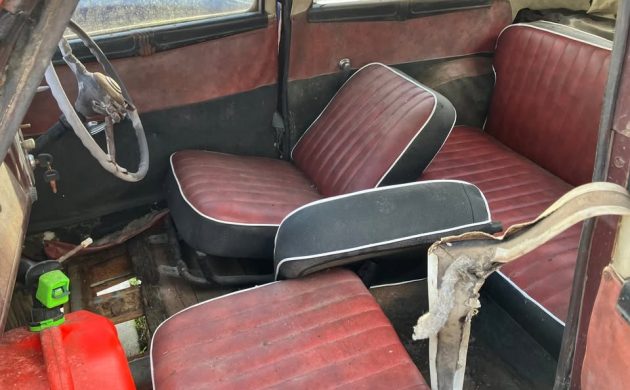
The body seems to have been gone over and applied with red primer. The interior is not stark but is in disarray as the front seats seem to be just sitting in place. The overall vehicle’s condition appears to be fair, and it would certainly be a novelty if restored. It’s sandwiched between other vehicles, one of which is an incomplete 1958 Chevrolet station wagon. Thanks for the nifty tip, T.J.
I can just see my old man, look dad, it even has “mox nix sticks”,( trafficators),,,I’m sure him and his army buddies blew up many. For a pre-war car, it was actually quite modern, and probably what most Germans drove to the factory, blissfully unaware of what products for war they were making. Make a great Gasser, :0
Howard it’s been many years since I saw or heard ”
Mox nix”. I first heard it from a bar maid in kaiserslautern, Germany in 68.
Probably there’s a lot of these resting in barns in Germany. You could find a complete one and ship it here in an ocean container.
Let’s try this again. Cute little beast; one of the nicest to come out of Europe. I saw a cabriolet version of this and thought that a V8-60 would’ve made it fairly potent. Yeah, it could come to my place…
Why is the steering wheel on the right? It’s my understanding that Germany was a left side driver country.
It is I was stationed there in the 80’s
These were made in right-hand-drive but in England as the Ford “Ten De Luxe” and almost exclusively in four-door form.
I heard that Henry Ford demanded (and got) paid for all damage to his German factories from allied bombing. Is that true? Imagine making profits on both sides of a war. Talk about a Capitalists wet dream. Daddy Warbucks could only dream of something that lucrative. Of course, all that yummy money gave us the Mighty Mustang, so what the heck, right?
Yes, it is partially true, though often slightly exaggerated in internet rumors. The Ford Motor Company did not sue or get paid by the US government directly for bombing, but Ford’s corporate parent did file claims and receive roughly $1.1 million in 1967 from the Foreign Claims Settlement Commission of the U.S. government for physical and financial losses sustained by its German subsidiary (Ford-Werke AG) during World War II.
1) Loss of Control: After Nazi Germany declared war on the United States in December 1941, the American parent company in Dearborn, Michigan, lost operational control of its Cologne plant, which had been converted to produce military trucks.
2) The Postwar Claim: Decades after the war, the U.S. Congress-backed Foreign Claims Settlement Commission evaluated property loss claims by American companies with assets in former enemy nations.
3) The Payout: In 1967, Ford was awarded about $1.1 million for wartime damages to the Cologne complex. (By comparison, General Motors received a much larger settlement of around $32 million for its German Opel operations)
Source: L’Internet
Most of the difference has to be based on the fact that Opel lost two factories to the Soviets, the truck plant in Brandenburg an der Havel which fell in the Soviet Zone and the machinery from the Kadett line in Ruesselsheim which became the first Moskvich, despite the plant being located in the U.S. Zone.
1172 is the sidevalve motor that was in 100Es, E93 Pops and so on. No shortage of spares.
Stick a crossflow / 4spd in it if you want to use it in traffic regularly.
Looked at some images on line and all of them had the steering wheel on the left. I wonder if this was meant for the export market. Of course by then I don’t think the Brits were buying any German cars. They also made these in a neat little roadster too.
Sweden was right-hand-drive at the time.
Sweden drove on the left but mostly in left-hand drive cars, including domestic Swedish ones (at the time only Volvo since Saab wasn’t in the car business until after the war).
Yes, the RHD is puzzling. Saw a LHD restored cabriolet Eifel at Hershey last year. It was obvious that the engine was a German built version of the engine used in Anglia’s, though unlike the Anglia the Germans saw fit to use a water pump. Anglias were thermo-syphon.
I’ve seen a few Anglias and Prefects that had a water pump, but it probably had been added after the car left the factory.
The 58 wagon appears to be a two door Yeoman . Needs a lot of work.
RHD could have been built for the Swedish market.
They drove on the other side until the early 60s.
Oh good catch. I’d forgotten about Sweden. Some time ago I watched a Utube vid on the day they switched. Chaotic of course but not as bad as I would have expected.
I used to deal with a Swede. He told me that on the day they switched to right hand traffic, he was a school boy. He along with his classmates were assigned intersections and they stood out by intersections holding arrow signs pointing to the right to remind people. I think the schools were closed?
Wasn’t the Netherlands right hand drive in the 30s?
Very cool. is interesting how deep that radiator is to handle the 1.2L haha
I see Resto all over this nice looking, cool ride!
Austria hungry switch to right hand drive in 1938
RHD because probably an American GI bought it after the war in the UK and shipped it home, intending to fix it up someday but that day never happened.
It sure would make a bad ass restomod with a turbo 4 or maybe v-6. Just pick it up and stuff a frame under it!
The 1938 Ford Eifel was primarily built by Ford-Werke AG in Köln (Cologne), Germany, and assembled in select European export markets like Hungary and Denmark. While continental Europe and Germany drove on the right side, factory-equipped right-hand-drive (RHD) variants and RHD dashboard layouts were produced for specific export destinations that drove on the left side or utilized RHD configurations at the time—notably historical RHD export markets such as Argentina and parts of international or regional territories.
For continental Europe, RHD configurations catered to remaining left-hand traffic jurisdictions, specifically Hungary (which drove on the left until 1941) and Sweden (which drove on the left until 1967).
The UK market received equivalent British-built right-hand drive (RHD) vehicles from the Dagenham factory, such as the Ford Model Y and the 1938 Ford Prefect, rather than the German Eifel.
Source: Das Internet
And don’t forget that many cars used on the very narrow, at the time, roads through the Alps were RHD so the drivers could more easily see and avoid the drop offs when traveling the outside (right side) lane of those roads. That was particularly true for large luxury cars.
I used to deal with a Swede. He told me that on the day they switched to right hand traffic, he was a school boy. He along with his classmates were assigned intersections and they stood out by intersections holding arrow signs pointing to the right to remind people. I think the schools were closed?
Drop offs! Just remembered some rally stages. Susquehanna mountains in PA…THOSE ARENT BUSHES (by the side of the road), THEY’RE TREE TOPS!
In CO at times the stage road wasn’t wide enough to meet a car and it was straight up on one side and down on the other, an oops here and we could land down in Colorado Springs.