

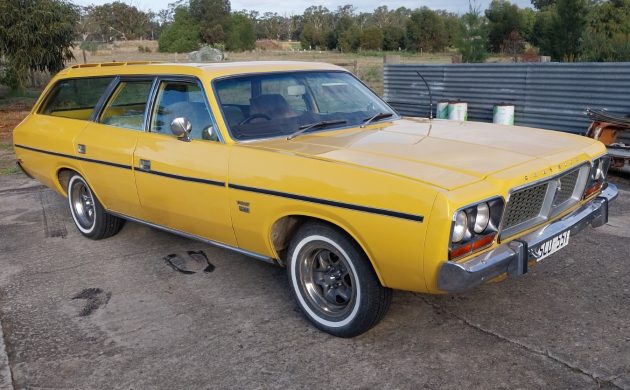
I was only thinking the other day that it has been a long time since we’ve seen an Australian classic at Barn Finds. Then, lo and behold, this 1981 Chrysler CM Valiant Station Wagon appeared to catch my attention. It represented the last hurrah for Chrysler Australia as the Head Office in Detroit sold the entire concern to Mitsubishi. It presents extremely well and could potentially be one of the best remaining examples left on the planet. The seller has listed the Valiant here on eBay in Frances, South Australia. They set their price at A$20,000 OBO, equating to approximately US$14,300 using the current exchange rate.
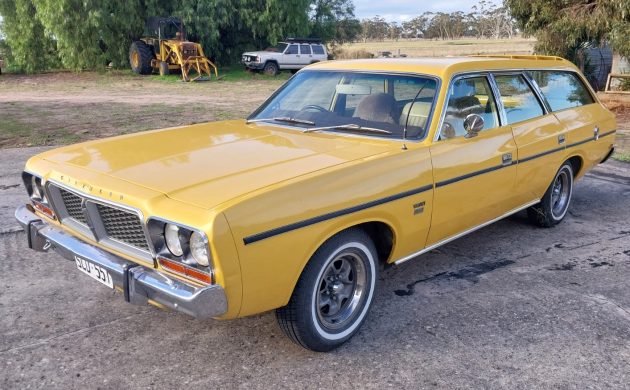
At the dawn of the 1960s, General Motors was in an enviable position Down Under. It commanded 50% of the new car market, with Ford, Chrysler, and some European models sharing the remaining 50%. The problem for Ford and Chrysler was that they were assembling models imported in CKD form, which was expensive. Ford launched the Falcon in 1961 as an affordable alternative, and Chrysler Australia unveiled the Valiant by Chrysler in 1962. Suddenly, Holden had some genuine competition on its hands. Both were based on North American models, but were entirely produced in Australia to circumvent a harsh tariff system. However, Chrysler Australia yearned for a unique model, achieving this goal in 1971 with the launch of the VH Valiant. What nobody knew at the time was that, despite ongoing updates during the 1970s, various circumstances meant that this series would be the last produced by Chrysler Australia. The final update of the VH platform occurred in 1978, designated the CM Valiant model. Although the body was familiar, it featured more modern styling and some engineering changes below the surface to improve driving dynamics and fuel economy. Although the seller doesn’t specify a model year for this Wagon, the “Mitsubishi” designation on the Trim Tag suggests that it should be a 1981 model. It presents extremely well for its age, with its Tiger Yellow paint holding an impressive shine. The panels are as straight as an arrow, and while some underside surfaces wear a dusting of dry surface corrosion, the supplied images confirm that this classic is free from penetrating rust. The trim and glass are excellent, and the Wagon rolls on a set of the company’s locally-produced sports wheels.
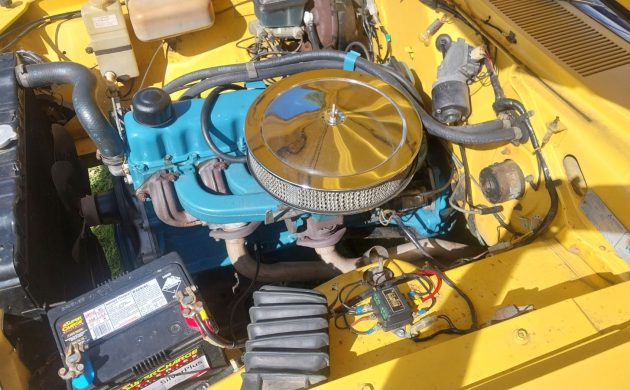
Readers outside North America may be unaware that Chrysler’s Hemi technology extended beyond the mighty V8. Chrysler Australia’s early models featured the venerable slant-six and V8s, but the introduction of the 245ci and 265ci sixes in 1970 marked an important milestone for the company. These motors were developed locally and feature Hemi cylinder heads. The 265, in particular, became a formidable weapon capable of producing extraordinary power and torque. Emission regulations during the mid-1970s hurt the motor, but it was still a good thing. How good? The 265 in this Wagon would have produced 162hp when the vehicle was shiny and new. The Ford Falcon featured similar physical dimensions and was considered the Valiant’s natural rival. Its 250ci six delivered 126hp, giving the CM a sizeable performance advantage. This Valiant has a couple of aces up its sleeve that will improve its performance potential. The first owner teamed the Hemi with a four-speed manual transmission at a time when most buyers selected the three-speed unit or the TorqueFlite. It also features an extremely rare split-system exhaust, which may have unlocked a few additional ponies. Potential buyers can consider it a turnkey proposition that runs and drives extremely well. The seller sometimes uses it as a daily driver, which is an intriguing prospect for some enthusiasts.
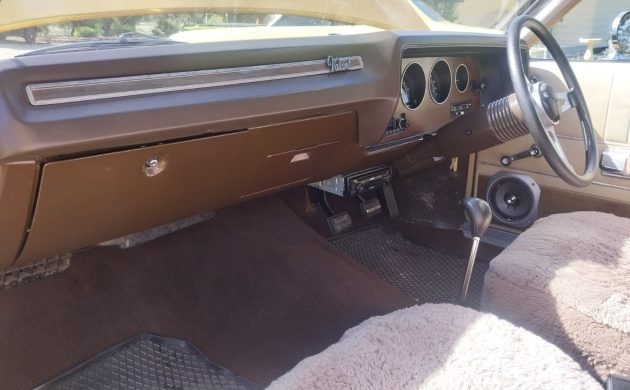
The seller’s interior shots aren’t great, but piecing them together tells us much about its overall condition. Slipcovers make it impossible to assess the front bucket seats, but the back seat is free from rips and tears. Someone cut the front door trims to accommodate speakers for the underdash CD stereo, but that appears to be the only change. The carpet looks pretty respectable for its age, the dash is clean, and the pad is crack-free. Of course, the fewer issues the better, because the rarity of these classics can make sourcing trim pieces difficult. I did locate at least one company producing replacement seatcovers, but they are expensive. Some enthusiasts would still consider them a worthwhile investment, ensuring that the Wagon presents at its best.
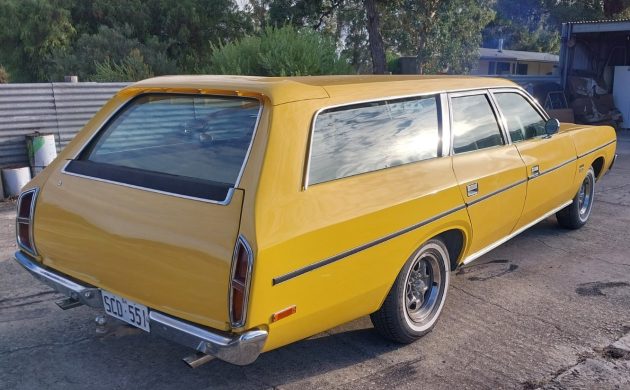
It is no secret that Chrysler was in deep financial trouble at the end of the 1970s, and it required some drastic action to save the organization from complete collapse. One of the strategies was to sell Chrysler Australia, with Mitsubishi becoming the new owner in 1980. It would have been easy and understandable if Mitsubishi had immediately ceased producing the Valiant, but it remained on sale for almost two years for one very sound financial reason. The corporate purchase included an enormous stockpile of Valiant parts, allowing Mitsubishi to build the Valiant range for little more than labor costs. That provided an exceptional return on its investment, and Mitsubishi followed that path until the parts shelves were empty. The initial production tally was relatively low in a “big picture” sense, and the Valiant soon disappeared from the Australian motoring landscape. Automotive technology had overtaken it, and ongoing development during the 1980s saw many CM Valiants discarded as consumers focused on the latest and greatest that money could buy. Therefore, this 1981 Wagon is extremely rare, and with the marque enjoying a strong following in the classic community, I don’t think it will take long for this survivor to find a new home.

Two cool wagons in the same day that are too cool. Both 4 spd haulers separated by a “couple” miles, both equitably desirable. Nice one, Adam.
As we said a couple days ago here in the Wild West “WAGONS, HO!!!!”
Thank you so much for that, Nevadahalftrack. I always appreciate your feedback. I knew I needed to write the Valiant the moment I spotted it. It marked the end of an automotive era in Australia, as the third player in the “big three” disappeared from the domestic market. I’ll always keep an eye out for other vehicles from Down Under, and I hope that you continue to enjoy our articles.
Too cool. Good looking car, unusually optioned. Love the front end. 🇦🇺
Greenhouse lines resemble the early ’70s C-body “fuselage” wagons.
No grills over the speakers? Watch your feet boys. Interesting car though.
With cheapskin seat covers. This would be fun at a car show.
Nice wagon with a manual here!
Just to set the record 100% straight….the Aussie 245 and 265 6 cylinders did NOT have a Hemi head. It was a ‘cant valve’ design,same as BB Chev and Ford Cleveland,albeit non crossflow. However they certainly cashed in on the Hemi moniker and they went very well….now you know..!!
I think that those motors came from Humber (Rootes), one of Chrysler’s acquisitions.
No, they were made in Chrysler Australia’s foundry and engine plant in Lonsdale South Australia.
I meant that the design was from Humber. They are similar tomthe 3 litre Super Snipe engine.
I had the 1968 model before this when I lived in Durban, South Africa. I bought it second hand from a taxi company with 85,000 miles on the clock although I suspected that it had rolled over at least once. I traveled all over SA from North to South and East to West and the ONLY trouble that I ever had with it was a noisy universal joint that I had replaced in Cape Town. I sold it several years later to an Indian fellow that had a transport company and he used it to run spares to his broken down trucks wherever they might be in SA and a few years later I met up with him and he had never had a major breakdown, or engine overhaul in all the time he owned it before he sold the car to one of his employees who was still using it! That slant six motor mated to the Chrysler automatic gearbox was bullet proof! It was the most reliable American car that I ever owned.
Adam, Thank you for going “down Under” to find this beautiful wagon. No idea of the cost of shipping it up here to the States??? And also the import process? I know going the other way, it is about a 1 month quarantine and inspection process. NO ASBESTOS!!!!! To add to your Chrysler Australian history. In the 50’s thru the 70’s Chrysler and International of AU were big business partners as IH used the Dodge “Pilot House” cab on their L & R trucks and later in the 70’s Dodge used the IH styled A cab on their trucks. Both were built in by Australian cab builders.
Agree with the Bills’s comment above about the 6. These were “semi hemi” engines that were marketed as Hemis. That said, they were no slouch. In the early ‘70s they had a Chrysler Valiant Charger that looked a bit like a smaller version of the ‘66-‘67 Charger with this engine, with triple factory Webers. It was the performance engine above the 340 V8 in those cars.
Great write-up! Thanks for some Down Under auto history. Would love to read more! I remember checking out the Holdens and other brands when I was in Australia many years ago, never knowing Chrysler was in the game too.
Austin had a strong Australian manufacturing presence, too, with Australia specific variations, as did Morris.
As for Chrysler, their big 6 and V8 Royals were a common sight in the 1950s!
The V8 VC Valiants took 10th and 11th places in the 1966 Bathurst race, the first cars home after the Morris Cooper S’s clean sweep! They were first and second in their class.
David, You can go to this website and learn some more about Australian Truck history::: https://www.hcvc.com.au/forum/index
Just spent some time browsing the site….. Interesting reading. Thanks for the link.
G’day guys. Awesome looking car. IMHO, this was the best looking car sold under Chrysler Australia since the Chrysler by Chrysler back in the early 70s. The only things I’d want for my Valiant would be an automatic gearbox and a visor above the windscreen.
Adam, cool write up. I had no idea that these existed. A RHD slant 6 with a 4 speed manual. I can’t even imagine how I would shift with my left hand!
I just arrived back in Oz from six weeks on the eastern side of the US with a diversion into three Caribbean islands. Was surprised that Barbados was RHD and found out it was part of the United Kingdom until 1996. I went to Daytona beach for a motor cycle event. A great trip but you guys need to tell your food manufacturers to cut down on the salt and sugar used. Also, the change from right to left hand for the gearstick is not so much of a problem. It is that the turn signal stalks are often on the other side of the steering wheel. So much easier to forget this.
If only our American Mopar cars were designed and tested the way Mopars of Australia. I would imagine much of Australian drivers drive in the rugged unforgiving Outback desert. What the hell do I know? I live nowhere near the desert. Depending on where you live here in the USA, we have desert area that’s almost as unforgiving. We all want comfort, but what good is comfort without durability?
Gooday, most of the Australian population lives in urban areas along the eastern, south-eastern, and south-western coasts, with approximately 90% of the population residing within 50 to 100 km of the sea.
Australian cars built by the Big 3, Ford Falcons, GM Holdens And Chrysler Valiants were built tough to handle the rough roads but the majority were driven mostly on city roads.
Nowadays, Outback trips are mostly done in Landcruisers, Nissan patrols and twin cab utes.
Cheers. Victor
I saw a lot of shopping hacks (Mazda 323 type stuff) on the Birdsville Track and on the Great Central Road. The Shitbox Rally sees very “ordinary” cheap cars on outback roads, including the Gib River Road. The Peugot Car Club does some adventure drives also.
It is surprising how often you read of Landcruiser drivers who won’t take their rigs off the black top!
I’m sure. I’d rather have a car capable of going off road, even if we don’t go off road. You never know what you’ll need to do. It’s better to have something and not need it than to need it and wonder why you don’t have it.
cool wagon. not a fan of r/h drive
Adam, that’s a neat wagon! I would probably have a tough time at at first shifting with my left hand but it sure sounds like fun rowing the gears in that bad boy!
I learned to drive in RHD car, went to America and drove LHD cars, back to South Africa to drive RHD cars, up to North Africa where I drove LHD cars again, go to Europe every year and drive LHD’s again before back to UK and RHD cars. There REALLY is absolutely NOTHING to it as long as you are careful for the first couple of days, and from then on it’s as automatic whichever side of the car has the steering wheel.
Golly that was a sad day here in Australia when Chrysler shut up shop and Mitsubishi took over the Valiant was a tough car our family had two wagons and I myself had two a sedan and of course the Charger the Mitsubishi era of cars here didn’t have the same aura as the Chrysler cars had. Thanks for sharing it brought back a lot of fond memories.
It seems to be happening here in North America. I’ve nothing against Toyotas, Mazda, Nissan, and Mitsubishi, but what’s wrong with Chevy, Ford, Dodge, Plymouth and Chrysler? I don’t understand it.
Actually, going back and forth from lhd to rhd isn’t too hard. I made many trips to the Bahamas and often wound up in rhd cars. Only takes a few minutes to get the hang of it.
Probably a lot easier than coping with these modern monstrosities that have a drive-in screen between the driver and front passenger!
I reckon it depends on the modern “monstrosity”.