

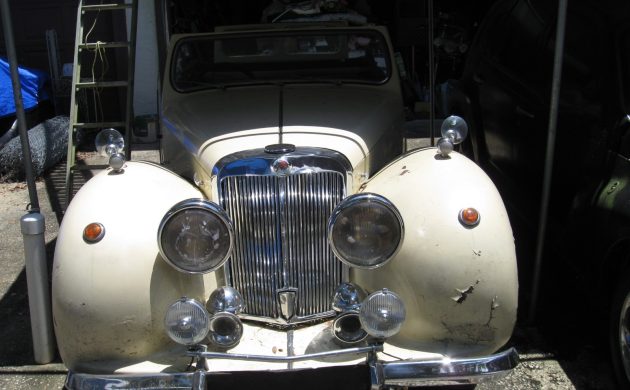
Hiding in this carport is one of the world’s rarest British Sports Cars. This 1949 Triumph 2000 Roadster has spent years in a barn. It looks pretty tired, but close inspection reveals it is rock-solid and has a feature that increases its versatility. It is ideal for enthusiasts seeking a classic that will stand out in a crowd and be unique at almost any Cars & Coffee. The seller has listed the Triumph here on eBay in Mims, Florida. They have received no bids on an auction that opened at $14,500, but do provide a BIN option of $18,850.
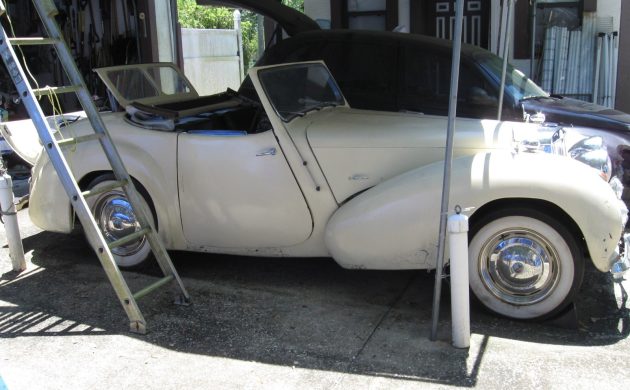
Triumph released the 1800 Roadster as its first post-war Sports Car in 1946. The “1800” model designation referred to the car’s engine capacity, and bolting in a larger motor in late 1948 for the 1949 model year created the 2000 Roadster. It remained in production for a single year, making it one of the rarest cars ever to wear the Triumph badge. The seller indicates that this Roadster spent years in a barn, only recently emerging into the light of day. It requires a total restoration, but is a prime candidate for such attention. The buyer will undoubtedly strip away the tired paint, but despite appearances to the contrary, they won’t face many panel repairs. Steel remained in short supply following World War II, so Triumph pressed the panels for these cars from aluminum, using rubber press tools that had previously served in Mosquito bomber production. The indications are that the car is structurally sound, with no frame rot or other problems. It retains its original trim, hubcaps, and dress rings. The bumpers require a trip to the platers, but the remaining items will look stunning once polished. The glass is clear, with this Roadster featuring roll-up side glass, rather than the curtains, which were a common feature of British Sports Cars during this period. The glass in the rear deck is there for practical purposes. The trunk houses a pair of folding jump seats, providing space for a couple of children or very small adults. The glass is there to protect occupants in those seats from rain, bugs, and other items that might spoil their fun. Therefore, despite appearances, this Triumph could be ideal for enthusiasts with a family.
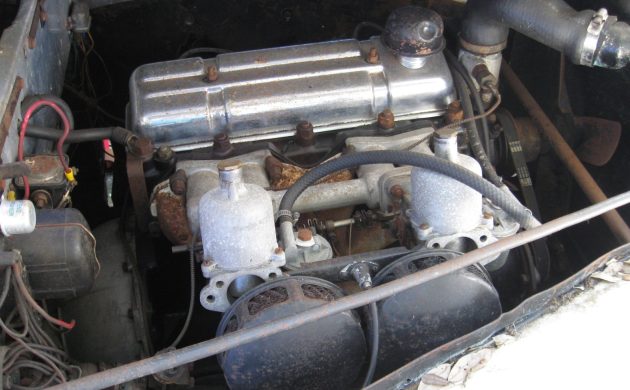
When Triumph updated the 1800 Roadster’s motor to create the 2000, it was a case of stepping back to move forward. The 2.088cc four, sourced from Standard, delivered 68hp, compared with the 63hp produced by its 1,776cc predecessor. However, while the 1800 received a four-speed manual transmission, the greater flexibility of the new motor led Triumph to equip the 2000 with a three-speed manual unit. The larger motor didn’t greatly increase the Roadster’s top speed, but with more torque available, its acceleration was significantly better. The seller confirms that this classic is mechanically complete and that the motor turns freely. They believe that if the buyer cleans the fuel system and performs some rudimentary maintenance, coaxing the four back to life should be possible.
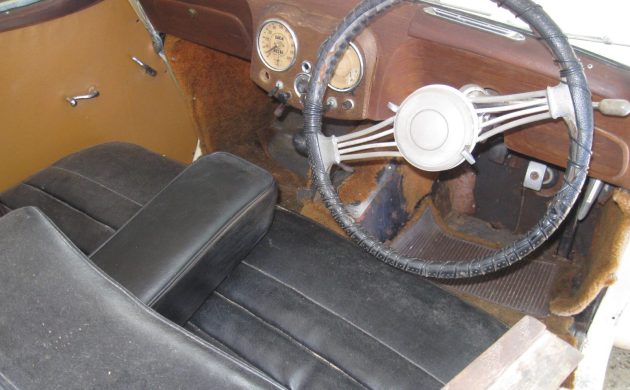
This Triumph’s interior is an interesting proposition. While some items need only basic cleaning or refurbishing, replacing others will be essential to achieve a high-end result. The front seat is a perfect example of the former. Its Black leather is said to be supple and is free from wear, cracks, or other problems. The timber dash isn’t damaged, although it requires refinishing to emphasize its natural beauty. However, the carpet is toast, and the jump seats require new covers. The new owner will probably send the gauges to a specialist for restoration, and I believe the wheel might be cracked beneath the aftermarket wrap.
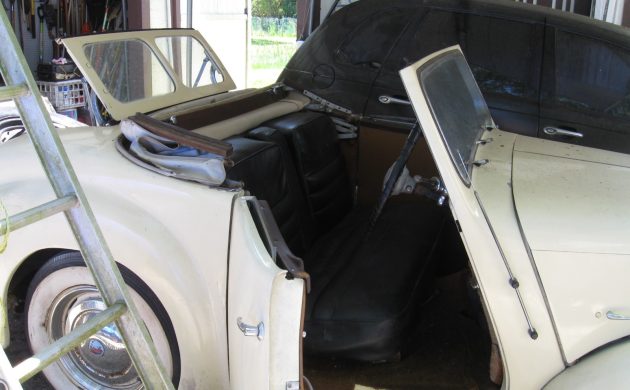
Although the records are vague, it is believed that Triumph produced only around 2,000 examples of the 2000 Roadster. Our feature car needs plenty of TLC, but with no apparent rust, its simple engineering could make it a perfect DIY project. Unlike many Sports Cars from the era, the rather cool rumble seat setup makes it a viable proposition for enthusiasts with children. If you fit that description, could this Triumph be your next classic purchase?

It’s always fun to see cars from overseas, and hopefully generates comments from people that had real experience with these cars, who may be uninterested in Corvettes and Firebirds. Now, I realize as a Rambler/AMC fan, unusual cars shouldn’t make me nervous, but what an unusual car this is. I’m particularly interested in the column shift AND floor shift. Apparently, safety advocates didn’t exist, thankful just to be alive at all after the war, those jump seats look,,,well, appears to be an uncomfortable way of travel. I mean, would some family man actually buy a car like this, and have kids in the way back? Big bump,,kids okay? Kids? Whilst I mean no disrespect , Triumph, at least the ones we were introduced to ( TR2?) seem to be a generic version of this car. What a front end, a stately car, that you can still see some of the styling that was carried over to the TR2s, but certainly nothing like this. Another one was written up here many moons ago, and apparently these had a hand crank start too, not seen here. To see these restored is almost a work of art. That wood dash,,WOW, let’s just say the Asian cars missed out on that with their bland generic plastic gray ones. Europeans had such cool cars we never saw. Anyone remember riding back there as a tyke?
The rumble seat was great, safe maybe not. My uncle had an A and as a kid it was amazing. Later on a friend and I got his grandfather’s Packard running and it also had a rumble seat.
What an an amazing automobile. Grace beauty and yet practical. Howard I think the view of the rear looks worse than it is. That door behind the seats is the got ya. Yet when they are folded up there is actually space for cargo. Very few rumble seats offer a windscreen. It does look as the three on the tree has been replaced with a four speed. This one would be the conversation piece of the show!
Unique. Can’t be many of these left, not even in the UK. Bit of sloppy strut repair on the rear but everything looks good underneath.
Did the 1800 cars use the Jaguar 1and half litre engine in fact a Standard side valve engine with OHV conversion.Also the Moss 4 speed gear box..
Engine and transmission are not original. They are a common conversion from a TR2/3. Parts can be sometimes difficult as the supporting Clubs in the UK are reluctant to sell and ship outside the country for supposed legal reasons.
As its eBay failure demonstrates, the only reason this ugly, underpowered orphan is “going up in value” is that it’s already about as low as it can get.
WoW, my sis has a TD ( 50 yrs now). I think I like this better.
Wanna see up close –
to decide… of course
;^ )
Thank you to Barn Finds and your finders for showing us such a wide variety of cars from around the world and through the ages. I don’t recall ever seeing one of these before. Another unique and interesting car.
Triumph did not market this model as a sports car. It was too heavy and slow for that descriptor. The “rumble” seats were known as “dickey seats” and most people in Britain have settled on the term “pseudo sports car” for this model. Their main selling point and collector interest lies in the aristocratic looks of a by-gone era. An excellent car to take to car shows and use for weddings.
Suicide doors, traficators, dickey seats, 3 on the tree, 68hp and 0 to 60 in 28 seconds…..watch out!!
I have a ’49 2000 Roadster project. It is one of the ultra rare left hand drive cars. It is said that only 22 of the 2000 were made, maybe a few more. The body is aluminum over ash with the exception of the front fenders which are steel. I’m currently finishing up the replacement of 3 pieces of the wood.The balance is solid. The original standard vanguard 2 ltr motor was used in a number of Triumph and Standard motors of the times. lt was the pappy of the TR2, 3, 4 motor. Wet liners are interchangeable and equipped with a low compression head and thin studs, and single downdraft Stromberg carb. It is not uncommon to swap in a TR3 or 4 motor as they are direct fit with the swap over of the front engine plate. I am doing this on mine which will increase from 68 to about 105 HP. I am going to keep my 3 on the tree tranny due to it’s left hand drive rarity, as opposed to this car which also has a TR3 tranny with floor shift in addition to the motor. The original tranny mates to the TR3 motor perfectly with only changing the front spigot, shift fork, and throw out bearing.
Never going to be a speedster but should be a fun driver that gets lots of attention. It will also be a great addition to my TR3 & TR250
It appears to have frame rot, as one photo shows a poorly welded patch.
This car has a TR-3/4 engine and gearbox, a simple and common modification that nearly doubles the horsepower. I assume the column shift lever has been just disconnected and left in place. With the upgraded engine these are fun cars to bomb around in and extremely rare. If anyone’s interested, I have 3 of them for sale All needing complete restoration but selling for cheap money. located in Vermont.