

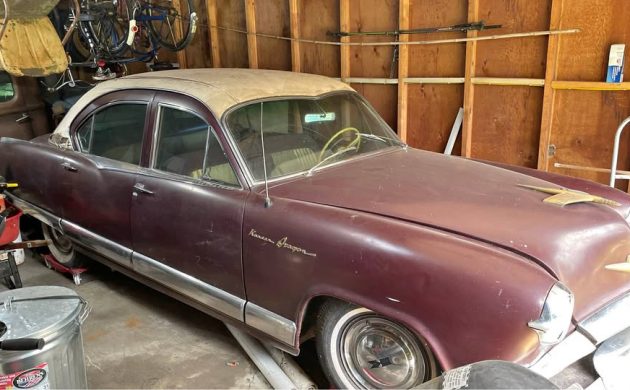
I’m familiar with Kaiser Motors and its previous iteration of Kaiser-Fraser, but I have to admit, somewhere along the line, I missed out on the Kaiser “Dragon,” such as this 1953 edition. Our subject is one of only 1,277 Dragons assembled and is claimed to be one of 33 finished in Maroon Velvet (not sure how that’s determined). This very unusual sedan can be found in Osakis, Minnesota, and it’s listed here on Facebook Marketplace for $20,800. Many thanks are due to Zappenduster for this great discovery!
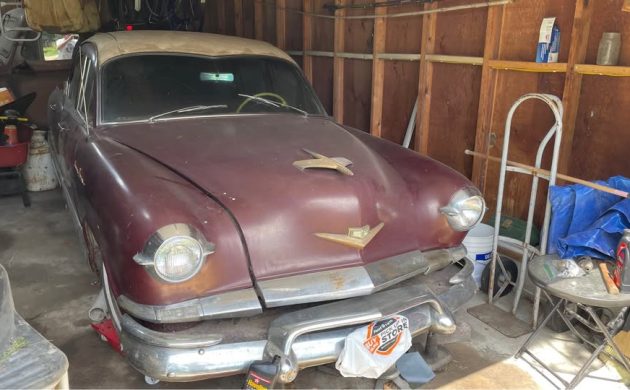
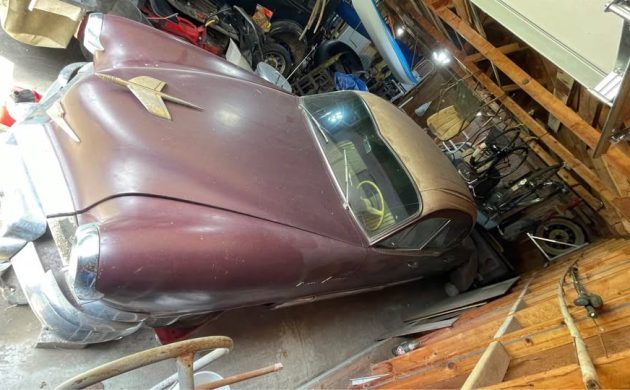
Tom Halter from Curbside Classic gives us some insight into the Kaiser Dragon, telling us, “The story goes that in 1951 Carleton Spencer was looking to make an upscale Kaiser model to fill the hole created by the pending discontinuation of the Frazer Manhattan, K-F’s then top-of-the-line model. Spencer collaborated with one of Kaiser’s suppliers to come up with an alligator-patterned (and textured) vinyl for use in this new model. Kaiser called the interior upholstery “Dragon skin,” lest prospective buyers think it was made from the skin of an actual alligator.” No Dragon edition was offered in ’52, but it reappeared in ’53 as its own model, based on the smaller “Deluxe” series. Other dragon features included a textured vinyl top, gold colored badging and trim, and “tiki” patterned cloth and vinyl upholstery – how odd! As stated earlier, it was not a successful sales endeavor. Actually, Kaiser, in general, was running out of runway in ’53 as it came in sixteenth out of eighteen places in the Great Domestic Auto Production Race with just 45K units in total. The seller of this Dragon states, “(it) has been well preserved in a dry garage for many years. It shows 77,xxx miles.” The exterior images are few and not very revealing, but what can be seen appears to be sound, and of course, being a Kaiser, it possesses the distinctive “Widow’s Peak” windshield treatment. The body looks aligned and straight, with complete trim, though the chrome bits’ plating is starting to go thin. Note the original wheelcovers, adorned with a large central “K”; I imagine trying to find one of these today would be a search and a half.
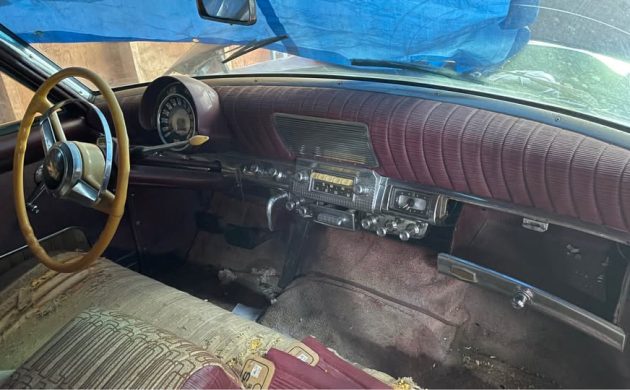
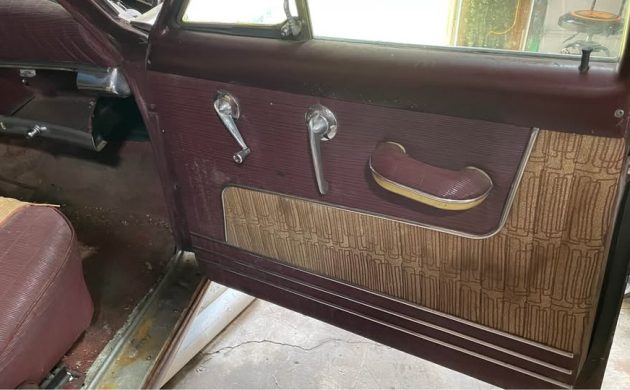
This interior image shows degraded seat upholstery, but the previously referenced “tiki” pattern is still evident – and that treatment is also reflected in the door panels. I imagine trying to reproduce such an unusual pattern would be quite a challenge! The padded dash and instrument panel still show well with heavily chromed accents, a hallmark of cars from this era. The floor is carpeted, but the image doesn’t accurately reveal its true condition. The seller claims all Dragons had factory A/C, but I see no evidence of that either in the engine compartment or an interior vent network.
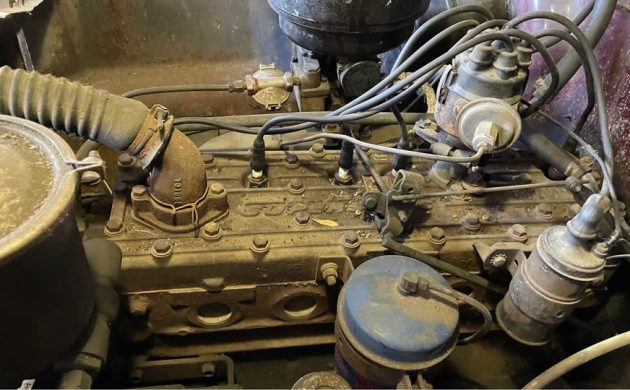
An 118 gross HP, 226 CI, inline, flathead six-cylinder engine constitutes “dragon” power, and the seller adds, “It does run, and I have no reason to believe it wouldn’t drive because it was running and driving when it was parked. Plugs and coil replaced last year.” I was expecting to find a three-speed manual transmission, but the seller states that all Dragons employed GM’s Hydramatic unit.
I’ve got a thing for fallen flags, and unfortunately, we’ve encountered many more since Kaiser went kaput so many years ago. And Kaiser, in particular, had a surprisingly short run as auto manufacturers go. I question what Kaiser was trying to accomplish with this peculiar Dragon model. Whatever the plan was, I’m glad they went through with it; one does not encounter automotive oddities like this today.
Time marches on, and nothing is exempt from that relentless march; fortunately, there are still barn finds like this rare Dragon to remind us of what we once had, automotively speaking. If you’re interested in this Kaiser sedan, please read the listing in its entirety; the seller has done a fine job of giving us the 411 on this uncommon sedan. So, show of hands, please, who’s familiar with the Kaiser Dragon?

Nice find. But at the price — and, as a former three-time Kaiser owner, I really like these cars — you’d be deep underwater if you attempt to restore it.
The interior, most specifically, will be almost impossible. Carleton Spencer used unique fabrics for most Kaisers, and the Dragon heads the list. Good luck finding matching (or even close) replacements. Ditto for the “Dragon Vinyl:” that was amazingly long-wearing, but again is unobtanium. The last two taillight lenses I bought came from Argentina, where Kaisers — but not Dragons — were built as “Carabelas” from 1955-58. As I recall, much of the bright trim on Dragons had a thin gold plating.
Mechanically, Kaiser restorers are better off. They used mainly off-the-shelf parts (though, last time I tried, rebuild parts for the four-speed Hydro — a wonderful, smooth-shifting transmission — had virtually disappeared). An old-timer auto parts store clerk directed to me buy gaskets and other bits from certain Case tractor models when I did an engine rebuild. It worked. IIRC, brakes were either Ford or Mercury (don’t remember which).
There’s no doubt in my mind Kaisers were much better cars than many today believe them to be, well worth keeping going and, when possible, restoring. I should never have sold mine, and many times wished I could have given it the full restoration it deserved..
The problem is nobody is looking for these 5k would be more like it
I looked the car up on Hagerty’s valuation tab, and their value for a #4 Dragon is about $10,000. This car could probably be considered sub-#4 condition, so Dabig’s 5K guess is probably just about right.
Earlier this year, I went to look at a Manhattan, a car which I’ve always liked. In preparation, as I usually do, I searched the interwebs to see what resources/parts/clubs/forums were out there. I sent out some DMs, but no response. Parts were barely available as you would expect. I guess that the interested hobbyists for this marque are now gone, and thus any support is rapidly waning too.
The Manhattan I looked at was a cool car, but it had lots of issues, so of course I passed. Even nice mainstream cars that are 60-70 years old will be a lot of work to re-commission, let alone a #5 car of an orphan marque built in low numbers.
Excellent writeup, Jim.
There was an active Kaiser Frazer owners club at one time which I belonged to, but it’s just barely hanging on now. I think it’ll be gone in a few years, or less and then Kaiser will be just one more orphan with no support and minimal interest. We had them when I was a kid….very nice cars.
There was a Kaiser Fraser Club in the 1970’s, I was a member from 1970 to 1974. I grew up in a Kaiser family, we had a 47′ Fraser, a 49′ Kaiser Traveler, a 51′ Kaiser Virginian and a 53′ Kaiser Manhattan, whe kept into the early 1980’s. In 1969 my Dad and I did a rare transformation on our 1953 Manhattan, converting it into a 51′ y Dad did a rare transformation and transformed 53 Mahattan into a 51′ Virginian complete with its continental kit from the parts from our junked 51′ Virginian. After completing the parts, we primed and painted the car and my Mom upholstered the interior. The car ran great and was one of the erly Hydromatic’s. We were not trying to do a restoration, but creat a fun car. We painted it burgundy and did the interior to match. My sister drove it her seinor year of HS amd got lot’s of attention. My parents sold it in the eary 1980’s and that was the last of our Kaiser’s.
I saw one at a car show in Hershey, PA. I’d never known about them. The owner had a wealth of information about it and it was a joy to speak to them. The car was green and was in pristine condition. I hovered for a while there!
I have always loved the unique interiors and vinyl on these Kaisers, not to mention, of course, the “sweetheart” windshield. But I also thought they called them Dragons because, at only 118 Gross HP, they be “dragon” down the highway :-P
So interesting, parts for a tractor engine fitting this car. Love automotive arcana.
Long ago I was at a car show looking at a pristine Kaiser and the engine looked new. The owner told me he bought the engine from Continental who manufactured engines for trucks and I guess, tractors, if my memory is correct. I know that the early Hudsons used Continental engines. I think the Continental factory was across the street from the Hudson factory.
👍
Steven – As I recollect, Hudson always made their own engines until the Nash merger, when the 1955 models offered a V8 option. I don’t recall Hudson ever using a Continental engine.
Here’s what Wikipedia thinks:
The Hudson Motor Car Company used engines developed by Hudson and manufactured by the Continental Motors Company during its early years before building them in-house.
1) Design and manufacturing: Hudson designed their initial power plants, but Continental Motors Company built them. “… by 1911, Hudson was asking for 10,000 engines.” according to Detroiturbex.
2) Shift to in-house production: This practice ended when Hudson introduced their famous “Super Six” engine in 1916, which was the first engine built entirely by Hudson.
The price of this vehicle is crazy. It needs a total restoration. This particular model of Kaiser was very rare. It was somewhat pretty at the time. Folding poor numbers as did all kaisers. Good luck on the sale.
An interesting find and write up, JIM… I think the asking price is a little on the high side as it will take a good checkbook to return this car to any kind of showable state. Finished it would be a great vehicle to show.
This seller needs a reality check concerning their advertised price in my opinion. If you purchase this Dragon at anywhere near asking and attempt to give it the restoration it deserves; you’ll not only be dragging mucho dinero out of your savings account and spending extraordinary amounts of time on the internet chasing parts but you’ll be instantly way upside down. Not that this isn’t a neat and unique car. Heck I would love to have it in my possession. But it’s going to be a lot harder to get this into good nick than your typical car made by the big three. And quite frankly I think the car deserves to be restored. But we all know where the market for this era of cars is heading. Unfortunately, financially speaking the juice will never be worth the squeeze. From a Kaiser lover’s perspective; they don’t come much more desirable and rarer. I know I’ve been to more car shows than I can remember and never seen one. If I actually bought it; I’d probably just do what’s necessary to make it safe and dependable and drive it and enjoy. GLWTS.
👍
What we sometimes fail to remember is that there are car guys out there that in a situation where money does not matter and they could find people to manufacture missing parts. You would have to be fanatical to go to that extent. If I again go to the show in Hershey this October, there is a good chance I could see a Kaiser there. It would be a miracle if it was a Dragon.
My Uncle by marriage to my dad’s sister had several Kaiser-Frazier cars through the 50’s and 60’s. At one point he had a Dragon. Of course with that 6 Bangor it was more dragon roar without the bite. I recall him having red ones and green ones and a blue one, some were Manhattan models and one brown Frazier I recall. For some reason he really liked those cars. Maybe because he was a bit of an oddball himself. He owned a wrecking yard for many years outside Red Bluff, California.
God Bless America
I’m sure your uncle had no Kaiser-Frazier cars. My guess is they were Kaiser-Frazer cars.
You’re probably right. I might have added a letter. Makes no difference to me.
Sure, Mr. LPSG, if we’re being pedantic and pernickety…
In 1953, I had more than one “dream car” — and this Kaiser Dragon was one of them. The others were:
1953 Chrysler New Yorker four door sedan
1953 Mercury Monterey hardtop
1953 Studebaker coupe
1953 Pontiac
I even would have been happy with a 1953 Plymouth (the top trim model; was that Belvedere?).That was a pretty year for American cars, with some exceptions (such as Chevrolet, Buick, and Cadillac — 1954 improved all three of those; even though the Chevy was basically the same, but with needed improvements to the tail lights and the grille). Lots of 1951 and later Kaisers based on their ’51 lately!
The “tiki pattern” on a 1953 Kaiser Dragon refers to its unique “Bambu” vinyl roof and interior trim, which was textured and patterned to mimic a Polynesian grass hut and bamboo during the 1950s South Pacific craze.
1) Textured Vinyl Roof: The exterior roof top was covered in a specialized “Bambu” pattern vinyl designed to resemble woven grass or bamboo, offered in colors like black, beige, or maroon.
2) Interior Integration: The exact same bamboo-textured vinyl material was carried inside the cabin to line the dashboard, door panels, arm rests, pillars, sun visors, and kick panels.
3) Mid-Century Fabric: The tiki-inspired vinyl was paired with “Laguna” cloth, a heavy-duty Belgian linen featuring an overlapping rectangular pattern chosen by interior designer Marie Nichols.
Kaiser introduced the Kaiser Dragon as a luxury model focused heavily on unique styling and custom trim precisely because they lacked a V8 engine to compete with major automakers.
A) Marketing Strategy: Because Kaiser did not offer a V8 engine—relying instead on a Continental inline-six engine—they used high-end interior treatments like “Dragon skin” vinyl, 14-karat gold-plated badging, and extra sound insulation to stand out in the luxury market.
B) Engine Deficit: Kaiser had canceled in-house development of an overhead-valve V8 engine to fund compact car projects, leaving their upscale cars underpowered compared to competitors like Cadillac and Buick.
C) Sales Impact: Priced around $3,924, the six-cylinder Dragon cost as much as a V8 Cadillac, making it difficult to attract buyers who wanted V8 performance despite its fancy trim.
Kaisers lacked the status that the Big 3 luxury brands had established. Therefore, the idea that Kaiser could carve a niche in the luxury market was doomed from the start, regardless of what kind of motor they offered. As a young kid in the early 1950’s I think I remember driving in my uncle’s Kaiser, but there is no one left from that side of the family who is old enough to know what kind of cars he drove back then.
After Kaiser cancelled their V-8 program, I read that the chief engineer on the project was hired by the newly formed AMC. Not surprisingly AMC’s V-8 looked a lot like the one Kaiser was developing.
They have some unique aspects. I have only had my Manhattan for two years and it had the features I wanted: my birth year, manual transmission with overdrive and a flathead, no power steering, no power brakes. I should sell it. Too many projects. I’ll probably put it up for auction here on BF, no reserve, but everytime I drive her I don’t want to!
Jim — As to what might have inspired the color name ‘maroon velvet’ in ’53 — ‘velvet’ promoted a ‘softer side of sears’ connotation, possibly inspired by an executive’s ‘softer side of sears’ thinking– while imbibing Black Velvet whisky, becoming popular at that time.
Yeah, I had one of these also body was straight & bright red. Interior was also red rolled and pleated pleather, Kaiser 3 speed with OD adapter plate and a 265ci Chevy V8. You could run out road before you ran out of rpm’s and great mpg. All for $100.00
Again, yeah the good old days.
Me and my wife was low crawling a friend’s junkyard/ collection and came across a 51 dragon! It was very rough but I never heard of the dragon! My friend has a large selection of the kaisers and Frazier cars. So we knew of them the vagabond and Manhatten! But when we came across the dragon we had to Google it and we suprise at what we found out about it! Dragon scale interior gold plated emblems! Just crazy marketing and engineering!
The last year of the Kaiser (1955) sported a McColloch supercharger.
Well, I see 1954 models for sale with the supercharger, so it seems I was off by a year.
This is a nice car, rare but I’m afraid overpriced for this market, rare does not sometimes mean that it can bring more money. At half the asking price would be more realistic especially for a 4 door because there really nothing real captivating besides the interior design just basically a plain Jane car…
“Plain Jane”, this car definitely is NOT. It was a very upscale and fancy model set to compete against Packard and Cadillac, but with not enough power from that six-cylinder engine. And the four doors worked perfectly on that design, because of the arching roof-line. By contrast, foor doors looked simply “wrong” on the 1953 Studebaker. However, four doors look much better, and are far more practical, on most sedans. Sadly, regardless of how rare, this Dragon is simply too deteriorated to make for a good restoration candidate. And the unique parts which another Dragon restorer would need, are the very ones badly deteriorated also on this example. Very tough sell at half of this price. But four doors should not be a concern, here.
Everybody is captured by this Kaiser Dragon’s magic. Who knew? For some out there, there might me a Kaiser (or Frazer) in their future. Love it !!