

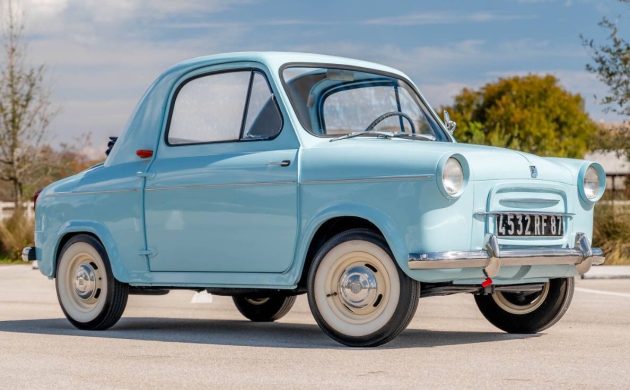
When people think of post-war Italian Microcars, the Fiat 500 often comes to mind first. However, Piaggio produced the Vespa 400 from 1957 to 1961, but political pressure meant that, although the company and design were Italian, the Vespa was produced in France and sold in many European markets, but not in Italy. This 1959 example presents superbly and is a turnkey proposition offering a quirky classic motoring experience. My knowledgeable off-sider, Russ Glantz, spotted this Vespa listed here on eBay in Pompano Beach, Florida, for $37,500 OBO.
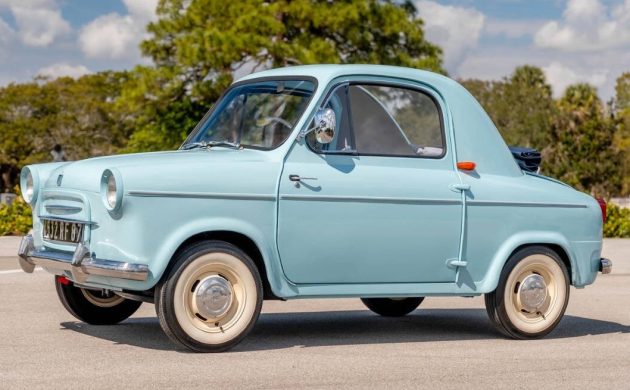
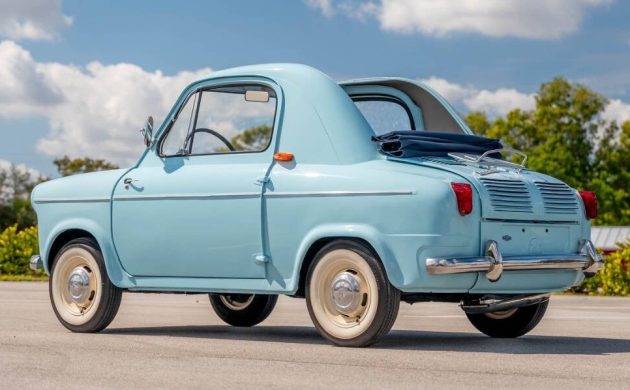
Established in 1884, Piaggio is an extraordinarily diverse manufacturer. Its product portfolio included Vespa, Moto Guzzi, and Aprilia, all renowned motorcycle brands. It also had extensive experience in railway and aircraft manufacturing, but in the 1950s it diversified further by designing and producing a small, affordable passenger car. Work began in 1952, and the company approached it with meticulous care. It undertook some of the industry’s most rigorous testing to produce a car as close to bulletproof as possible. It unveiled the Vespa 400 in Monaco in September 1957, ending a five-year development cycle. However, problems arose behind the scenes. Fiat placed enormous pressure on Piaggio not to produce or sell the Vespa in Italy, but Piaggio had an alternative. It owned ACMA, located in Fourchambault, France. ACMA was already building Vespa motorcycles, and with surplus manufacturing capacity, it could handle building the company’s new Microcar. Sales began in several European markets in 1957, and the 400 remained available until the end of 1961. Manufactured in 1959, our featured Vespa was restored approximately ten years ago. The panels look excellent, with no obvious dings or dents. The Narvic Blue paint shines richly, and the fabric Cabriolet top is in first-class condition. I can’t spot any rust in the seller’s comprehensive image gallery, and the trim and glass are excellent. The whitewalls are an interesting touch, giving this very humble car a classy, upmarket look.
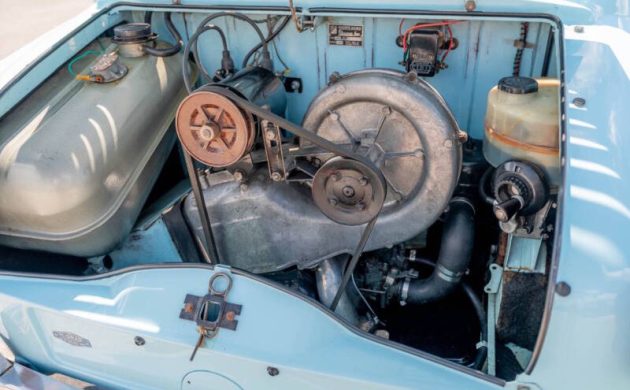
If the Fiat 500 was renowned for its tiny engine, the Vespa takes the concept a step further. Its rear-mounted, two-cylinder, two-stroke, air-cooled powerplant produces a dizzying 14hp, fed to the road via a four-speed manual transaxle. That feature is interesting, as most 400s featured a three-speed. The company limited the four-speed to the GT variant, suggesting someone installed this transaxle later. Early production 400s required owners to pre-mix their two-stroke fuel, but this car features the later semi-automatic system, with the fuel tank in the engine bay on the left and the oil reservoir on the right. Given the modest engine power, it is unsurprising that Piaggio quoted a top speed of 55mph, though that figure could be lower in a headwind. The seller provides no information about the car’s mechanical condition or how it runs and drives. That said, I would expect nothing less than perfection from a Vespa 400 in this price bracket.
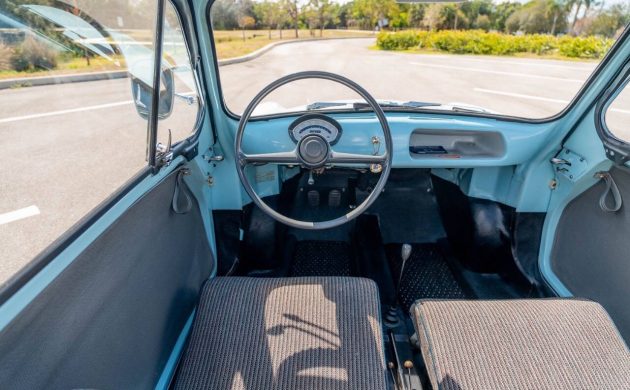
Although Vespa marketed the 400 as a two-seater, it admitted the rear shelf could accommodate a couple of small children. It had no padding, so owners needed to add cushions for comfort, or use the area only for relatively short journeys. The front seats were a better proposition, with reasonable padding and cloth covers. The door trims are plastic, molded to follow the contours of the outer doorskin. The floors sport a molded rubber mat, and the dash houses a lidless glove compartment, a speedometer and odometer, and rudimentary warning lights and switches. The interior condition is extremely tidy, with no wear or evidence of neglect. The painted dash has minor scratches, but they don’t detract much from its appearance.
During its five-year production run, the ACMA line in Fourchambault produced 30,976 Vespa 400s. The 1959 model year was the second most successful, with the company selling 8,717 cars. Those numbers are small potatoes compared to the Fiat 500, which makes you wonder why Fiat saw the Vespa as such a threat that it forced it out of the domestic market. Rumors circulated that some very shady characters were involved with Fiat at the time and applied pressure, but nobody ever said it out loud. Whatever the reality, total Vespa 400 sales amounted to a mere 1% of overall Fiat 500 production, making these classics relatively rare. That is reflected in the fact that this is only the tenth example we have seen at Barn Finds since 2011, and it is also the most expensive. The price is in line with market expectations, but the seller’s willingness to negotiate might improve the situation. Do you believe this Vespa could find a new home in your garage, or is it too quirky for you?

Who wants to drop an LS in it?
I’m sorry, but I wouldn’t spend $37,500 on any car that only has 14hp. I bet Fred Flintstone can go faster using his feet!
I love it! It’s probably the cutest car I’ve ever seen; nearly looks like a toy. I highly doubt it could keep up with modern traffic, though, unfortunately. I’d still love to buy this.
More likely to get run over by traffic. With the amount of big pickup trucks and SUVs with most looking at everything but the road ahead driving this would be scary to say the least.
Really fine writing in the write-up, imo. Pretty fascinating story, too. Cars from this era and country and always make me wonder what life was like for people who lived in that time and bought one of these cars.
Thank you for your kind words, Cheetahkins. My late father worked with people who lived in post-war Italy, and they said that life was pretty hard. However, the population was resilient, and that undying determination helped the country recover so well. I hope that you continue to enjoy our articles.
Originally from’France; my aunt had the exact same one and it just blended in with the other small cars of the era. It was more a city car than a grand tourer, but some people were not afraid to go on vacation hundreds of miles from home, making good use of the diminutive luggage rack, some even adding a small single wheel luggage trailer. This was France in the ‘50s and early ‘60s; people were content with much less than today….this being said, I have no problem driving my 2CV anywhere here in the US, just drove from Phoenix to Flagstaff last week on I17….I would not attempt this with this Vespa…..29hp vs 18hp….vive la différence!
Nice write up, merci!
It’s just not something I would own,although I like it more than those stupid “smart” cars.
So it can only hold two clowns.
A 1959 Piaggio Vespa 400 sold for $40,320 at an RM Sotheby’s Arizona auction, and another well-documented unit fetched $33,600, so the price seems about right, but at these prices, you really have to want one.
https://youtu.be/IfQQ0GmbCuo?is=wHL2Dkk7iCiAMWlq
I know someone with a summer cottage on the lake that this would be perfect for making beer runs. I wonder if you could swap in a Moto Guzzi motor cycle engine in? Keep it in the family.
Probably. could it carry more than a couple cases if you have to go uphill? Per the backstory I can see Signore Agnelli saying “give Vespa an offer they can’t refuse” Dang, this car makes the 500 look like a Bimmer. I don’t know the price or that much about Europe’s economy in the 50s but I can’t see it beating the 500 or Citroen 2CV on price by cranking out 20 to 30 cars per day.
I own two of these and I have owned others before as well. They are very capable little cars and can easily keep up with traffic up to about 60 mph. They are strong, reliable engines and a delight to drive and if you attend a car show, people will leave Bugattis, Lamborghinis and Ferraris to come and see your adorable little Vespa 400, and you won’t have to worry about them breathing on your paint. Not sure that I would pay $37K but wonderful little cars to enjoy at a fair price.
I have one of these, a ’61 in Sea Foam Green. It is a hoot to drive and pulls more attention than anything at shows and Cars & Coffee. This one is a Euro model with different turn Indicators, bumpers headlight bezels and interior trim. The US models are a little more rare and typically command a small premium. Performance is OK up to about 30 mph, but after that, you’re on a very slow climb to a top speed of 54 mph. I live in a hilly area and struggle to hold 25 mph on the steep ones. Still, if you live in an area with low street speeds and not a ton of multi-lane traffic they are a lot of fun!
Couple of interesting features: The front cover slides out like a drawer to expose the car’s battery. It has an oil reservoir and pump to supply oil to the grass tank for the 2 stroke mixture. Put gas in the tank, set the number of gallons you put on the oil pump, crank the pump handle to zero and transfer the correct amount of oil to the gas tank.
Oh, and the Monaco product launch was headlined by Bridget Bardot and Juan Manuel Fangio. Piaggio had big plans for 827# Vespa 400.
Can you confirm that your European version was a four speed transmission verses the US export three speed transmissions.
I have no problem maintaining speed up hills although I do have to use the gearbox to keep the two stroke engine revved in the power band.
Do you have any video clips or confirmation of BB and Juan doing the introduction of this little car. My understanding was that Brigitte Bardo introduced the Autobianchi Bianchina Eden Rock Cabriolet at the Eden Rock Resort in the French Riviera. I have one of those Bianchina as well.
Can you confirm that your European (French, I presume) vesion has the four speed transmission versus the USA Export car’s three speed transmissions?
I have no probem maintaing adequate speeds (45 to 50) on hills although you do have to use the gearbox to keep the tiny two stroke engine revving in the power band.
My understanding was the Juan Fangio and other famous racers might have been involved in promoting the introduction of the Vespa 400, but Brigitte Bardot actually introduced the Autobianchi Bianchina Eden Rock Cabriolet at the Eden Rock Resort on the French Riviera. The Bianchina was a Fiat 500 derivative, and therefore a competitor of the Vespa 400.
We have two of each of these cars and they are delightful to drive!
Hi Charles,
My car is a US version with the 3 speed transmission. I originally had the highly restrictive polished stainless muffler but now have one of Ferenc’s on the car. It’s better but still won’t pull the hills regardless of which gear it’s in. I may have an advance spring issue as both of mine were broken and I had to make new ones (maybe too stiff?). I have replacements now but have yet to install them. My car is 100% original except for an engine rebuild. I built it with Larry’s new pistons bearings and seals so a little more compression than stock.
Not sure about Bridgette and the Bianchina, but if you Google her name and Vespa 400 a very famous picture will come up where she is sitting on the hood with cigarette in one hand drink in the other – at the Monaco launch I believe.
You are absolutely right and I stand corrected. That photo clearly shows Brigitte Bardot posing with the Vespa 400. I never saw that photo before. Thanks for setting me straight.
Your higher compression pistons may actually be limiting your performance and ability to climb hills.
Adam, guessing you meant to say that it was produced from ‘57-‘61.
Thank you so much for picking that up, Bunky. Sometimes, no matter how many times I proofread something, glaringly obvious slips through the net. I appreciate it, and I hope that you continue enjoying our articles.
Inspiration for the Nissan Figaro?
Highly likely.
Not exactly. The Nissan Figaro was designed after the Autobianchi Bianchina with the roll back roof and pastel colors.
This little Vespa 400 microcar was also a car with an identity crisis. Originally designed and introduced at the 1957 Auto Salon, the Vespa 400 was received with great objection from Fiat, who was producing their Cinquecento model microcars for the masses in Italy. They promptly advised Piaggio that if they introduced a microcar in Italy, Fiat would immediately start producing motorscooters to compete with Piaggio, and they would also instruct all of Fiat’s parts suppliers to boycott Piaggio. Piaggio realized that these two threats could bankrupt them, and they decided to move the entire production and assembly of the Vespa 400 microcar to France so as not to compete directly with Fiat in Italy.
So the Vespa 400 became the only Italian microcar actually produced in France!
Possibly the biggest centripetal supercharger I have seen in the engine bay!
https://youtu.be/ONmlsxM20qU?is=jCWuXrt3qQb_1MJS
Forget the LS swap, put a Harley in it! Saw a yellow one with that swap in 2011 up on YouTube when I got my first tablet. And from what I saw, that thing was a
blast to drive! The owner punched it, and the front tires came off the ground as he did a smokey burnout followed by a wheelie! Too bad someone doesn’t make an EV replica of this
car. That would be the only way
you could drive it on the street and keep up with traffic unless of
course you opt for the Harley swap.