

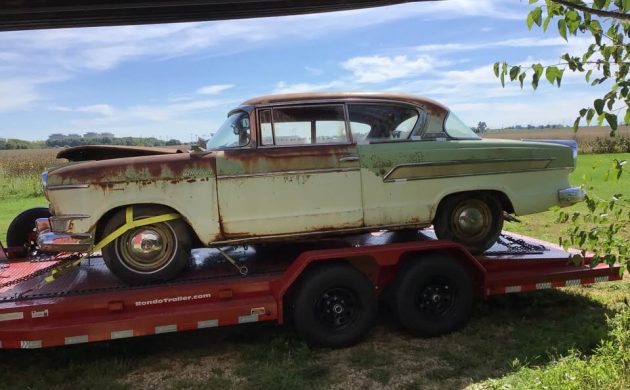
Well, what do we have here? It’s a 1956 Hudson Hornet “Special”, a model that has certainly escaped my attention. The seller claims that it’s one of only 200 “Hollywood Hardtops” assembled, so we’ll have to dig into that and see if we concur. This one looks like a field find, and it appears to be in rough shape, but let’s not write it off without first writing it up. Zappenduster gets a vote of confidence for this Delkalb, Illinois find, and it’s listed here on Facebook Marketplace for $500.
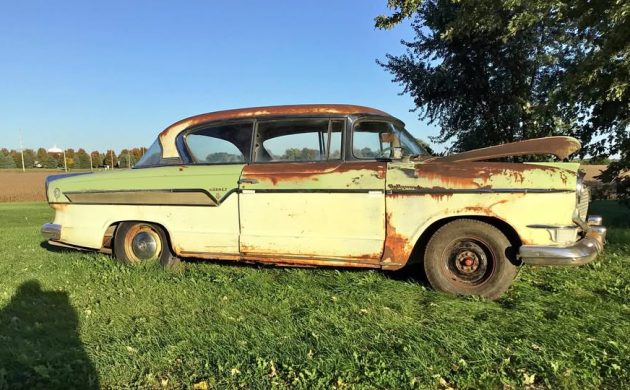
Most auto guys and gals know the story of American Motors’ formation in 1954 – the result of the merger of Nash and Hudson. After 1957, both marques disappeared, and AMC was off to the races with the Rambler. I think this “Special” is an interesting reflection on where Hudson was in 1956 – that late in the game and still trying to remain relevant in an automobile market totally dominated by the Detroit Three. Back to the numbers, Hudson manufactured 1,757 Specials in ’56, and only 229 were two-door “Hollywood Hardtops” such as our subject. Specifically, this Special was built on the shorter Nash Statesman platform, as opposed to traditional Hornet underpinnings, and received a newly developed V8 engine – more on that to follow.
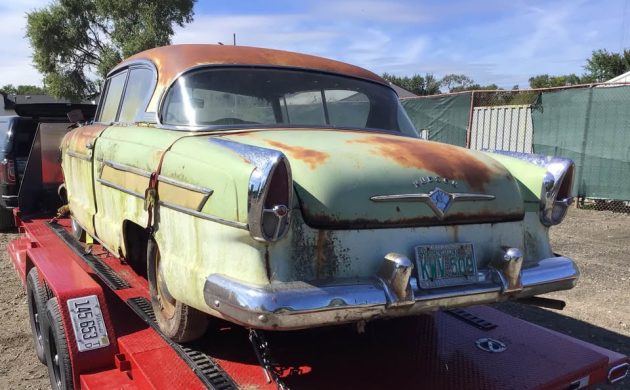
The seller states, “Sold new in Fresno, migrated to Washington state in 1970, dragged to Illinois fifteen years ago, parked in a wet field. Pity.” Besides the obvious outdoor sunburn, we’re told the floors have collapsed. That said, the body panels aren’t complete cinders – they’re still sorta sound, and all the stainless trim appears to be attached. In its day, this Hornet, with its oh-so typical fifties two-tone paint scheme of Crocus Yellow and Willow Green, was probably quite the attention-getter.
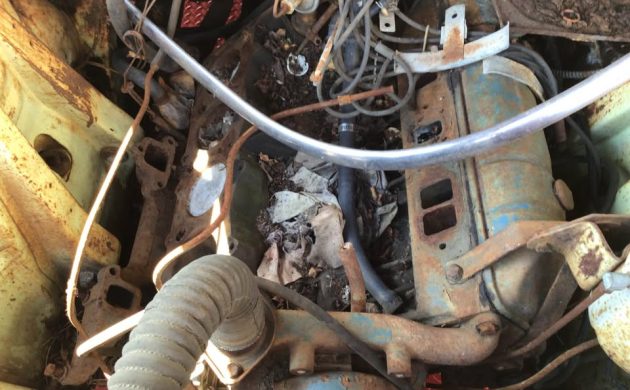
AMC was forging ahead with new V8 engines in this era, and its first was a 190 gross HP, 250 CI V8, as currently rests under this Hornet’s toasted hood. Unfortunately, as you can see, the engine was disassembled in 1977, and this is what’s left – it’s missing a bunch of parts. The automatic transmission is either a Packard-sourced “Ultramatic” or a GM-originated “Hydramatic”, which I’m not certain of, though the shift indicator makes me think it’s the latter.
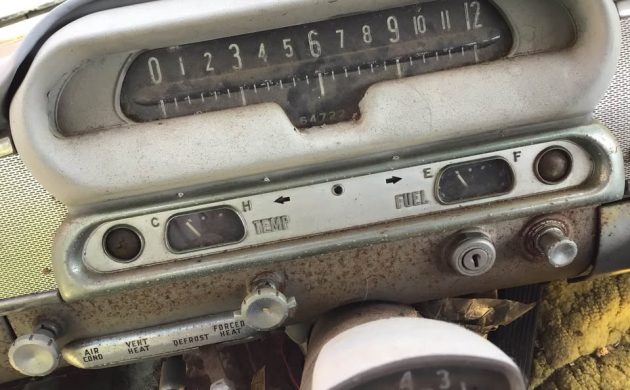
The interior is imaged in snippets, with nothing comprehensive included, but this one shot of the instrument panel and all of its surface rust will give you an idea of what’s in store.
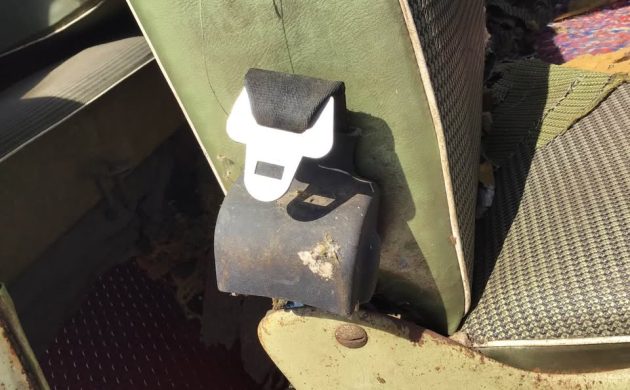
The seller adds, “She has the rare factory seat belts!” but this image looks like an aftermarket add-on. I went through the ’56 Hornet option list and couldn’t find any reference to seat belts. Does anyone have some insight on this feature?
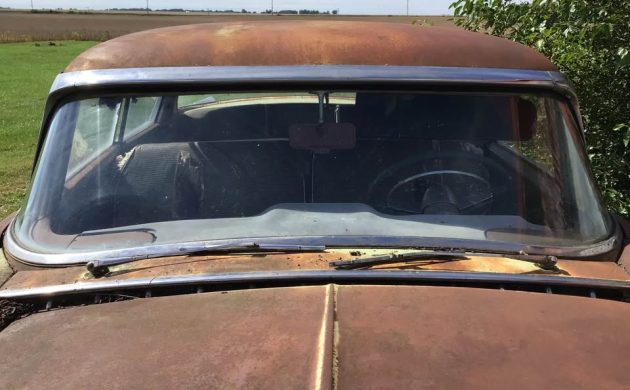
The seller concludes with, “This hulk has a wealth of usable parts including windshield and backlight, bumpers, radio and interior trim, five correct wheels and a thousand other pieces. Or it would be a restoration project for a dedicated welder.” Much like the recent post I penned on a ’54 Mercury coupe, this one’s a judgement call. I’d suggest this Hornet is a more valuable find than the Mercury, but it’s still gonna take a ton of time, effort, and $$$ to bring this Special back to the presentable land of the living. And I think you can forget about a return on investment; nope, this would be a labor of love to restore this rare model of a long-deceased brand. What do you think – anyone up for the challenge?

The last picture in the ad shows how good it would look as yard art.
Steve R
I agree. That was artsy…
Yes, could be right out of an expensive Hemmings calendar.
I don’t have enough acreage to show it off properly.
You will NEVER park beside another of these at C&C :P Totally worth restoring knowing you will be the only one within 20 states to have one :D
“The automatic transmission is either a Packard-sourced “Ultramatic” or a GM-originated “Hydramatic”, which I’m not certain of, though the shift indicator makes me think it’s the latter.”
Pretty sure the Ultramatic was used only with the Packard V8s bought by AMC, not AMC’s own in-house engines, and the Packard engine was not offered in the Hornet Special.
That is correct. The Packard engines and transmissions were purchased by AMC together. The Ultramatic was left behind when AMC developed and deployed their own V8 engine. (The AMC V8 was developed in a crash program when the parts sharing agreement between the two companies went sour.)
Nash, Hudson, and Kelvinator.
Kelvinator was absorbed into Nash in 1937 – long before AMC was created.
JO
This is an interesting car.. a basically rare vehicle at a reasonable starting price.. Only a Hudson collector will buy and restore it.. But I think it should be restored..
parts or yard art. 500.00 can’t go wrong.
Pile money into it fix it up and what would you have
Sad to see it so far gone: what a shame!
I love Hudsons almost as much as I hate rust. (One of the main reasons I moved west) I think this was a cool car. (If only maybe for it’s rarity) Most Hudson freaks don’t consider the later Hudsons (non-step down and earlier) as Hudsons. It still has a little of the Packard/Ambassador lines to the car. But different enough for me to like it. (I’m not a Packard fan) If I had seen this car before the DeKalb pirahana strain of tin worms got to this car. I may have been tempted. But as far as I’m concerned now. This can remain in the field until it is nothing but tin worm fertilizer.
My next door neighbor has one of these he has put a 302 ford in it , narrowed rear and big meats with mags. Has kept the patina weathered paint rust look , it has the rat rod vibe to it . Looks and sounds really neat . This be a nice car to update Motor and trans brakes . Rat rod it .
A very fair price for a car with many useful parts for someone who could use them.
At least it still has taillights.
My Pop about 12 years ago sold his green on green with white top1956 Hudson Nash with straight six195 a 4 speed Hydra-matic factory 4 door dual spotlights with 14K original miles. The factory air still worked after all the years it sat mostly garaged. It was a perfect car but even with low low miles was an orphane car then as now.
Really the Hydramatic was dangerous as they did not have a park position in the transmission, only hand parking brake. Other archaic engineering like shared arbor shaft for the generator-waterpump or power steering was involved . Vacuum windshield wipers that only worked at idle, and to work on it was a experience all its own. The carburetor I must have cleaned 10 times before I figured out the stabil in the gasoline was the problem clogging the air bleeds.
The day he sold it put a smile on my face. I like wrenching on old equipment but that car was an orphan. I still wonder today where it is at, Warrenton Missouri or did it get driven far and wide.
And the rubber step on floor plunger windshield washer pump, top of the game back then, yep.