
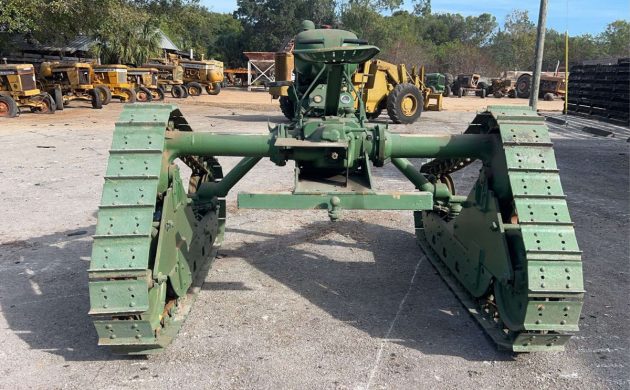
Oliver’s history stretches back to 1857, when it sold plows made from chilled metal, which resisted abrasion and lasted longer. In time, manufacturers began attaching implements to the new-fangled tractor, boosting sales of both products. Oliver expanded its repertoire when it bought Cleveland Tractor Company in 1944, adding dozens of new models to its inventory. The “Cletrac” offered a valuable option for farmers plowing tender fields – tracks spread the weight of the machine over a larger surface area, helping to prevent wheel ruts. The Hi-Crop configuration was made specifically to cultivate rows, providing enough clearance to leave seedlings intact. This one is an HG-68 with a 68″ center-to-center track width. It’s listed here at Aumann Auctions, with bidding at $4050; retrieve it from St. Cloud, Florida.
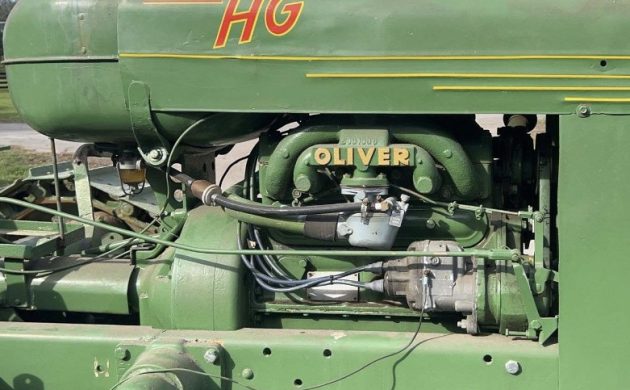
The HG-68 was made from 1939 through 1951, with power supplied by a gas-fueled Hercules four- or, later, a six-cylinder engine. Output from the smaller engine ranged from 14 to 21 hp at the drawbar. This example’s engine is free, both clutches work, and it steers in each direction. Research shows that this should have a three-speed-plus-reverse gearbox; speeds are very slow, since Hi-Crops are made for careful work, including hand-harvesting. This one’s fuel tank is rusty, but considering that the entire vehicle will need reconditioning, that’s a minor issue.
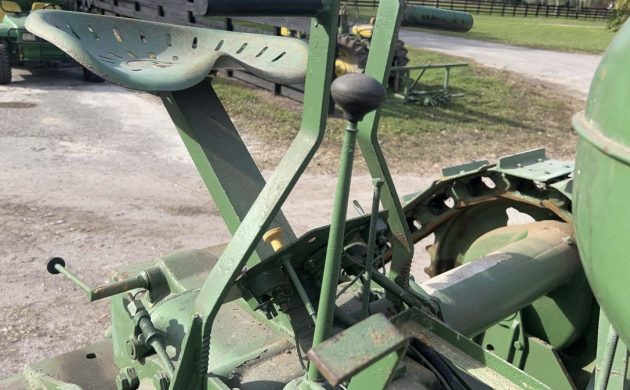
The operator sits well behind the action, with the only suspension provided by the flex in the metal seat. Two gauges give oil pressure and water temperature readings. This example has a rear PTO and a hitch. HG survivors are rare, with fewer than 30,000 ever made, including all width variants. Oliver HG parts can be found, but no doubt ingenuity will be required during this restoration.
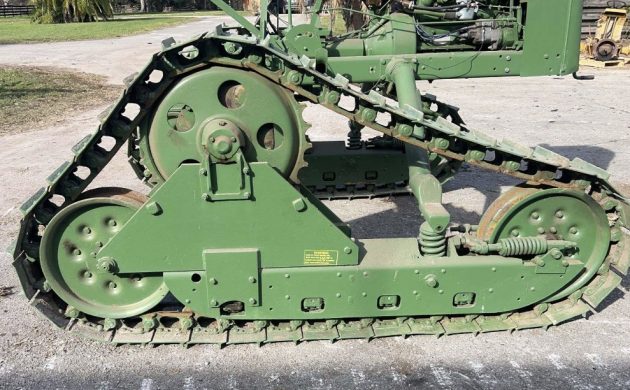
Tracks are tricky, and these are in great condition. Oliver made a rubber-tracked version of its Hi-Crop, called the HGR, but it didn’t sell well. The rubber stretched, and stones slipped between the belts and the wheels, wrecking the tread. The condition of this HG-68 makes it an excellent restoration prospect, and it’s a seldom-seen model. Sixty-nine bids have been clocked so far; it wouldn’t be surprising to see this tractor sell for more than the current quote.




Howard would look good riding this thing around…
Who will be first to suggest the SBC swap?
SCJ
Godzilla!
This is a different crownd than your cars and coffee bunch with their T shirts, beer guts and compulsive regailing about how their SBC or LS powered hot rod is somehow more unique than the 10’s of thousands of others. The farm crowd are more suspenders and shirts with that kind of walk derived from decades of climbing on and off equipment.
It is great to see a write up like this! I wish there were an original ad for it. Oliver tractors are durable and good looking. Having a tracked version on the farm will open up the working season of any farm for early field work. Tractors like this a very hard to find and would be useful even today. They are a specialty use, and probably wouldn’t accumulate many hours.
I suspect this has had some kind of an older restoration or a respray as the tracks are green and the paint looks better than it should. Plus it looks more like a JD green than the Oliver green, which was darker.
There are tons of really good images on the listing.
The old tractor community has changed a lot. I was heavily into steam tractors I would look forward to our local fathers day weekend show all year. But about 15 years ago something changed and people stopped showing up. Sometimes there were more displayers than people on the grounds. Then those old timers started dying and the event became a junk swap meet with a few tractors puttering around. I finally stopped attending all together.
While you “might” be able to use a side-by-side UTE with tracks to get the soft field capability of this, the price tag would be 10 times the ask for this one. I suspect it will go for a lot more before it is done as I would certainly have bid it up if I were still farming.
But I have gone the other direction now. I sold the tractors and sold the farm some years later.
The phrase we use around here is “age related change in farm operation”, which always brings a smile and a knowing nod from guys our age.
SWEET! Really nice example of a rare machine. This is the kind of machine that you’d see in the Gulf Coast sugarcane fields.
Wow. This is great!!! To me, it looks like its in good shape especially for it’s age. I’m used to seeing more Cletracs than Oliver’s with tracks i like the high stance too, this definitely had a specific purpose when it was ordered new. I definitely hope it goes to a good new home ( or barn) and get used and enjoyed. Michelle, thank you once again, great write up!!!
The design makes me think it’s capable of walking LOL. What a neat piece of history. Not sure I’d have much use for it around the homestead, but it would be pretty cool to drive in a parade or something.
It might not be welcome at parades. Those metal tracks aren’t going to be kind to asphalt and other surfaces, that’s likely to limit where it can be driven and displayed.
Steve R
That’s what those old sections of truck tire bolted to the pads are for.
Jim, from my vantage point it looks like metal, if it was rubber I’d figure the green paint wouldn’t hold up. Why would it just be a small 90 degree lip and not cover more area?
Steve R
Hey Steve, I guess I should have been a little more clear in my comment. Track machines, when run on the road, like between close job sites, have rubber blocks that bolt to the tracks that are thick enough that the lip or “clete” won’t hit the pavement. In this case you could cut sections of old truck tire for the same purpose.
Yeah I was thinking the same, as I posted, but didn’t want to get into it in the OP. As Jim Randall commented, I figured there would be a rubber solution, either the plates he mentions, or maybe a whole rubber track might fit over (or replace) the metal ones, for use on hard surfaces. I think people did something similar with Model T conversions, maybe Bombadier B12s.
Jim, thanks for the clarification.
Steve R
That would look good next to my Oliver RC 60, but it is too far away.
Awesome piece of historic engineering here. Looks to be simple as far as under carriage maintenance as well. With the weight or lack of it, pavement is much harder on the tracks than the tracks are on the pavement.
Nice job Michelle on the research and write-up.
We use to have one that was similar the only thing is the one we had wasn’t a high crop!
I like the hi-crops – they look like aliens!
I thought Praying Mantis Michelle. 😃
You put a good twist on this story, Michelle!
Very cool tractor!! Thanks for the write up!!
Attach a tow behind lawnmower deck and cruise around the yard
Hagie Hi-Tractor built in Clarion, Iowa competed with this, but it was not on tracks.
Michelle, A great write up. There is a Hi-Crop very similar to this displayed each year at the Labor Day Farm show in Dacusville SC. Since this tractor still has a Hercules engine parts are next to impossible to find. I know, I have one in my Diamond T!! The 4 cylinder Willys engine is an excellent repower and fits easily.
I’m a little late to the game here but fantastic write-up, Michelle.
I could look at stuff like this all day.
Btw, bidding ended at $9350.