

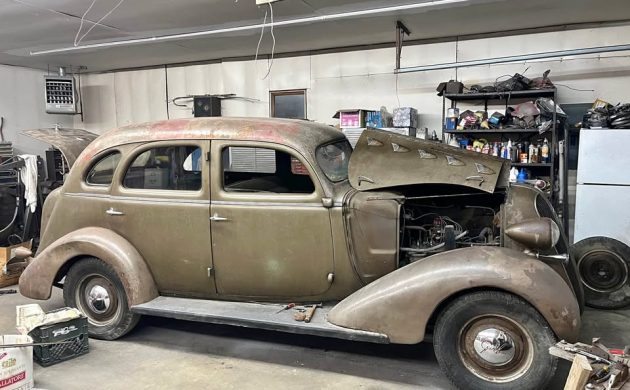
Graham, along with several of its peers, limped into the latter years of the Great Depression with slender earnings and a tattered balance sheet. Financial distress encouraged creative maneuvers – all in the name of staying alive. Competitors became cooperators, rivals became partners. Graham, lacking the resources to retool to update its styling, decided to buy Flying Cloud bodies from another distressed auto company, Reo. With light alterations to the front end, Graham launched several models for 1936. But the Graham’s secret sauce wasn’t its body styling – it was its supercharger, with an alloy impeller belt driven off the crankshaft of, by this time, a six-cylinder engine. Boost was not extreme, but it was enough to bring output from 85 hp to 115 hp. Here on facebook Marketplace is one of these rare cars, located in Florence, Kentucky, and priced at $5000 or best offer. Zappenduster sent along this tip – thanks!
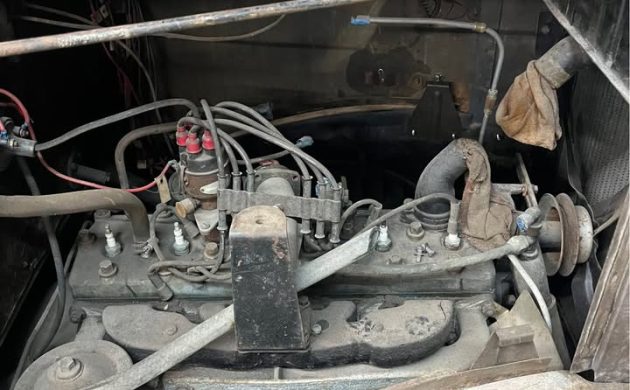
This car doesn’t run, but it does retain its engine parts, including the all-important supercharger. The seven-main bearing mill utilized an aluminum head – foisting head gasket issues upon owners. But Graham made more supercharged cars than any other maker by the time the company sold its assets to Kaiser-Frazer in 1947, a record not surpassed until Buick in the 1990s. The only transmission offered was a floor-shift three-speed manual, sometimes augmented with overdrive. Graham’s 1937 models were differentiated largely by their wheelbases – either 116″ or 120″ – with the supercharger offered as an option.
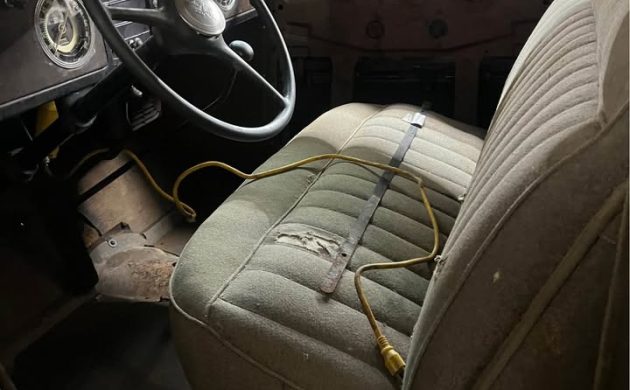
Inside, the Graham provided an upscale experience with mohair upholstery and a unique, plastic center dash section. One large multi-pupose gauge and an equally large clock flank the steering wheel. The seller identifies a rusted-through spot on the cabin’s floor as the only serious corrosion. The car’s badging depicts three knights in semi-profile, homage to the three Graham brothers.
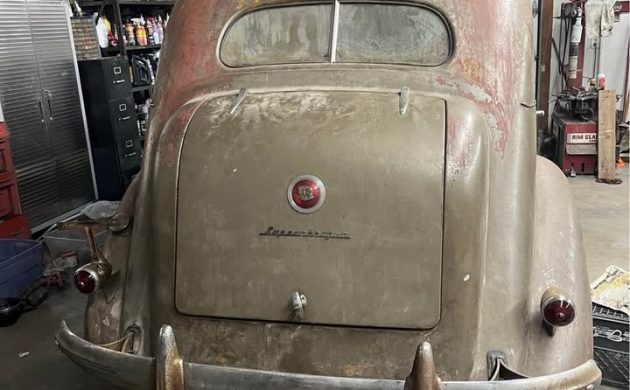
The car’s styling featured horns mounted on the front fenders under the headlamps, at a time when most designers had tucked those beneath sheet metal. The front portholes are non-functional; the longer wheelbase version displayed its spare mounted outside, above the front passenger’s fender. The “bustle back” external trunk doesn’t do the lines of the car any good, but that attribute was still in vogue. Researching the value of these cars uncovered some examples hanging around on the market for not months, but years. Values have stagnated in the high teens for nice original cars, even when the supercharger is present. On the one hand, it would be a shame if this car became part of the expanding extinction statistics that apply to 1930s cars, but on the other hand, recommissioning this rare car will be challenging, to say the least. What would you do with this Graham Supercharged?

Don’t know much about Grahams, until now, and looking at it, it doesn’t look much different than most other 30s cars. I read, it was the supercharging that got them through the depression. These cars were competitively priced, about $1095, to $1200 for the supercharged models. The word “supercharger” conveys images of fire breathing dragsters, or Detroit blowers, but for a passenger car application, it was rather useless. Since a turbocharger, initially called a “turbosupercharger”, was years away, superchargers were the most advanced way of forced induction and did add HP. However, a supercharger is most efficient at higher engine speeds, typically when a flathead runs out of steam. Besides, in the ci at slow speeds,, it was pretty useless, and fell out of favor.
2 ways to go here, restore it original WITH the supercharger, as it was its main gee-gaw, or put your LS motor and drivetrain in, but whatever you do, don’t hack up a nice car like this.
Your sort of correct but first these early units didn’t add the boost or pressure that today’s units do. But your remark how a flathead does fall flat, anytime you can increase the volume of air and fuel into the combustion chamber you add power and what’s more you add torque. I don’t think they really measured that in a reliable way then but I am sure it was a benefit to power output and drivability. Most cars from this era the scariest part is the brakes not the speed.
I think I’ve learned more about Graham Paige here than ever. My only experience is that my Dads Grandfather had a 1930 Graham Paige. It was quite a car, and theres a couple photos of him dressed in his “Sundays Best” in it burried somewhere. They were fortunate during the depression because he was an Ice Man. And back then, you always paid the ice man. He worked hard, theres even a picture of him sweating standing by his ice truck he buggy lugged ice up and down flights of stairs in NYC. My Dad has his Ice Tongs. Thanks Michelle for sheding more light on this company and I’m hoping this gets restored to stock. Its a good looking car.
This is the best I could find from the old photos. I wish I knew what color it was.
There was no mention of Graham Paige. My first car was a 1934 Graham Paige. I was discouraged when a local
“,expert” told me that it was worthless not being supercharged.Then i found rotten wood in the body and gave up.
They didn’t supercharger any cars till 1935. The body became a short track modified.
I scrapped the rest and was a couple $ ahead.
Great original car . . and a true barn find, unlike a lot of the stuff here.
Why would anyone cannibalize this rarity?
How many of these can there be?
Restore it or drive it ”as is”.
I agree. The interior looks great, get it running and driving and enjoy it.
Had an uncle who was said to have had a Graham when he met my aunt. He later had Buick Roadmasters. I recall their Gold Duster, but I had come along late.
With the exception of (2) my grandfather always drove Fords before the war. He had a Durant and in the 30s, a Graham Paige. Since Grandpa saw fit to buy a new car every year there wasn’t a lot of time for any problems to make themselves known.
The Durant did what it was supposed to do. Grandpa might have bought another one but the year was over and he did have a little bit of Ford loyalty in his system. However, he wandered away just one more time.
In about 1936 Grandpa bought the Graham Paige. It ran well and the handling was great but there was something in the front end that constantly broke. From what Dad told me the part that broke made more noise than affected the handling; it was just more of an annoyance.
Grandpa brought the car in 2 or 3 times to get the problem fixed and the shop crew went right about the task. And a couple of weeks later Grandpa would be right back in there so they could do it again.
The salesman was fairly aggressive and believed in his Graham cars. One time, they were trying out a new repair that required reinforcing the part and welding it. When the car was brought in, the salesman said, “If that breaks again, I’ll eat it. A couple of weeks later, Grandpa pulled up to the dealership and called the salesman over.
“Would you like a little salt on it?” he asked.
A Ford was parked in the driveway the next year…
Has everyone gone batsh*t crazy
these days? The seller says parts
or restore, while you’re gonna have a bunch of knot heads tell you
to drop a fire breathing LS in it.
Okay, let’s do this: get the engine
unstuck get it to run, and then see what you have. That guy at
Jennings Motorsports could more than likely free the mill up
in no time at all. Oh sure, I’d go with a custom made modern head gasket as we all know that
gaskets have come a long way
since the ’30s anyway. The 800
pound gorilla 🦍 in the room is gonna be finding someone to rebuild that puffer. There might be a few guys left that know how,
but they’re few and far between.
I wonder if Chilton’s repair manuals from the ’30s would have something on how to repair it. It was probably parked because the backwoods mechanics in Kentucky have never seen one in person. Yeah, they can build you a great car for
running moonshine, but when it comes to classic cars, they come
up short. It’s like an old friend of
mine had a ’91 Chrysler New Yorker sedan with a worn out water pump. It took them 3 months to get a mechanic 🧰 down here to Florida from Atlanta
just to install his new water pump! None of the locals here either couldn’t or wouldn’t do the job. Such was life in Polk County
Florida.
Ken,
I don’t think there’d be much to rebuilding the supercharger. Couple of bearings and a shaft? Some bearings and seals are getting scarce. My engine machine shop can spray weld and turn shafts.
Some things have been more challenging.
924 racecar (Doc Bundy) came here after someone else assembled and installed the engine. Strange oil system issues and i found a circle track shop that could correct the assembly of the Weaver oil pump.
An old midget racer gave me advice rebuilding a very early Halibrand quick change. First time I used the torch, freezer and oven on thr same job.
I am with Driveinstyle on this!!!! get it running, drive it, and enjoy it!!!!! It will run OK without the supercharger so just leave it there for looks.
Brocky that looks like a short hood Diamond t pictured.
This typical 1930s six-cylinder flathead engine should be simple to rebuild. Its insert bearings don’t require the skill of pouring babbits. There’s probably a club somewhere that could offer advice, parts, and help.
My buddy had one of those out in his back pasture in Montana. Might still be there.
When in high-school a teacher befriended me and was helping me paint my ’55 Chev convertible. I was at work and I was driving his metal flake gold TR3. For some reason he decided to move my car and for some reason the starter wouldn’t spin. So he decided to jump the solenoid with a screw driver. He dropped the screw driver and it jammed into place and kept cranking the starter. That wasn’t bad enough, but he had forgotten to put the car in neutral and the car chugged forward into his Graham Paige supercharged that was sitting on blocks in front of the garage and just kept pushing it into the back garage wall until he managed to scamper around and knock the car out of gear. So I had an early intro to Graham Paige cars.
Marked SOLD as of 04-27-2026. “Barn Finds” did it again!
my dad had one of these when I was a kid, his was too far gone to save but they are cool cars. somebody save this old gal!