
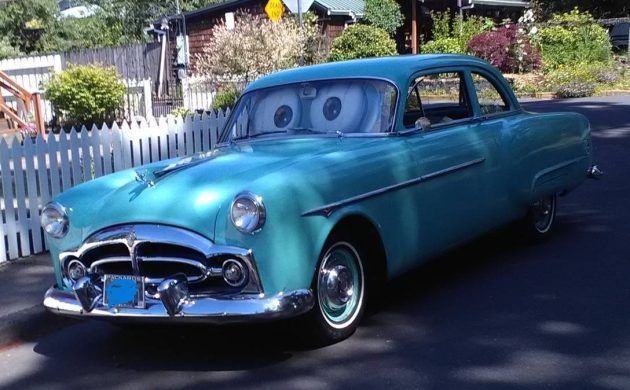
By 1952, the sun was setting on one of America’s most iconic auto manufacturers, Packard. It wasn’t all over yet, but it was headed that way with rapidity. Today’s discovery, courtesy of Curvette, is a Packard 200 Club Coupe, a bottom-of-the-line two-door sedan and a decidedly un-Packardlike model. Tough times call for tough measures, and in the interest of survival, this model is an example of what Packard conjured up to stay in the uber-competitive auto biz while battling with the behemoths that were GM, Ford, and Chrysler Corp. Any Packard, by my estimation, is worth a gander so let’s look this blue “stripper edition” over. Estacada, Oregon, is where you’ll find it, and it’s available here on craigslist for $5,900.
Packard managed to survive the 1930s economic recession, continued smartly through the war years with defense contracts, and entered the mid to late forties in sound shape. The early fifties were still relatively kind to this stalwart of luxury auto manufacturing, but then things changed. Packard couldn’t keep up in the Detroit horsepower wars, and new buyers weren’t interested, as many viewed Packard as dowdy and an old man’s car. In 1952, Packard offered several different series, including the 200, 250, 300, and 400 Patrician models. The 200’s, in two and four-door sedan body styles, were the volume leaders, accounting for 46K units. Packard managed a fifteenth-place finish in the 1952 domestic production race, knocking out a total of 63K vehicles.
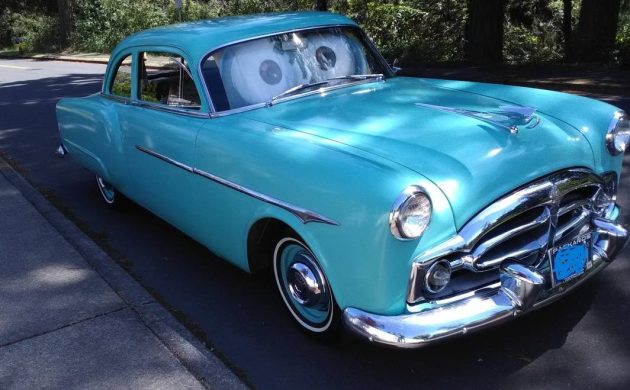
Our subject is believed to be a repaint and presents well with a respectable shine, complete trim, and still lustrous chrome bits. Rust doesn’t appear to be an issue, nor does crash damage, though the seller rates the exterior only as “Exterior in fair condition.”
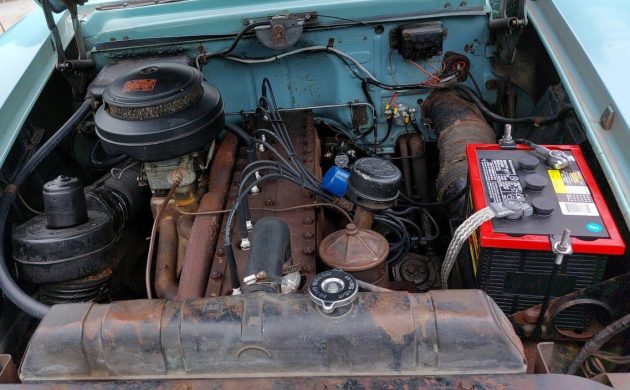
Power is provided by a 135 gross HP, 288 CI, in-line eight-cylinder engine, which drives the rear wheels via an “Ultramatic” automatic transmission. No driving characteristics are mentioned for this over 100K mile 73 year old sedan but the seller does add, “New battery and cables, New oil pump New oil/gas filters, New tires, New front brakes (back brakes need replacing), New master cylinder, Transmission filter, Gas pan(?), Thermostat, Radiation (sp) hoses Ignition coil, Rebuilt starter/generator, and Oil change (performed).”
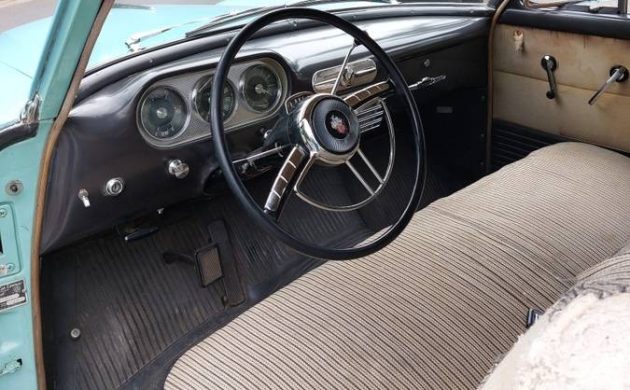
The interior looks like an entry-grade level affair and is typical for the era, with mattress-striped fabric upholstery (seat cover?) and muted hues for the door panels and headliner. The driver’s side seat backrest looks like something took a chunk out of it and will obviously need a redo. A rubber mat, not exactly Packard province material, covers the floor. The dash and instrument panel, however, seem to have fared well.
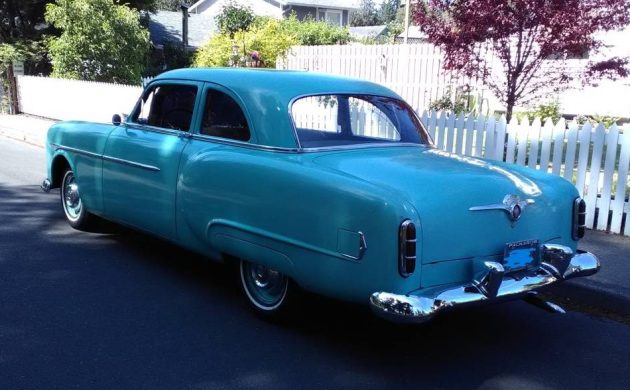
Packard’s slogan was, “Ask the Man Who Owns One,” but that’s getting harder to do as one hasn’t been built since 1958, and that entry was really a rebadged Studebaker. I’m happy to see that this Packard is still together and running, and seems to be in sound shape. But comparatively speaking, it’s a disappointment from the lofty heights where Packard once was in domestic automotive stature. Regardless, this one needs a new home; any takers out there?




I find the styling on these ’52 Packards to be very smart, certainly as compared to the Mopars of the same years. The Mopars were really puffy, but these Packards look crisp.
I really like the styling. Vent wings in the rear doors. Interesting.
That was common for decades. It’s the only way the rear windows can go all the way down in some doors.
Well, I tend to disagree with Rex, it was these cars that spelled doom for Packard. These really were just warmed over pre-war styling, and a motor from the 30s. It wasn’t what America wanted in a middle class car. GM had the market cornered in the 50s there, and the “all new” Packard(1955) was just plumb too late. Don’t get me wrong, this was a very nice car for someone that held the Packard name dear. Thing was, people like my grandfather that bought new Packards after the war, they were so well built, they didn’t need a new car in 4 years. That didn’t help Packard any.
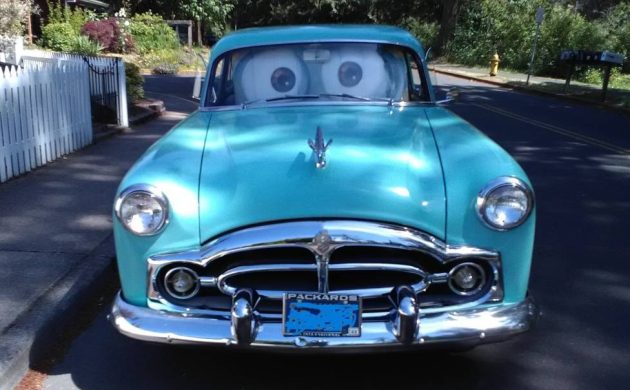
This car has the “improved” Cormorant hood ornament, with the downswept wings. Ours was discontinued after 1951, deemed a pedestrian hazard. Make no mistake, this car would roll like thunder, and is very similarly equipped as our 1950 was.This was a pretty basic car, and sold for about $2400 new, and seems the automatic, a $200 option, was the only thing these folks got. A similarly equipped Buick was about $2100, so the Packard was a bit more, but to those 110,000 people that bought Packards that year, about 24,000 bought the 200, there were people like my grandfather, that thought Packard was the best,,,,,and I say they were too. If I never owned one, I couldn’t say that, but I did, and Packards were in our family, that’s believable testimony.
The ’52 engine was definitely past its prime, but the body styling doesn’t have anything from the ’30s, or even the ’40s, except the contour of the top of the grille. The ’48-50 Packards were plainly a clumsy facelift of the beautiful ’41-47 Clipper, but the ’51 was a clean slate design. Certain things like a hood flush with the tops of the front fenders were more modern than the competition. Was it beautiful? That might be a stretch, but I don’t see anything ’30s about it, either.
I’ll never understand why Packard didn’t take advantage of the fact that they didn’t have to design their main war product–the Merlin–and keep their engineers and designers busy planning for the postwar market.
Andy, could you mean- not- keep their engineers busy?
Now a Merlin powered Packard, that would be something. This is about as plain jain as it gets.
Chris, I meant why did they not take advantage of not needing their designers for the war effort, and therefore put them to work on new cars for after the war. In other words, why didn’t they design new cars? It was awkwardly put, I suppose.
Quite a change in body style from the 23rd series !
Wonder how much that straight 8 would weigh, I bet it would cruise all day long.
So where is this car?
Note the first paragraph: Estacada, Oregon
JO
Usually the comments on the styling for these later Packards are not very favorable but their looks have grown on me over the years
As an orphan car aficionado I would have no problem slipping behind the wheel of this Packard. Admittedly this isn’t in the same class of Packards as the one Jeeves pulled up in front of the mansion pre-war. But it was still a Packard and no one could say it wasn’t well engineered and built. And as is the usual case this car is in the west coast. What else is new? I got a chuckle out of the photos with the eyes poster placed in the windshield. Throw those in with the sale and I’ll buy. GLWTS
The tombstone grill looked stately on the pre-war Packards but keeping it into the shoebox era with what I consider awkward and even homely results couldn’t have helped sales.
I’ve always liked the continuity that grille represents, but I’m sure for some it seemed old fashioned. At a time when Cadillac and Oldsmobile (Olds being more of a competitor for the 200) had fresh new OHV V8s and a better automatic, I doubt the grille was the biggest factor.
Maybe not the biggest reason for some but can you imagine if Ford or GM stuck with their prewar grills into the 1950’s? Ford moved on in 39. I just don’t think the tombstone fit with built in fenders. Stretching it out to more than three times its original width looks tortured to me.
It is a Packard, but I’ll stick with my 1936 Packard updated with a 350/350.
Packard wouldn’t have compared themselves to Ford, but they might have aspired to compete with Mercedes-Benz or Rolls-Royce. (At one time they were on par with those brands.) Packard’s grille shape was a trademark dating back to 1906, while other US brands couldn’t say the same. You don’t throw that kind of identity away.
lol it certainly worked for them
This is a very nice car at a very reasonable price maybe not as fancy as some of the other makes that GM offered but still a reliable good carfare someone looking for a nice old car that is affordable, considering it is 78 years old and an orphan still would make a nice car for someone to enjoy and looks like the owner has put a considerable amount of money in it with people asking so much for old cars these days it is a great deal ..