

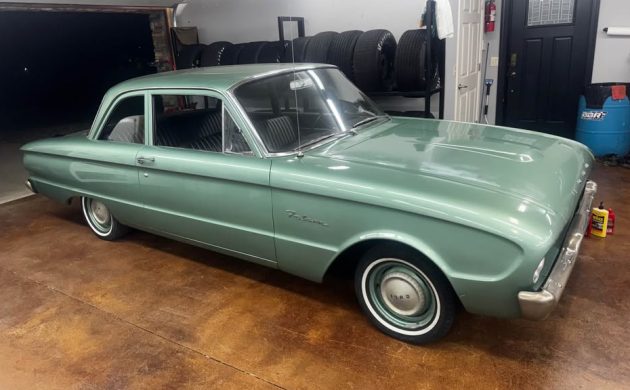
Remember when a small, economical car could be a perfectly good reason to visit your local Ford dealer? When the Falcon arrived for 1960, that was exactly the idea. It wasn’t trying to be a luxury car or a hot rod. It was a straightforward little Ford that could handle the daily grind without asking its owner to spend big money. And look at this one, finished in a shade of green that seems right at home in 1960.
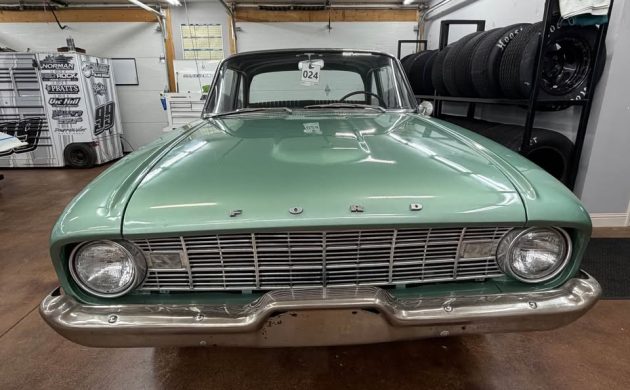
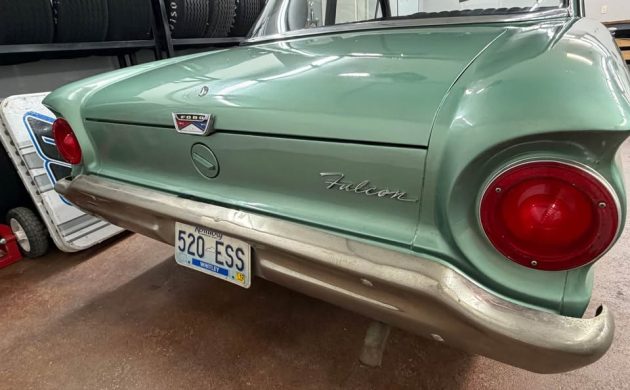
This two-door sedan is listed on Facebook Marketplace in Corbin, Kentucky for $11,500 or best offer. The first thing that caught my eye is the color, which I believe to be Mint Green (Light), Ford paint code M-1373, followed by those skinny whitewall tires and matching green wheels. The front end is about as simple as they come, with round headlights, a wide grille, and just enough chrome to dress things up. Around back, the big round taillights and Falcon script leave no doubt about what you’re looking at.
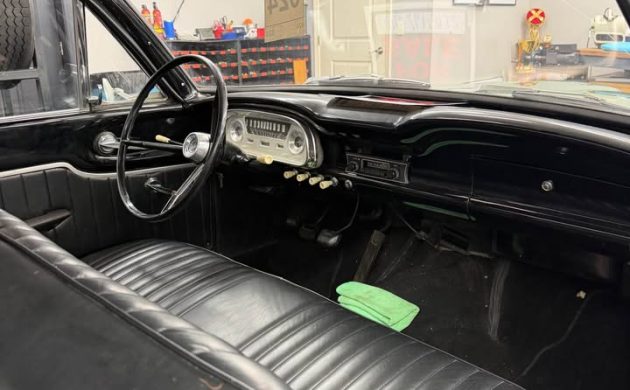
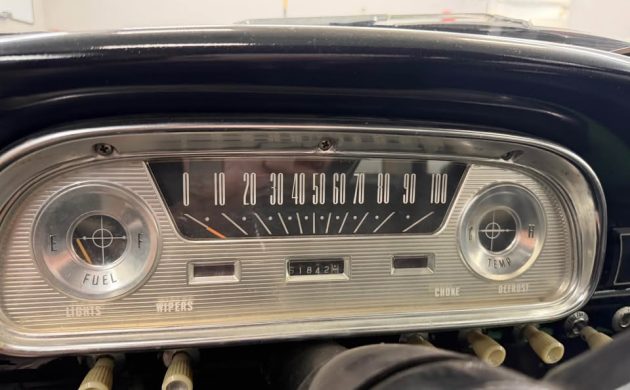
The interior features a black vinyl bench seat and a dash that puts everything where you’d expect it. No giant touchscreen, no confusing menus, and no need to scroll through three screens just to find the radio. There’s also a three-speed manual transmission shifted from the steering column. If you’ve never driven a car with three on the tree, you’re missing one of those little experiences that made driving older cars different.
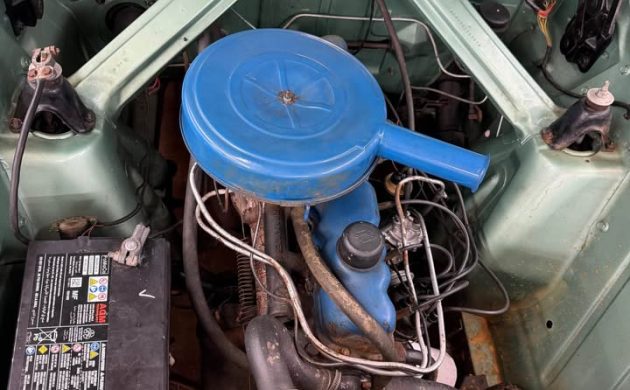
Under the hood is the 144-cubic-inch Mileage Maker inline-six. Rated at 90 horsepower when new, it wasn’t going to win many stoplight races, but that wasn’t the point. The seller says this Falcon has 62,000 miles, has had one owner, and runs and drives great. New tires, a new fuel system, and new brake cylinders are also mentioned in the ad.
Here’s another interesting bit of Ford history: the Falcon helped pave the way for the Mustang. When Ford introduced the Mustang in April 1964, it borrowed heavily from the Falcon’s platform and mechanical components. Some enthusiasts jokingly call the early “1964½” Mustangs rebadged Falcons, although the Mustang had its own body and identity. Not bad for a little economy car, is it?
At $11,500, this Falcon isn’t pocket change, but the right buyer might appreciate its simple mechanicals, tidy appearance, and old-school driving experience. Would you keep it as-is, or would you be tempted to make a few changes? Let us know in the comments. And thanks to Pnuts for sending us this tip!

Welcome to Conrado too. Sheesh, major overhaul at BFs? Maybe, but always room for one more. Barn Find writers are some of our favorite people. I can say from all of us, we enjoy all the work that is done by them.
This stuff is seemingly coming out of the woodwork( storage sheds) in alarming numbers, practically insuring a writers job here for years to come. Never in our wildest dreams, did we think the Falcon would achieve such greatness. Falcons, and such, were for spinster old biddys who knew nothing about cars, except they needed one once a week. Gas mileage was of little concern then, when ’57 Olds J2s were around, but someone had a vision for the future, with average mileage about 13 mpg then. One could say Rambler was the start, but Valiant, Falcon and Corvair proved it was the next big thing, 20 years later. Once again, the stick. I’ll maintain my stance, the sticks are the ones not selling. Shame, it would be a great car for someone.
Thanks, Howard! Glad to be part of the Barn Finds team. It’s been fun discovering these old cars and hearing everyone’s stories and opinions. And I hear you on the sticks! 😂
I could go for this, although it seems the days of being able to pick up a decent Falcon for a Hundo or less are long, long gone.
Fast enough for the real world, economical, simple, and reliable. Those are traits sorely missed today. And even if this Falcon isn’t one of them, Ford developed it into models that really grab me (like, for example, the Sprint with its little V8). I even like the body design. Wouldn’t change a thing, as this one is too nice as-is to mess around with.