

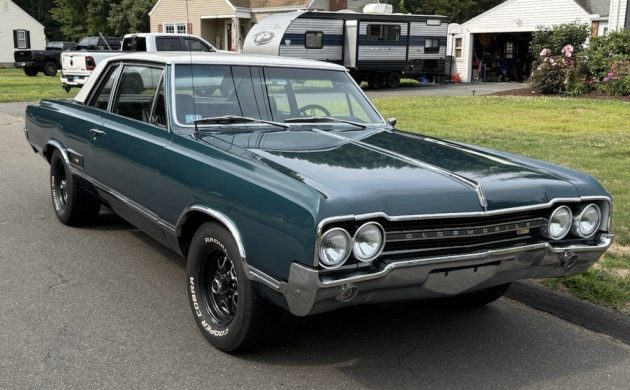
There will never be another decade like the 1960s. It brought a revolution in music and lifestyle, and the technological triumphs of the first human-to-human heart transplant and mankind setting foot on the moon. Automotively, the muscle car broke cover, redefining the high-performance market as the horsepower race gained momentum. One of the key players was the Oldsmobile 442, and this 1965 example is a gem. It presents well and is a turnkey proposition ready for action. I must say a big thank you to Barn Finder Curvette for spotting the Olds listed here on eBay in Windsor Locks, Connecticut. The seller set their auction to open at $10,000, but there is a BIN option of $22,000 for those wishing to bypass the auction process.
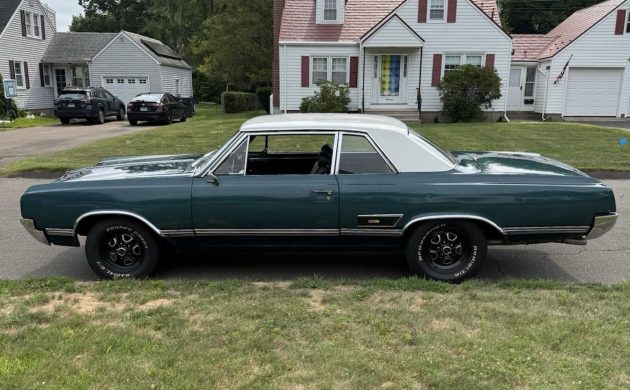
Introduced in 1964, the 442 was a hastily prepared reply to Pontiac’s GTO. Oldsmobile did a sterling job of developing its muscle car over a very short period, but the badge hit its stride when this car rolled off the line in 1965. The company made significant upgrades with its latest offering, allowing potential buyers to consider the 442 as a genuine high-performance vehicle. This Olds looks subtle but stunning in Turquoise Mist and Provincial White. The Super Stock wheels are a later addition, but perfectly suit the car’s character. The 442 presents nicely, with no major cosmetic shortcomings. I can’t spot any evidence of penetrating rust. While the interior trunk shot shows surface corrosion and there is a similar level of corrosion on some suspension components, it appears this classic is rock-solid. The trim provides a welcome contrast to the dark paint shade, and the glass is clear.
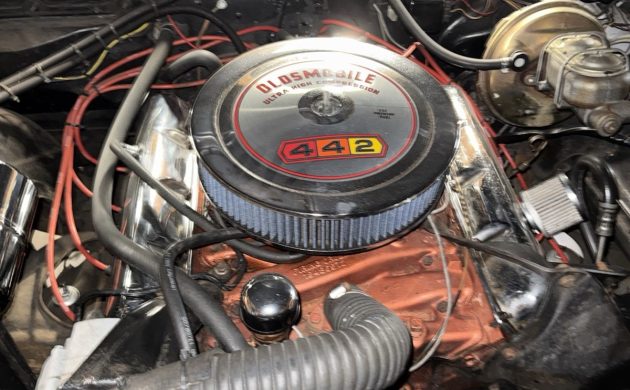
Due to the rushed development cycle, the 1964 Olds 442 featured a 330ci V8 delivering 310hp and 355 ft/lbs of torque. However, the 442 came of age in 1965, with the company bolting its 400ci V8 under the hood. The results justified the effort, with power and torque rising to 345hp and 440 ft/lbs. This car teams its V8 with a two-speed “Jetaway” automatic transmission, power steering, and power brakes. It is fair to say that the 442 wasn’t the industry’s fastest muscle car, but Oldsmobile focused on combining performance with comfort and luxury in its marketing strategy. The seller states that they recently replaced the suspension bushings at both ends and fitted a new set of tires. The tires are a mix of 14″ on the front and 15″ on the rear. However, they will also include the other 14″ tires if the buyer prefers. Although not stated explicitly, the indications are that the Olds is a turnkey proposition.
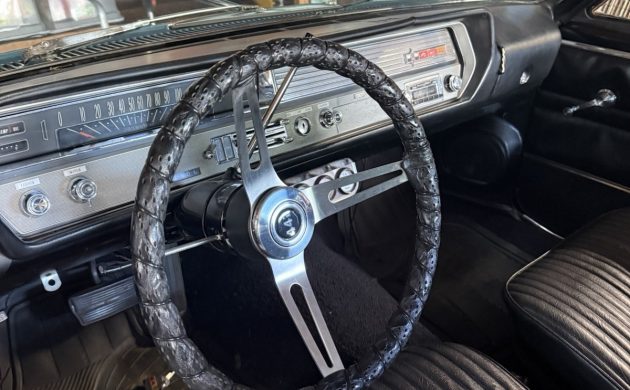
This classic’s interior is far from pristine, but it is serviceable in its current form. The new owner will probably address its shortcomings, but could do so as time and circumstances allowed. There is a very obvious pad crack, and the new owner will probably bite the bullet and spend approximately $280 on a replacement. The seatcovers show slight wear, and the foam on the driver’s seat is beginning to fail. However, there are no rips or tears, and the carpet is in good condition. The speakers mounted in the kick panel will bring music from the retro-style stereo to life, and the sports wheel wears a wrap. With the few identified faults addressed, the presentation will be comfortably acceptable for a survivor-grade classic.
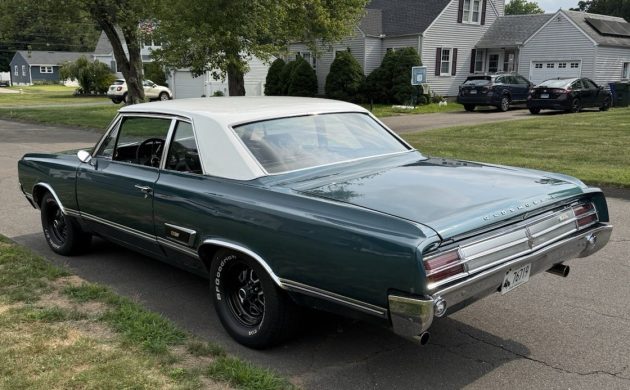
This 1965 Oldsmobile 442 is a striking vehicle, but its paint color conveys a subtle sense of muscle. It has no apparent needs, allowing the buyer to indulge in immediate motoring pleasure. The seller’s BIN looks quite realistic for a car of this caliber, which makes me believe it should find a home fairly quickly. Like many marques that have faded into the dusty pages of history, Oldsmobile’s heritage deserves preservation. Are you tempted to do your bit by submitting a bid, or would you prefer to hit the BIN button?

why were they called 442
Four barrel carburetor, four speed manual transmission and dual exhausts. Although in this case you have a 400 ci engine with the four barrel. It’s complicated.
The 442 moniker did indeed mean 4 barrel (carb), 4 speed and dual exhaust through 1967. Then it became 4 barrel, 400 cubic inches and dual exhaust.
I owned one. A ‘65 convertible. But it was not a 4 speed. It was a 2 speed “slip and slide power glide” automatic transmission. It was still a 442. I was told it stood for 400 cu. In., 4 barrel carb, dual exhaust. That makes sense to me. It was nonetheless a very fast car, winding out to 80+ mph in first gear. Wish I still owned it.
That was only good for 1964.
1964 – 4-barrel, 4-spd, dual exhaust
1965 – 67, 400 ci, 4-barrel, dual exhaust.
’68 you could opt for a 455ci and ’69-’74 it became standard.
4 speed 4 barrel dual exhaust
Probably sell a lot faster with 3 pedals
If I had the money, I’d buy it right now…I love muscle cars, grew up with them, and rode in and drove many of them back in the day…not to mention, dark teal is my absolute favorite color!
Not fond of what looks like fresh paint over unaddressed rust in the trunk floor and bottom of the drivers door. If the prep work wasn’t thorough, why pay a premium for a car with shiny paint that won’t last.
Steve R
Around 1973 a young women early 30s that lived two houses over from me had a 65 or 66 Olds She would come out to wash the car in a bikini and for a 16teen year old (at the time )that is something I will never forget
When was a two speed automatic ever a premium choice for a muscle car?
When shiftless people bought them.
AND it was not a Powerglide as stated above. Yes, it did have some Powerglide parts inside. But the BPO (Buick, Pontiac, Oldsmobile) 2 speed was much heavier duty than the Chevy Powerglide.
I own an original ( never rebuilt or restored just maintained) 1967 Oldsmobile Cutlass Holiday Coupe 330cid 2 barrel 250hp 335ftlbs torque with a 2spd Jet-away variable stator automatic . Oldsmobile 2 speed automatics share zero parts with Chevrolet power glides. Its a common but wrong assumption. Oldsmobile remained mostly separate from GMs corporate policy to integrate and subjugate all acquired brands until 1968.
My car has the 2 speed Jet-Way automatic. Everyone raves about the 4 speed manuals. And I have driven a few of them myself. They are close ratio attention hogs that do not offer any liveable highway gears especially when paired with a BB. My husband’s 66 Chevrolet Chevelle SS396 4spd car would be screaming at 3500 rpms at 65 mph with 342s. Try driving that a few hundred miles. It’s hard on tge driver even with accoustic insulation, on the wallet and very taxing on the engine and drive train. Conversely my 1967 Cutlass might not be a 442, but she can fly down the highway at 75 mph comfortablely and pass easily 80+ uphill without the engine straining or even questioning if I can afford the gasoline to do so. The variable stator makes the 2 speed perform more like a 3 speed and gets her going fast enough. A bigger engine with a good driver with a 2 speed often beats most manual cars at the tree… ( i said most!) That’s a huge part of the reason why Oldsmobile swapped out the 4 speed for 4 barrel. Fuel computation on those newly built thruways , driveability and comfort for the commutes to work yet still won Races at the track or just stop lights on the weekends for Oldsmobile intended market. Oldsmobile Engineers are accredited with designing, testing manufacturing, and improving upon existing products with several jey breakthrough automobile performance milestones under their belt.
GM killed them slowly over decades and it wasn’t even with their own engines but Chevrolets under the hood and corporate policy of starving the other brands for R&D funds and refusal to allow any bought out brand to outshine Chevrolet’s Corvette, Camaro .
colors look good but everything else looks a bit questionable to me.
We know what the priorities were in 1965 if this dashboard is any indication. The ashtray and lighter are closer to the driver than the radio which appears to be in front of the passenger.
My son in law just had the 1968 Olds 442, the first car that his father bought new when he got home from Nam, professionally restored. What a great Vehicle!!!!!!
My high school car was a hand-me-down from my sister. My dad bought it for $600 in 1973. It had been repainted 1973 Corvette yellow, much better than the blah light blue. It was a 1965 Olds Cutlass F85 two door hardtop w/330 and two speed on the console with built in tach. Nothing special as far as performance. It had no rust and no dents, and I took meticulous care of it. When I came home on leave from the Navy, it had disappeared. My next car was a $100 rust bucket from our farm neighbor. 1962 Chevy Impala two door hardtop w/327, 2-speed on the column and dealer added AC. It was light green. The window seals leaked, which is why to this day I prefer post cars. It too, disappeared. Love to have kept both of them.
The sellers’ car IMHO, needs to be solid yellow with original wheels. 442 with column shift? I’m aghast! Still, I’d love to own it.
I have a ?… we’ve seen several 4-4-2’s in the BF listing’s over the yrs and my question is did they ever come with the Old’s 425 ci engine? Had a classmate back in 1970 that I kinda remember having a 67 with that engine 4 barrel 4 speed… but honestly may be it wasn’t a 4-4-2 but possibly a Dynamic 88? But I do remember it was a good looker with the wider Micky Thompson tlres on the rear and a Teal color paint
No 425’s from the factory.
Steve R
442 powertrains were 330(64), 350(72) 400(65 to 69) and 455(70 to 76) in the early cars.
I had a 65 442 with a 4 speed. It was one of the most fun cars I ever owned. Wish I still had it naturally.
With this one I’d have to replace the transmission with a TH400. That Jetaway is not acceptable for a performance ride.
This car is begging to have the trim rings re-installed.
I dont see taht as a a 442 ? Its a slushbox mounted to that 400 . Ill bet it still boogies though and it sits smart !
Swapping the 2 speed power glide for a TH 400 would really help.
And the car wash post is fantastic…
Looks like an aftermarket steering wheel on this. I don’t remember a steering wheel like that being offered originally.
1965 was the first year for Pontiac to gain the new BOP (Buick, Oldsmobile, Pontiac) transmission/bell housing bolt pattern. I’m going to assume that Buick and Olds did also. So later model transmission swaps were not easy on the earlier cars. Just sayin’
Lori-Anne M Henry, the Buick, Oldsmobile, Pontiac 2 speed were the same transmission. They had different names, but were the same transmission. Many here call them a Powerglide which is a Chevrolet name for their 2 speed automatic transmission. And I usually comment that the BOP transmissions are not Powerglides but heavy duty 2 speeds that are different. When in high-school the first car I “legally” drove on the highway was a 1963 Biscayne 230 6 cylinder Powerglide. In very short order, I replaced the 6 cylinder with a hotted up 283. WELL, the Powerglide was not strong enough for the V8/or possibly how I treated it. Buy I learned how to rebuild that transmission, and did so a couple of more times. So there is no love loss between me and Powerglides. While in college, I worked in the parts department of a Pontiac store. We didn’t have a very high failure rate on the 2 speeds, so we didn’t stock very many parts. So when we needed the parts for one (if needed right way) we would go to the price book with our needed parts list and see what other car lines used the same parts. We always checked Chevy first as they were the closest dealership to us. And invariably there were one or two parts that were the same as Chevrolet, and the rest would come from the Buick or Oldsmobile dealers. There are a couple of pieces that are the same. (some friction clutches IIRC) which may also be used in turbo 350 transmissions also. However the quantity of clutches were most definitely not the same, or used for the same gear. For example, the largest clutches in a Powerglide may only be used as reverse clutches in BOP 2 speed. They share a few pieces. BUT, the transmissions aren’t the same as a Chevy Powerglide. (I made too many trips to Chevrolet for two speed Pontiac transmissions to claim that there are o Chevy parts in there.