

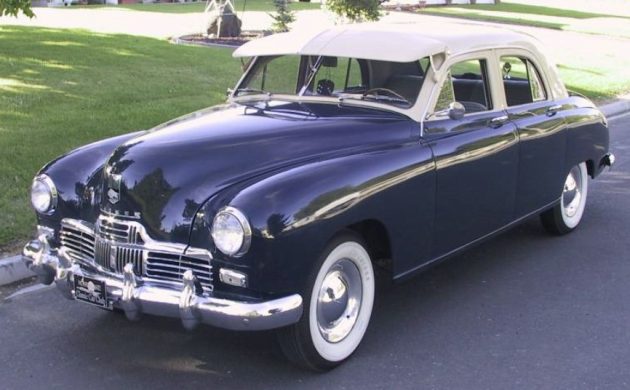
Kaiser-Frazer was founded in 1945, seemingly with every advantage at its fingertips: two big-name industrialists with plenty of money, ideas galore, and an eager post-war buying public. In 1946, the company unveiled two models at the Waldorf Astoria Hotel in New York City, and by 1947, it had purchased Graham-Paige, which provided much-needed facilities, personnel, and experience – particularly in the form of Graham-Paige’s president, Joseph Frazer. Powerhouse designer “Dutch” Darrin’s Los Angeles studio was commissioned to generate the fresh styling that sold so well against the Big Three. Unfortunately, a falling out between the two founders and a massive pile of expensive debt plunged Kaiser-Frazer into a tailspin. It eventually merged its way out of existence. Here on craigslist is an early example from this short-lived company’s production history – a 1948 Kaiser Special sedan. The car is located in Moses Lake, Washington, and the seller is asking $10,000. Thanks to Curvette for the great tip!
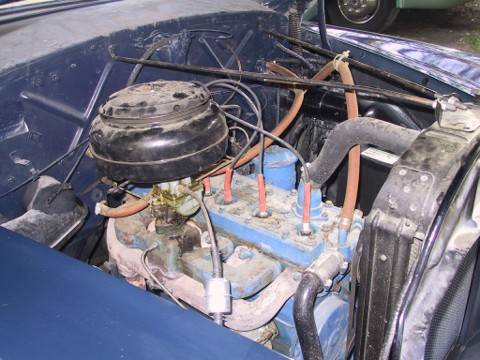
Initially, Kaiser-Frazer divided its offerings between downmarket Kaisers – called “Special” and “Custom” – and upscale Frazers – the “Standard” or “Deluxe”. Despite minor sheet metal and trim differences, the same Continental 226 cu. in. six-cylinder flathead powered the whole line-up. Output was around 100 hp. This example is fitted with a three-speed manual with overdrive. Looks like she hasn’t run in a while, judging by the dust, though the seller notes the car has accumulated several trophies over the years.
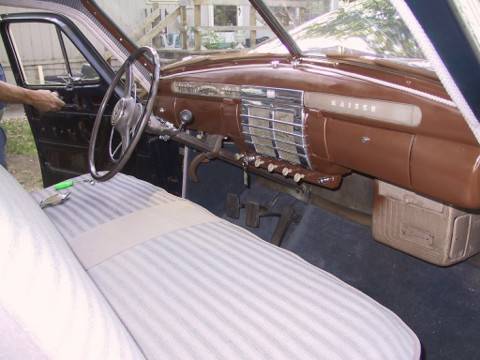
The Special was the base model in Kaiser-Frazer’s line-up, with simpler interior fabric options, less brightwork, and a slender equipment list. Here, the restoration work still looks good inside and out – it’s easy to understand the shelves of trophies. Notwithstanding the tidy but bland cabin above, Kaiser-Frazer was fortunate to have Carleton Spencer on board in the company’s style department. Spencer was a revolutionary when it came to unusual materials and colors. He developed the unusual embossed “Dragon” upholstery for the Kaiser line, and it was his influence that brought a kaleidoscope of fresh paint colors – like Indian Ceramic and Glass Green – to the entire industry.
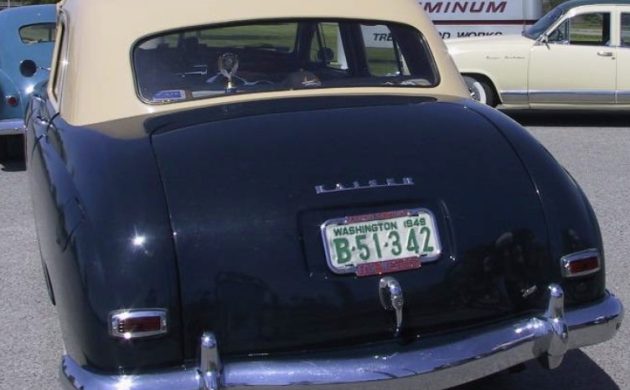
As the years rolled by, Dutch Darrin put his imprint on Kaiser-Frazer cars ever more obviously, styling waistlines with the “Darrin dip” and adding a widow’s peak to roof lines. The effort failed to generate enough interest: all in all, Kaiser-Frazer – later just Kaiser – managed to produce 950,000 cars from 1947 to 1955, including the Henry J, the Kaiser-Darrin, and its entire global production. Unfortunately, as fast as the cars went out the door, the losses mounted. This offbeat brand would be a novel sight at Cars ‘N Coffee, and it also offers a reasonably-priced way into the world of vintage cars. Here’s a 1951 Deluxe, exhibiting more pronounced Dutch Darrin signature styling, that sold for $10,600 recently. What do you think is a reasonable price for this Special?
Poor little orphan car that nobody will want, the next owner will probably be the last.
I say cheap fun for 10k! Through check over and drive it EVERY chance you get!
You are right. Unfortunately, this car is representative of a lot cars from this era, even from more mainstream manufacturers. The interest in cars from this era among potential buyers is approaching nonexistent. There are now YouTube videos from nearly major auction highlighting cars that sell for as little as a few thousand dollars, many are similar to this, orphans in good condition. It’s getting to the point where projects from this era are becoming infeasible, unless that specific year, make or model is the buyers dream car.
Steve R
My great-grandfather owned a 1952 Kaiser. Hence, they hold a special place with me, and someday, I hope to own one also.
Strange overspray on the (inside) heater box there…
Could they have tried any harder to make it look like a 48 packard? LOL
That front end, those lines, yep that’s a 23rd series Super 8!
,
Even the dash, with faux wood grain and chrome elements, looks like my Packard.
Although the engine did originate from the Continental, by 1948 they were all manufactured by Kaiser Frazer at Willow Run Michigan.
These were very nice cars for the time and competed very well in ride and comfort with the pre-war technology offerings from the big 3 after the war. We had several Kaisers in the family when I was a kid….learned to drive in one. Slow but steady.
Josh….I understand you run this site. Why are my comments being deleted? Has been going on for several weeks or more. I just put an inoffensive comment on about Kaisers and my history with them, and it’s immediately gone. What is the deal? Did I offend someone?
Yes, I had a restored one here selling for customer. Could barely give it away. Not quite as nice as this one but in very nice shape. I think sale price was $3500. or so. I have a parts one here we have tried to find a home for or sell parts off of it, but are about to scrap.
they lacked pizzaz. Think only reason they sold was because new cars were in a can’t produce enough to fill the demand situation. The left over designs from GM, Ford, Chrysler had so much more personality than the Kaiser-Frazer. They were more like just a bigger version of a Crosley.
You’d have to go back to 1947. KF cars had full width seats with no ugly bulging fenders sticking out. Most of the big 3 were still manufacturing what they had in 1942. Sure KF sold due to the sellers market, but at the time, KF cars were considered revolutionary. What you consider “personality” was 5 year old obsolete design. KF offered a more modern chassis, easy steering, easy handling, even with the L head 6, good performance. KF offered overdrive, something that many of the big 3 didn’t.
I remember when these cars first appeared. The ultra-modern styling was overshadowed by aggressive and even bland practicality, which is why they initially sold well when demand ran exceptionally high but did not capture the public’s imagination in the longer run. Had they had more intriguing trim and higher power under the hood — some exciting postwar optimism — I believe they would not ultimately have failed to establish themselves.
I am reminded of the hundreds of niche independent record-labels which showed up during and after the War. Those that lastingly succeeded had something MORE going for them, than simply filling a void left by the major labels. For example, in a world of often so-so audio, both Capitol, Atlantic, and then Mercury, emphasised extending the ability of high-fidelity sound with brilliant realism and detail, in a sea of mainstream recordings which had not brought out anywhere near the most of what 1940s recordings could be capable of. Brilliant marketing and promotion, along with strong early hits, obviously benefitted those then-fledgling labels; however, they offered a definitely superior product, which is what so quickly advanced them in the marketplace.
Realisation of this potential with Tucker — a greatly advanced, highly innovative, and superior quality product, yet at a practical price which Americans could actually afford — was the threat which caused the Big Three to utterly crush Preston Tucker before he could get his automobile off the ground; for if he had been able to do so, and advance it to market, then catching up to him would have proved to be a nearly bankrupting proposition for the inertia-bound “establishment” auto-industry.
Kaiser-Frazer, on the other hand, fronted boldly postwar styling, though with no “flash” and unimaginative prewar earth-toned interiors, and prewar power under the hood. They failed to read the war-weary public and its thirst to leave the War Years behind, for bright colours, flashy styles, and some real power accelerating their new cars. Kaiser-Frazer were instantly “old” before they were new, and despite promising sales and advanced boddy-shapes, that lack of vision is what sank them after their initial offerings.
Easier to see this many decades in the future I would imagine than it was at the time. And interesting to look back and see who had a real vision for what the public wanted and who did not. So much depended on being right, too. Can’t imagine being a major decision maker in that era and hoping you got it right. In any era I suppose. Until Barn finds I as totally unfamiliar with Kaizer-Frazer cars, whereas I was very familiar with the big three..
Here we go again with the fable of the big 3 “crushing” Tucker. Baloney. That movie is fiction. You’re also disregarding that Pontiac, Oldsmobile, Chrysler, Hudson, Nash, Studebaker were all running L head 6 engines, maybe pre war, but all were contemporary with Kaiser Frazer. The Continental 226 that KF adapted and manufactured in their factory was actually a modern thin wall lighter weight engine, in many ways advanced over some of the competition. Kaiser was so successful, that the 1951 model outsold all other independent makes that year, even running a L head 6 cylinder. Where is your evidence that Tucker had great quality and was highly advanced, while it used a antique Cord transmission, adapted a Franklin helicopter engine, Tuckers were a big compromise at best. The auto industry had Tucker’s and Tatra’s to fully examine and consider, if the design was so fantastic, then why didn’t any other company go in that direction, of a full size, rear engine, automobile?
It always feels so strange to hear someone report that they were totally unfamiliar with a car that I saw first introduced: I think, at some point in life, things we have ourselves experienced (such as Pearl Harbor on December 7th, 1941), simply become a “given” common recollection of present-day Americans; and we forget that so many now living were not there to witness sitting by their radios to hear first hand the shock and horror of that world-altering event. Some never lived during even the very recent Presidency of Ronald Reagan. We oldie “fossils” do well to keep this reality in mind, especially in light of the clear fact that we ourselves once only were witness to then-recent events. I got a powerful reminder of that when my own great-grandparents told me of their experinces in the Civil War. We come, we live through a time, then we are gone as all before us, and somewhere down deep, we wonder if we will have mattered. Sobering; isn’t it.
This comment is terrific, one problem with the world is that people don’t know any history, and of course, those who forget are doomed to repeat it. I’m fortunate to remember the stories about the great depression, the hardships Americans endured, the English living through the blitz, the horrors of WW2. The lessons we learned back then that when evil is growing stronger and perpetuating horrors, it’s a mistake to ignore the other side of the earth because it will come back to injure us.
Can’t argue with THAT, Duaney! The Great Depression was coming to an end when I began paying attention. But my brother-in-law, who passed away at 91 and would have been 99 now, was a boy during the Great Depression, and he found it to be a heart-warming time when simple pleasures such as eccentric grandparents, yo-yos and 25 cent afternoon matinee movies and penny candy brought such joy and sense of privilege, and they did not realise that they were in a state of privation. Adults whispered late at night about the expenses they did not know how they were going to be able to meet; but as a child, such anxieties were off over there and outside of your realm of the funny papers and ice cream.
Young people certainly can not relate to the shock of 9/11. Even now I can’t describe the horror of it happening in real time. I was certain that the world was never going to be the same, but I could not have predicted that it would have evolved to where we are now. Not in my most far-out-there imagination.
Now, to my mind, I was extremely lucky to be a grown adult before that time, certainly my golden age. On so many levels I can trace the difficulties that have followed to the decisions that were made after that day.
Thank you for the writeup and history on these Michelle.. I didn’t know much about them other than the name. I like the ’51 you posted better but this is still a lovely old car. I remember my dad having a ’49 Mercury when I was a kid and then a brand new ’53 Chevy Bel Air convertible and I have a digital picture of a Christmas card from ’53 with us standing in front of it. I have no idea what this old beauty might bring but my hope is it goes to a big Kaiser fan and will be preserved.
I owned a 1954 for 23 years as collector and the car was well designed, reliable, attractive, comfortable and depreciated in value. It attractive more folks in the true antique car shows than the familiar brands. It would go 75 mph in overdrive with its 120 Continental 6. I would climb steep hills in 3rd Gear. Poor orphan! The club was friendly and helpful.
Kaiser-Frazer was challenged to build a big enough dear base. Often gas stations were signed as dealers and the could only take a half dozen cars as inventory.
Note that Kaiser corporation was a big steel company and during WW2 produced one Liberty Ship each day and sometimes more. The war vwas won because of massive logistics and Kaiser was a commendable force in the war victory.
1949-50 shoebox Ford design was a better copy of Kaiser 1946 prototypes and a big success for modern automotive advancement.
Kaiser produced the first production fiberglass sports car.
Kaiser developed a healthcare system for their employees and today exists as Kaiser Permanente. Leader in corporate worker benefits!
FYI.
I get history from cheaper sources than 75+ years old product of industrial manufacturing.
Books work too.
No way to bid. No way to contact owner. Moses Lake address for the car???
[email protected]
Link will not open.
Click on Reply in the upper left hand corner and you’ll see options for email, call, text or chat.
There is no “reply” on my version of the car. Maybe it is because I am not a 10$ per month member.
I think you misunderstood.. this car isn’t being sold on BF, it’s a private sale on the Craigslist website so BF can’t provide a contact link for you to get in touch with the owner. You have to click on the red text in Michelle’s writeup that says “Here on craigslist” at the top of this page and that link will take you to the Craigslist page. Then once you’re on Craigslist the link to contact the owner of the car will be on the upper left.
You were correct. I have a name and an address for the name. I will try them next tuesday. Thanks for the help.
John
The Kaiser is in my home town – Moses Lake, WA. Give me an address.