

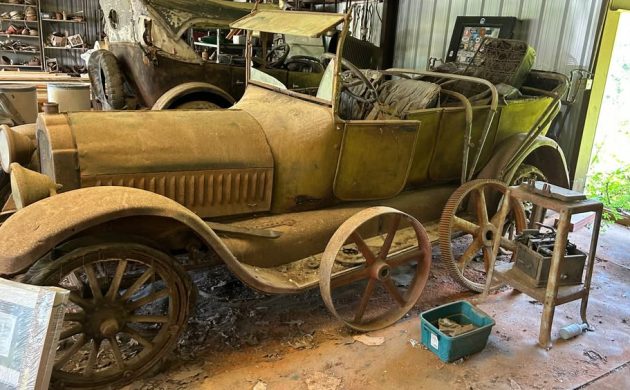
Any automobile, regardless of its condition, deserves a lot of respect for avoiding the scrap heap for more than 100 years. In this case, it’s been nearly 110 years for this 1917 Studebaker Touring Car. These were open-air “horseless carriages” produced by Studebaker Corp. from 1904 to the mid-1920s. This example looks to have been living in a barn for decades and has earned rust and other forms of deterioration to its credit. Located in New Albany, Mississippi, this crusty antique is available here on Facebook Marketplace for $2,500 (trades considered). Thanks for the cool tip, “Zappenduster.”
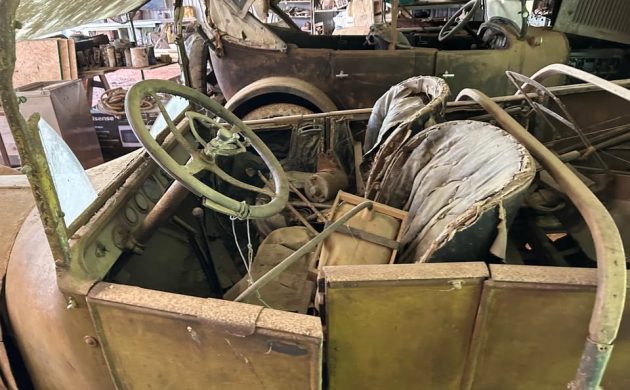
Before closed-body vehicles became popular, open-air cars like the Studebaker Touring Car were the automobiles of choice. Over time, these machines evolved, beginning with 2-cylinder engines and eventually advancing to 6-bangers. 4-cylinder models emerged around 1913, which probably includes the seller’s car because the sixes didn’t catch on until 1918. Cars like the seller’s were 4-door, open convertibles that were good for transporting at least five people (some models could seat seven).
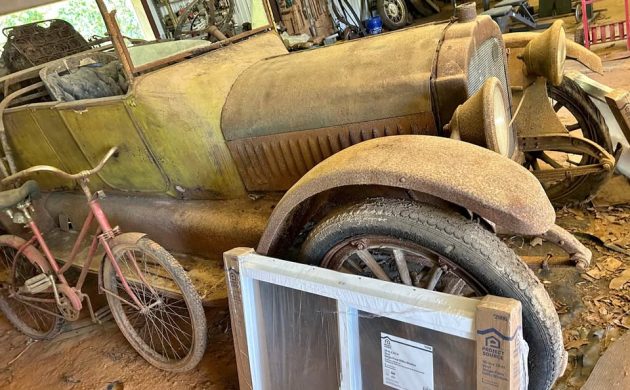
We don’t know which product line this Studebaker is, but someone who’s an early Stude expert may be able to chime in. Assuming the 4-cylinder is intact, it could be 3.9 liters in displacement, putting out about 40 horsepower. 3-speed manual transmissions were the order of the day. We assume there’s black paint on this car somewhere and it may have once had a contrasting fabric top. Features could have included a split windshield, running boards, and a hand crank for the starter (to improve your muscles).
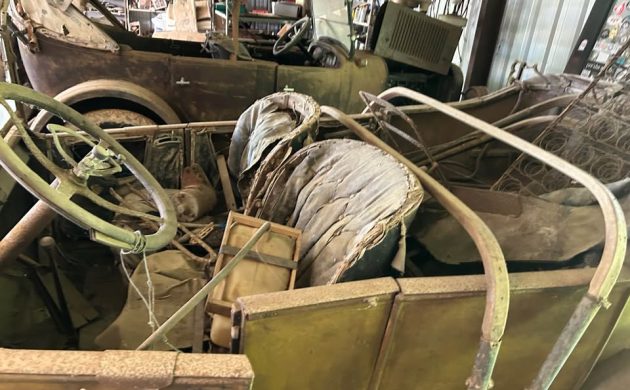
Whether this car gets restored ($$$) or is left in its current state, you have to wonder if the Studebaker museum in South Bend, Indiana would be interested in such an artifact. When this machine was built, Studebaker was still a relatively young company and had another 49 years to go before the enterprise would run out of gas for good.

I feel I always lead these off because nobody else does. Cars of this type have very few followers today. I’m just as guilty, as these predate anything I’m used to, so it’s all relative, I suppose. I think back to what 1917 must have been like. Lucas McCain was probably in a nut house and Mark “out East” somewhere, but not far from horse and buggy. In fact, these shared the road with horses, and many times to the riders dismay. More than one of these had holes in the radiator. Studebakers were high class automobiles. Research shows, I think this was the ED6,(?)7 passenger and was top of the line costing a whopping $1095 new or 3 times the cost of a Model T. The up side, it’s all there,,,the downside,,,well, I think the museum is a good choice, maybe if donated. Sad to see such a magnificent car, and for 1917 it was, in such condition. Maybe,,,it was a casualty of WW1, April 6, 1917. Bought a new Studebaker and didn’t come back.
If I had the room Howard…….
Looks like it’s all there and not all beat up, how much work can you and are you willing to do to bring it back to life? Seller should be happy with a grand to see it go to a good home.
To restore this you’d have to be a blacksmith and forge your own parts. Are those wooden spoke wheels? Not much interest in one of these anymore except to ride in a Fourth of July parade. Like the Stones’ song, time waits for no one. Wow that got dark.
Howard’s post about covers it. This is “all there” so at least the restorer has some good patterns to work with. Also what is the other touring car in the background???? Although there is not much interest in these old vehicles today I hope there is someone willing to take on these projects to help preserve the American contribution to the automotive history.
Is it a model t Ford in the background?
No That’s a 1928 Porter.
A “relatively young company that had been around since the Civil War…
Actually, before the Civil War. Studebaker started making wagons and carriages in 1852. The Civil War definitely helped their pocketbooks at that time, and they were amongst the leaders in carriage building. They were young (but then most manufacturers were) but had been dealing with transportation for several decades. It would be cool to have someone with deep pockets restore it, but that would be a very limited group that have a liking for Studebakers.
If I had the room Howard…….
We have a Studebaker that’s bout 10-12 years older. It is a Surrey, don’t know the model number, but we have her trimmed in a red fringe.
There are a couple of original Brockway buggies which show up at the Brockway truck weekend celebration in Cortland NY each August
Jed Clampett’s Oldsmobile was in better shape. The century has not been kind to this poor relic.
Please don’t identify American antique/classic/vintage car engines by liters.
It appears that the radiator and shell are not Studebaker but the rest of the car is. The radiator looks almost like a Packard but not quite. Also, Studebaker did offer a six cylinder from 1913 on up and the length of the hood looks like a six lies under it. If I were a younger man I would snatch this up in a heartbeat as it would be a fun project.
Days gone by the younger generation has know interest
It’s a wonder this car is still here at all. In deep Southern states like Mississippi, cars like this were either turned into crude trucks or mobile moonshine stills
once their people carrying days were over. And if that wasn’t bad
enough, it very well could’ve been
a victim of the scrap drives that
were prevalent during WW2. But
it wasn’t and it should be preserved for future generations
even though they could give two
hoots in hell about it. Before he
passed away in 2003, my father was half owner of an auto restoration business in Sand Springs, Texas. They would’ve
been all over this one.
Ad shows that it is Pending, so someone likes it enough to buy it.
Goodbye Bugtussle, hello Beverly Hills! Wish I was younger – properly outfitted, I could load that baby up with relatives and hit Route 66.
I think I would install some low-rider bounce to start grannies chair a rockin
I like it!