

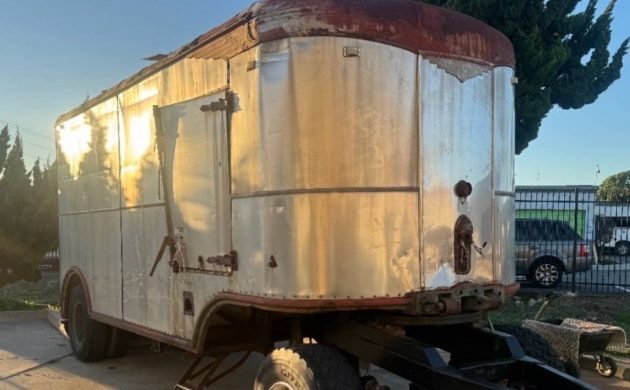
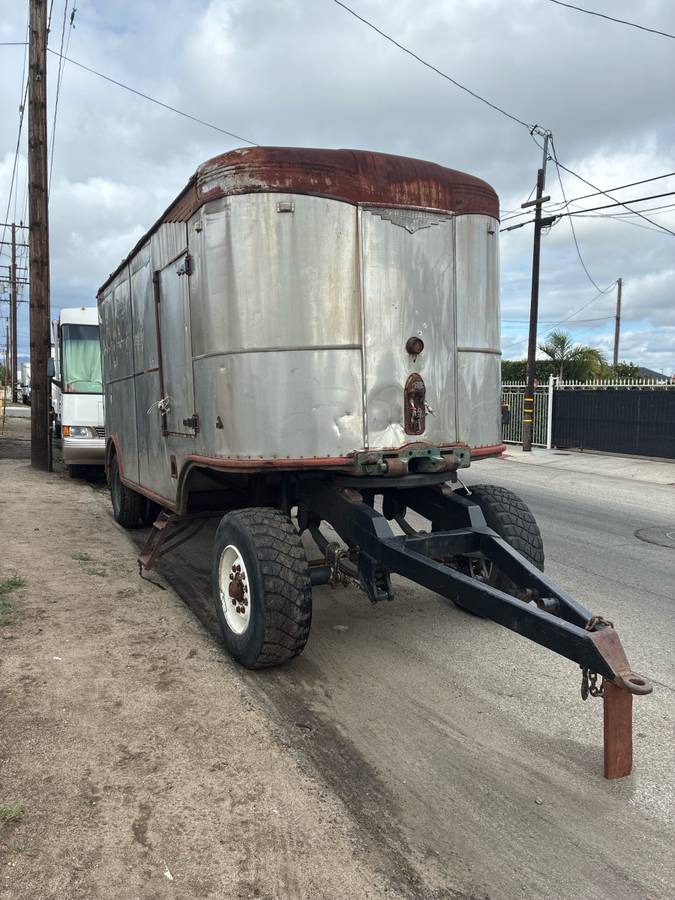
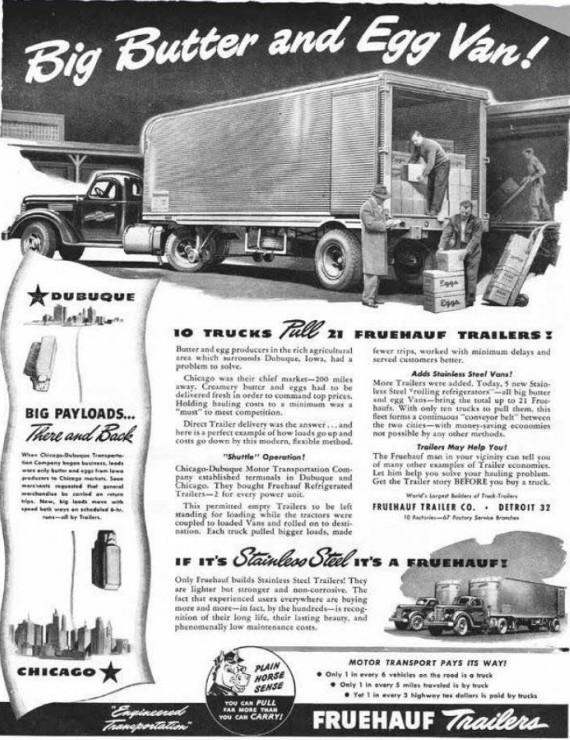
Who better to invent the trailer than a professional blacksmith working in post-buggy Detroit? The story of Fruehauf is a consummate profile of capitalist reinvention: August Fruehauf’s substantial farrier and carriage business came to a sudden stop with the advent of the combustion engine – until 1914, when a customer came knocking with a specific need. Lumber baron Frederic Sibley asked the blacksmith to come up with a way to carry a boat behind his new Model T. Fruehauf and his partners devised the first trailer, customized to embrace that boat securely so it could be towed for miles. So pleased was Sibley that he asked Fruehauf to make several more trailers – this time, designed to haul lumber. Seeing an opportunity, Fruehauf pivoted his business, not only selling his own product, but acting as a dealer for other emerging trailer-makers as well. From the early days of Fruehauf’s history comes this 1938 Aero-Van refrigerated unit, advertised here on craigslist for $10,000. Tow it home from Filmore, California. Thanks to T.J. for spotting this unusual offering!
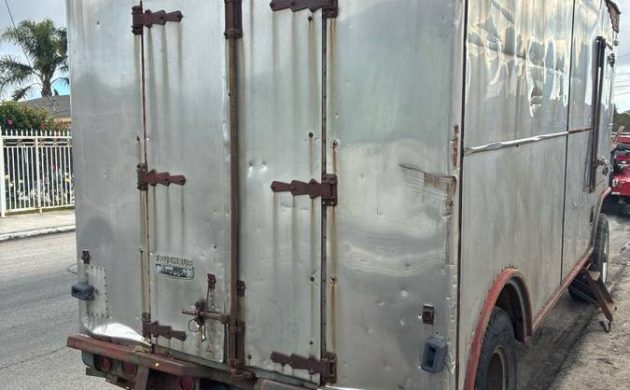
The trailer itself was a blockbuster invention, allowing truck owners to carry far more than their cargo holds would allow. But Fruehauf also patented several other items that made goods transportation what it is today, including the automatic coupler and the hydraulic dumper. The decades-old company eventually succumbed to family infighting, culminating in bankruptcy and a sale to Wabash National in 1996.
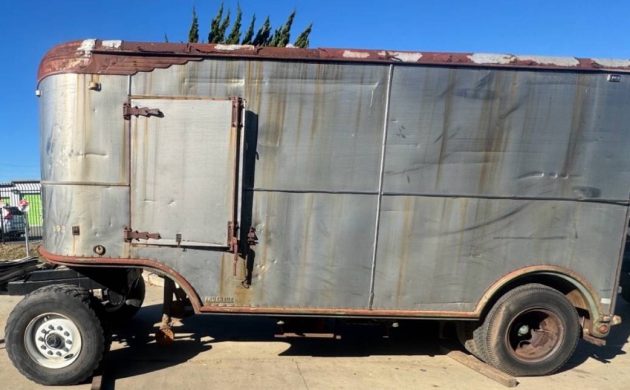
The seller notes this example is 19′ long. The trailer is already set up with a tow dolly, and can be moved with a one-ton truck. The rear tires are flat-spotted, so plan to replace those before becoming too ambitious about rolling up the miles. By constructing the trailer with an aluminum body, Fruehauf ensured that its weight came in considerably below a steel unit, allowing truckers to carry more cargo in an era of increasing load restrictions.
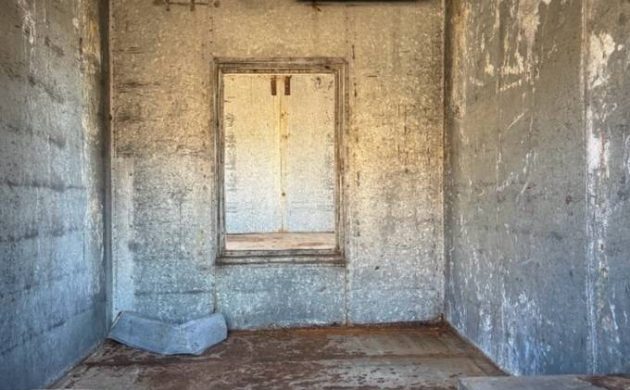
The interior showcases the galvanized lining, the last layer in a sandwich that included insulating material, then the outer aluminum skin. A cavity positioned in the top of the trailer, accessed via a hatch, held ice. These trailers could preserve butter and eggs over miles of transport. The rounded nose helped stabilize the trailer, reducing jackknifing. The seller suggests several uses for this vintage Aero-Van – a tap room, as a companion for your COE truck, a coffee shop. Here’s another ambitious project: these folks made a 53′ refrigerated trailer into a mobile home! How would you use this classic Fruehauf?

Fruehauf changed the world again in1956, when he patented the shipping container, probably the biggest single factor that propelled the rise of global commerce.
That is actually not completely true. Malcolm McLean, a trucker, invented the shipping container and received patent #2,853,968 for his invention in 1956. He was able to complete the design with the help of a Fruehauf engineer, Keith Tantlinger, and the partnership between McLean and Fruehauf took on the manufacturing duties.
https://www.invent.org/inductees/malcom-mclean
What Fruehauf holds are the patents for Tantlinger’s devices including locks, drawbars and other items that enable container stacking and moving. The patent for the container itself was released for industry use to expand the market.
Hmm, I’m impressed. It should be noted that McLean sold out to Sea-Land, which became CSX. McLean was a big promoter of piggyback rail service, where the trailers were backed onto railroad flat cars, but the container won out.
When I pulled RR trailers, there were both vans and containers, but the van trailers were phased out as you could stack 2 containers instead of one van trailer. Then to find a decent chassis,,,oy,,
Thanks for the history lesson, Michelle! I’m glad that he saw the profits of his enginuity! I feel smarter today than yesterday now!
It’s cool, but I think money-wise, I’d rather get a vintage trailer that always has been a camper. There are some beauties on the Vintage Camper Trailers website, even if you had to restore them, it would be cheaper than converting a cargo trailer.
It would have to be trailered to its new location as it’s not DOT compliant. Citation waiting to happen.
Would you need the doubles endorsement to pull two trailers?
I can see this now at the shows pulled by a White 3000. Used to be a Fruehauf plant outside Harrisburg Pa.
This is some find!!! True story, a couple days ago I saw a fully restored B Model Mack pulling a trailer near Easton PA. On route 22. This Pup trailer ( restored ) would be perfect behind it. I never knew Fruehauf trailers started off as a Blacksmith and farrier business. Although I’m not surprised. Great, well researched, write up Michelle, thank you!!!
Weeeeeell, tis’ no reefer in the true sense of the word, it was merely an insulated van trailer for local deliveries. True reefers had a motor, typically a single cylinder 4 stroke that turned a big fan and blew air over a bunker full of ice, hence the term”bunker and blower”. It allowed for longer shipments of items that needed refrigeration. Stopping for ice was a regular thing, but luckily before my time. The 1st actual reefer was made by a man named Fredrick Jones in 1935, which was later sold to Thermo-King, and revolutionized refrigerated transport. They were expensive and ice cooling went well into the 50s, but by the 60s, motorized reefers were the norm.
I never heard the round front was to prevent jackknifing, more of an early aerodynamic thing then, and Mack B model with a concave rear was the only truck that could scale out a round front trailer. This looks to be updated some, many of these trailers had no parking brakes, and some were vacuum, or no brakes at all. I think it would be neat as a display, or behind one of Brockys trucks( is that a Diamond T or a Federal in the last pic?). Trailers led a rough life, most becoming tool sheds out back, reefers especially as the ice water ruined them. It’s a “cool” find, fer sher.
By the way, in all my trucking shenanigans, Fruehauf was by far the most common trailer I pulled, but not the best. That would be a Great Dane.
I’m gonna back ‘er down, swing into the 76 for a 10-100, some motion lotion and some go-go juice, I’ll catch you on the flip side, and I’m a gone,,,
Oh, oh, one more thing,,,these early round nose trailers often had a sleeping compartment in the front. Many a story came about with changing drivers while moving was common.
Howard, Not sure which picture you are thing of?? Probably Diamond T as I have a 49 model 201 pick up and also had a 59 model 921C China Closet cabover. Along with a 71 Brockway358LL straight truck. Thanks for explaining to our non trucker friends the difference between an insulated trailer, a putt putt bunker blower, and a true reefer trailer.
In the CL ad, the last picture, now that I look at it again, is a Diamond T (704?) road tractor pulling one of these.
That truck is definitely a Federal, model 60 ? 1948/9?
Thanks, Peter, it’s the grill, isn’t it? I think they both used the same cabs however.
Hi Howard.
No, Federal had their own sheet metal , front to back. If you type in Federal Truck Images and Diamond T Truck Images on YouTube ,you will see the differences quite clearly. Thank you.
What was the insulating material in these? Balsa wood?
Anyone know?
Wood, which would add strength as well as insulate or fiber board like Beaver Board.
Thanks, Jim. The reason I thought it might have been balsa was because I remember a shipboard fire years ago on a refrigerated cargo ship from the WW2 era. The holds where the storage compartments were constructed were made of balsa for the structurals, with packed asbestos in between more balsa. Balsa was considered as the best option because of the light weight. This trailer was built during the same era. The ship’s name… The Hades. It was a long night. We put it out. A few days later it caught fire again. That shift let it burn. The scrap yard wanted it to burn anyway. All that wood was in their way for the cutting torches to get to the steel.
Cool……