

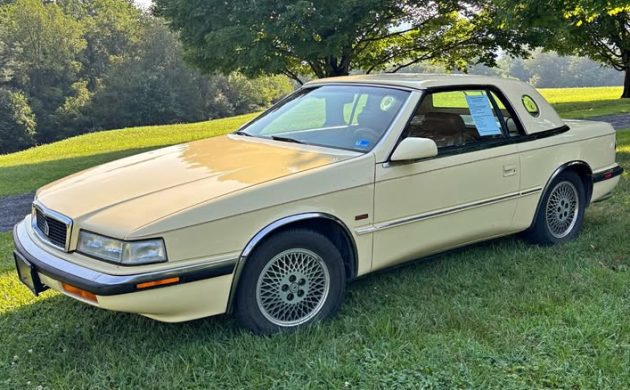
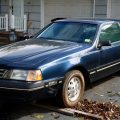
The Chrysler TC by Maserati made many missteps during its fleeting run here in the U.S.A., but perhaps the biggest mistake was not building more copies of the one example that made sense: the 16V, turbocharged edition with a head assembled by racing powerhouse Cosworth. The newfound horsepower and 5-speed manual transmission turned the disappointing TC into a legitimate contender in the narrow market of luxury vehicles that could also provide inspired performance. Find this one-of-500 example listed here on Facebook Marketplace for $10,000.
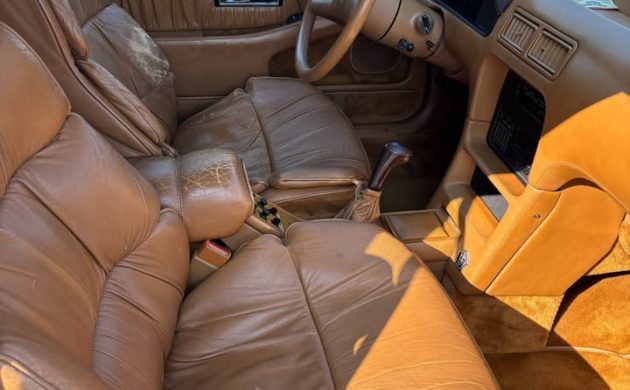
The curious thing about this rare variant of the TC is that it was still a luxury-laden boat of a car around that racy powertrain. Even though the 0-60 time improved dramatically, cutting the run from 10 seconds to the high 6/low 7 second range, it was still a floaty, comfortable convertible. It seems like in the rush to get the car to market, the brain trust behind its conception really spent very little time on actual execution, realizing many of its pitfalls far too late in the process to correct them. The interior of this example presents well, and it’s wild to see a manual gearbox sitting in the center console.
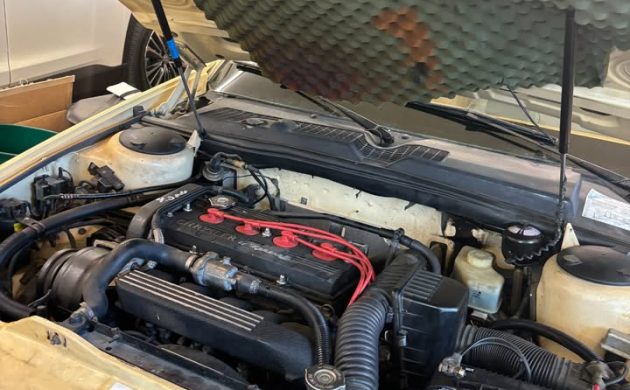
Hiring Cosworth to design the DOHC head with unique pistons was another curveball no one saw coming, and a dose of exotica that is undeniably cool but also makes little to no sense. Legend has it that Chrysler CEO Lee Iacocca and Maserati owner Alejandro de Tomaso were both somewhat enamored with the idea of creating a performance variant out of their ill-fated luxury car, and thus, the plan to engage Cosworth and build the 16V TC was born. I speak from some level of experience owning a Mercedes 190E 2.3-16V Cosworth; finding parts for its specialized head is tedious at best, and I can only imagine it’s even more challenging for an oddball like this.
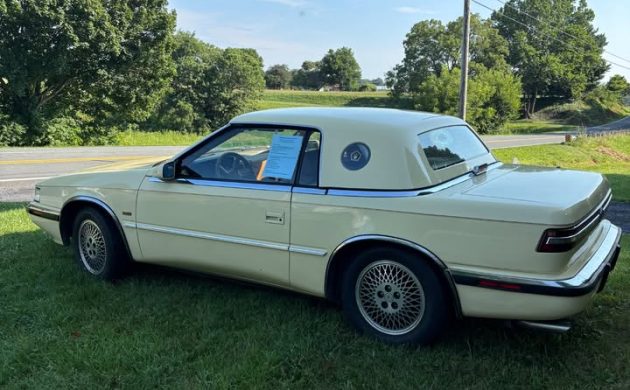
With under 50,000 miles, this TC is like so many others that haven’t seen significant use in their lifetime. The seller mentions it was “garage parked,” which I can’t tell means it was kept all of its life indoors or it was discovered on four flat tires in a forgotten garage (likely both scenarios are true) With 200 horsepower on tap and the punch of a turbocharger jolting its force through the front wheels, this has to be an interesting driver, and one that most observers will write off as a standard TC. Thanks to Barn Finds reader Jack M. for the find.

Minor correction: the 16v head was indeed designed and cast by Cosworth, with cams by Crane, but production heads were actually finished and assembled at Maserati, which was the only thing credibly “Maserati” about these.
Even the bodies were actually stamped and assembled at Innocenti, which De Tomaso also happened to control at the time, tho’ to be fair that’s also where he was having Biturbos built at the time.
All 500 cars with the 16v head got a Getrag 5-speed. The rest got an automatic, in the first year with a standard Mopar 2.2L Turbo II engine, then a Mitsubishi 3.0L V6 after that.
The original plan was for the TC to debut first as a “halo car”, then a couple-few years later the LeBaron coupe and convertible would launch with similar styling to inherit a bit of cachet from the TC at a more affordable price. Instead, development and production delays stalled the TC’s launch until well after the LeBaron, making it seem like an overpriced, tarted-up LeBaron despite sharing no body panels in common.
As usual, a well written and thorough note
Like the Allanté and Ford’s Merkur program , these vehicles were all battered by swings in the value of the dollar in the mid 80s. Cheap to build in 1982 and very expensive to sell in 1988.
This car was simply a bad idea, one that every single person did Chrysler opposed, except Lido
My guess is that the plan was for every one of these cars to have the twin cam motor and expensive Zetrag transmission That is the only way the performance of this car was even remotely credible
The contract with Cosworth required that they purchased 500 of the twin cam heads and that is all they bought. This expensive hardware was probably eliminated to try to cost control costs as the dollar collapse. This reduced the price of the car, but drastically reduced any claim to prestige.
One of the biggest product failures in automotive history, it sold approximately 10% of projections.
Is the foam under the hood from the factory?
That’s a big no.
This is a super interesting car, a unicorn amongst the TC sheep.
An old friend of mine had one of these in the mid 2000s. He was a
regular at the Taco Bell restaurant I was working at back then and as luck would have it, we went to the same church as well. Well, one Sunday morning,
he passed me a note in church
asking me to make 2 prints for
him– a 31 Willys Knight and a 34
Plymouth coupe. After he passed away, his daughter looked
me up at the restaurant one day.
She told me that he had the prints
framed in elaborate frames and that he enjoyed them very much.
Dunno if his car was a turbo or not, but I recall him always driving it. As complicated as this
car is/was, I wondered just how he kept it on the road as the Chrysler mechanics in Polk county had no real idea how to
service it! RIP John, you are sorely missed.
Aside from the 16v head on 500 TCs in the first year, all the others had standard Mopar 2.2L Turbo II or Mitsubishi 3.0L V6 engines that many other Mopar models used, and the rest of the drivetrain and running gear was standard K-car derived stuff, so Mopar mechanics should have had little trouble servicing them.
Seems well bought at that price. Rare TC rocket, w stick 😎 👍
A lot of wear on the driver seat bolster and center arm rest for 50k miles.
Given how soft supple and luxurious the leather was, I would assume it was predestined to wear prematurely, unlike the plastic coated leather used in many cheap cars.
The finishes on these cars were top-notch. The mechanical bits were not.
Did like these cars, and this engine with the turbo and 5spd was the best way to go. Not too crazy about that egg crate foam replacement pad.
Would like to know if they can verify the mileage claim. Seems like a bit more interior wear than expected.
The big problem was the braking system which had a hydraulic booster not vacuum.