

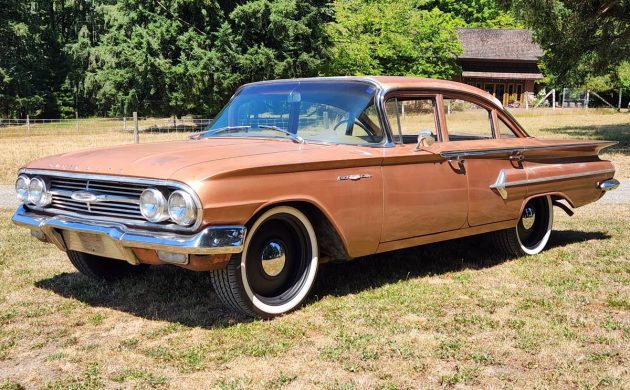
What to make of a 1960 Chevrolet Bel Air? There was a lot of swervin’ going on at GM’s entry-level division in the late fifties. From the iconic ’57 to the Cadillacesque ’58 and then to the outrageous batwing ’59, it was enough to keep everyone guessing what would come next. Well, on deck was the ’60, such as this Bel Air four-door sedan. It’s a tamped-down redo of the ’59 – hardly a radical rewrite, more of a refinement. This example, which hails from Renton, Washington, has been treated to an unusual modification – more on that to follow. Curvette gets the nod for this four-door find, and it’s listed here on craigslist for $12,000, OBO.
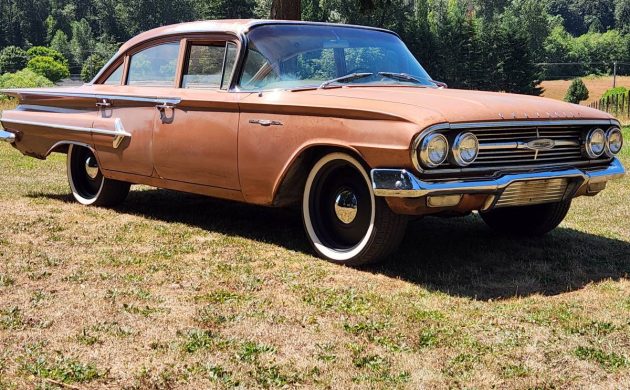
I would imagine the ’60 Chevrolet cost a lot less to design than what occurred between ’57 and ’58, and ’58 to ’59; a positive for the design department’s budget, I suppose, but it’s the result that matters. My initial assumption was that the ’60 full-size Chevy would have outsold the ’59 for the very reason I suggested – a less ostentatious visual bearing, but nope. The ’59’s volume of 1,481K units outpaced the ’60’s by 77K units. OK, it’s only 5.2%, but I assumed, incorrectly, it would have been a greater divide. As for this 1960 Bel Air sedan, it’s one of 497K four-door sedans assembled by the Bowtie in ’60. Unfortunately, I couldn’t find a breakdown among the three trim levels (Impala, Bel Air, and Biscayne).
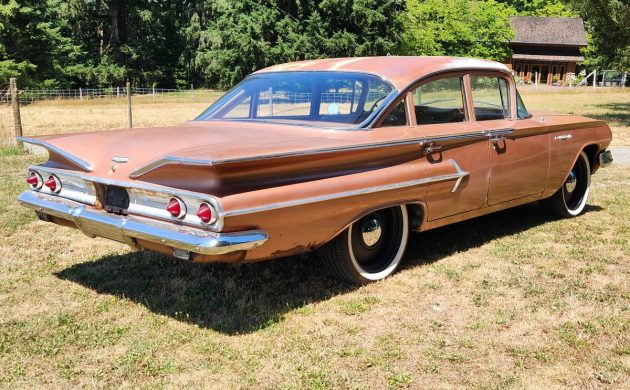
As for our Bel Air, its Suntan Copper finish is pretty worn, with rust bleed-through most evident across its curved sedan roofline (as opposed to the distinctive flat top that adorned the hardtop body style). All of the Bel Air-specific trim is still where it belongs, and the chrome bits are pretty fair. Body-wise, rust can be observed on the lower passenger-side quarter panels, and there’s a horizontal crease on the lower portion of the driver’s-side quarter panel. All in all, this Bel Air is still in reasonable condition considering it’s old enough to qualify for Medicare. The elephant in the room, however, is the 20″ steelies adorned with Moon-style center caps. No, this old Chevy doesn’t present gangbanger swagger; it’s just odd-looking with such tall, plain hoops. Oh, I almost forgot, the seller will take $2,000 less for this rig if the big rollers are removed and replaced with the original fourteen-inchers.
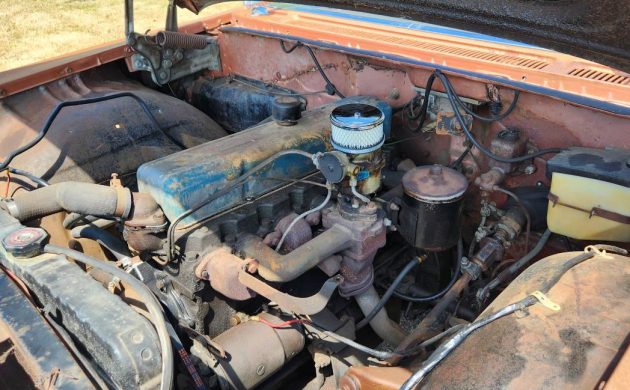
A further surprise is what’s occupying the engine room. I was expecting at least an entry-level V8, but nope, this baby’s sportin’ a 135 gross HP 235 CI, in-line six-cylinder powerplant. We’re told it “runs, drives, stops.” With 137K miles on its clock, performing the minimum may be the best this old Bel Air will do. And for you purists, the seller states that he has the original air cleaner assembly. There’s no Powerglide or Turboglide automatic gearbox here; a three-speed manual transmission, shifted courtesy of a three-on-the-tree shifter, is what you’ll encounter.
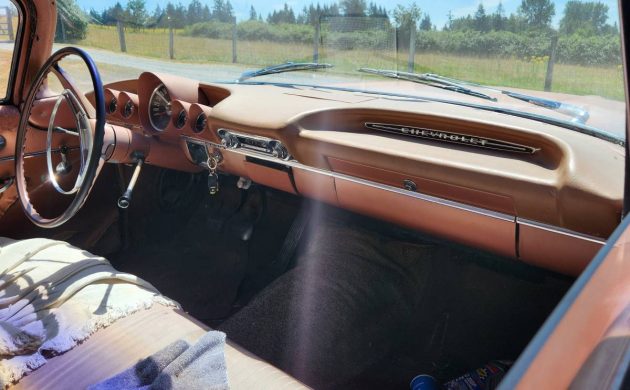
The interior is not well photographed, but I imagine that the driver’s side of the bench seat has a problem owing to what looks like a towel positioned on top of the bottom rest. Also noted is what appears to be a padded dash – an option in ’60. Generally, these Chevies came equipped with an expansive stretch of color-matched steel serving as a dashboard. One advantage to that arrangement was not having to worry about a cracked pad. The disadvantage? Well, all steel construction and no seatbelts…you get the picture.
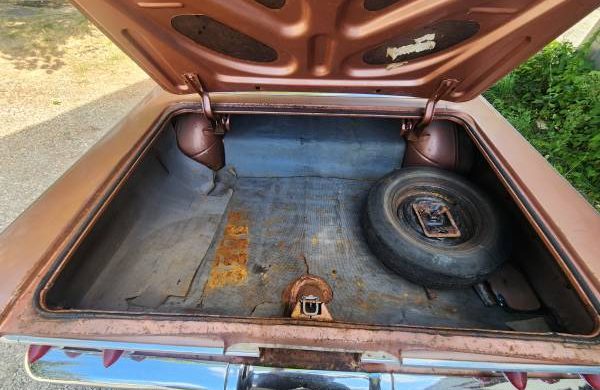
So let’s recount here: four doors, a six-cylinder engine that is likely quite tired, and incongruous 20″ urban rollers. What would be the market for this Bel Air? Search me, fish; anyone have an idea?

Hahahaha Hahahaha Hahahaha
Runs, drives and stops? How well? 2 grand is my best offer!
Even at 10k minus the clown shoes, still a stretch.
Ha! That’s a $3000 car at best! The wheels and tire are a joke………….. I’ll pass
Save the big wheels for a stage coach restomod. They look ridiculous on cars like this.
I initially couldn’t figure out what was wrong with the wheels, then read the article after looking at the first pic – those wheels on this car look HIDEOUS! The standard 14″ wheels were a bit puny, but they went up too far in size. I can only imagine how far off the speedometer is with these “clown shoes” on! As for the dashboard, I never knew that a padded dash was an option on Chevrolets in 1960 (my mom had a ’60 Impala sedan, and my dad had a ’59 Bel-Air sedan, and neither one had that feature). It does lower the risk of concussions, but not by much. My dislike for the lower models (Biscayne and Bel-Air) on the interior was the door handles – they weren’t nice like the Impalas and made the car a bit plain (which they were!). It appears to be decent for its age, but I’m more of an Impala guy!
Tim Mack- Well, you probably know the method of correcting the speedo, after changing tire size, is by installing a different drive gear where the speedo cable enters the tranny. Haven’t kept up with what’s available now, however.
Yeah, I don’t like the wheels either. Look at all that rust! Oh wait, just a little behind the rear tires. A MAN can fix in that metal without a break or shear. The rest is surface rust. Some touch up paint and Bob’s your uncle. S#1+ can the 6 with a 283 that are all over the place, and add a 4 or 5-6 speed overdrive MANual tranny, A new Ciadella interior would be nice. Marc. $10K tops to buy it.
Love to own it (again), This was my first car and is correct down to the six cylinder, three on the tree and s…t brown color. Now if I only had the girl who was in the back seat with me…
Mine was a Biscayne 2 door sedan. I don’t have it anymore but I do still have the girl Been married 55 years now.
Someone had enough cash for the big wheels and tires, but not enough for the lowering kit to make it look halfway decent. I would pay the seller $2K more to have him keep the 20s.
Straight 6 and 3 the tree probably means unassisted steering too. I can’t imagine how heavy it is to park on those meats.
Finaly someone who gets the proportions carsize-wheelsize right – I like it!r
A metal dash is safer than padded. The blow from banging your head on metal, which gives way a little, is less lethal than the rebound from the padded.
Robert- … but…they pad the cells in some of the rooms of mental institutions…because the patients bang their heads on the walls.
Nothing turns me off like those ugly wheels. The cars of those days do not deserve wheels larger than 18″ at the maximum. Seeing a nice older car all painted up and sounding nice then look at somebody’s idea of nice wheels and see those wagon wheels makes me ill.
But that is just me.
I’d offer $1000, the same I paid for my 1st Belair, a near-copy of this one. But mine at least was a 283 with the Powerglide tranny. Drove it into the ground as a disrespectful teenager.
I upgraded to a ’65 squareback Vdub about a year later.
With the original wheels it’s a 5k car to me which is way off what he wants for it
looks decent but those wheels will not sell this car. i think the 12k is way off the mark.
When I saw the tire/wheel combo the first thing that came to mind was
“…….we know we can’t pull it, but if we could find a way to push it up to 88 miles per hour…”
Dr. Emmett Brown