

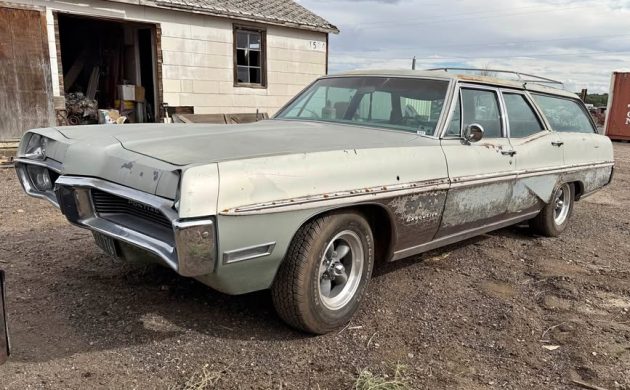
Boy, does this 1967 Pontiac Executive station wagon take me back! A wagon like this was a part of my high school years, having belonged to a close friend. It always seemed to be at the center of some hijinks, and it had a nom de guerre that would be completely inappropriate in polite society today (you know those high school boys…). Anyway, I haven’t thought about that car until I spied today’s submission, courtesy of Zappenduster. I’m going to take a trip down memory lane and review this old wagon, so please come along. Pueblo, Colorado, is where you’ll find this mag-wheeled wagon, and it’s available here on Facebook Marketplace for $6,950.
Being slathered in faux cellulose and riding on a 124-inch wheelbase makes this wagon an Executive, whereas the de-treed version was known as the Catalina and had a three-inch shorter stretch. I mention this because my friend Frank’s family had both, and they were both finished in the same Coronado Gold Poly. I used to think I was seeing things; one day the Executive was roaming the school parking lot, and the next day it was the Catalina. Anyway, in between those two models was the Bonneville, a non-wood-trimmed six-passenger model but utilizing the same 124″ wheelbase as the Executive. Pontiac had a bang-up year in ’68, coming in third in the great domestic automobile production race with 911,000 units and trailing number two Ford (1,753,000) and number one Chevrolet (2,138,000). Poncho’s wagons, in total, sold well, but the Executive edition moved the fewest, with a total of 12,000, and just 6,200 six-passenger versions such as our subject car.
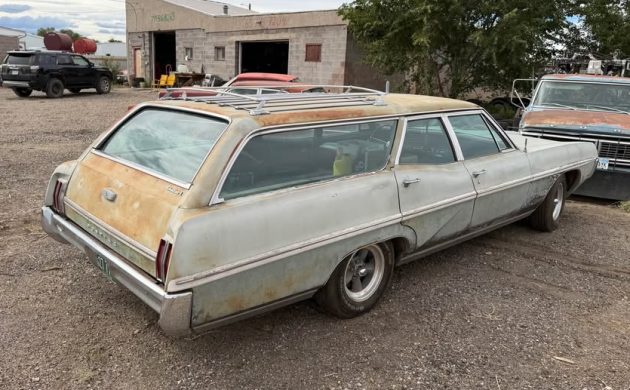
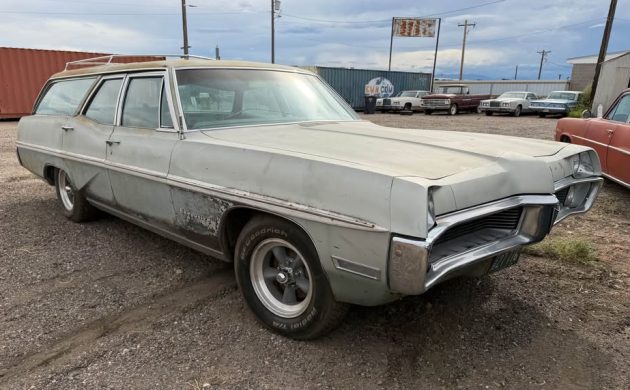
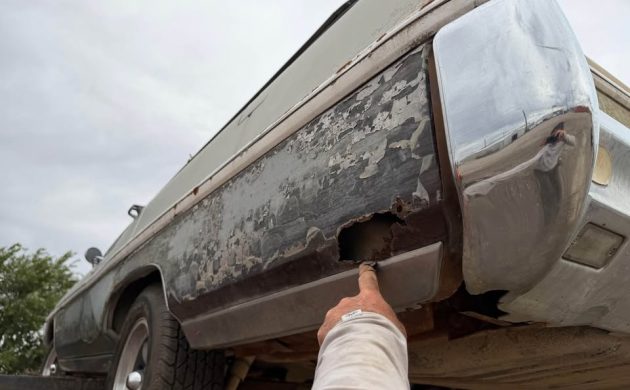
The seller claims this is a California car, and it is still wearing its CARB-mandated A.I.R. pump. The underside is rust-free and dry, while the topside has been blasted by years in the hot western sun. The dinoc wood appliqués have been reduced to less than sawdust, but the body is pretty sound, minus one rust hole in the driver’s-side quarter panel. The American Racing Torque-Thrust wheels are a curious addition; I wonder how long they’ve been holding up this car’s four corners.
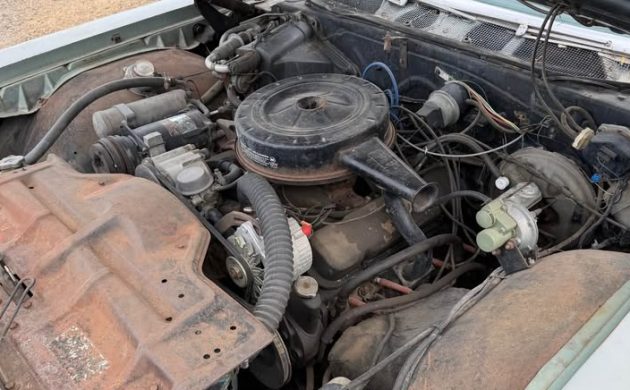
Power is provided by a 265 or a 290 gross HP 400, CI V8 engine, and the seller adds, “Runs and drives but needs maintenance to drive far. I’ll be working on rear brakes soon if it does not sell fast, as that’s the biggest issue currently. Needs exhaust too.” The underside image reveals that a Turbo-Hydramatic 400, three-speed automatic transmission is on the job.
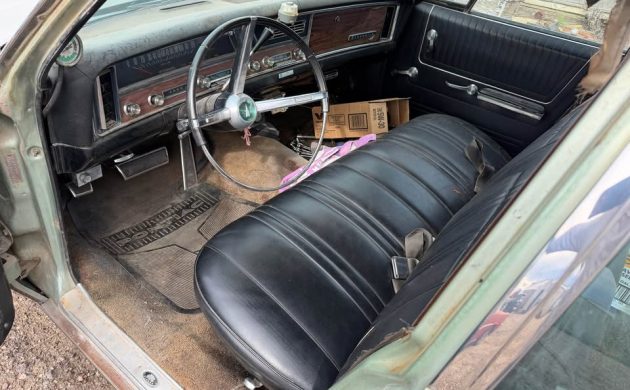
The interior actually looks better than I would have imagined. The “Morrokide” black vinyl upholstery is still holding up, and the dashpad appears to be unblemished. The carpet is shot, but that’s to be expected. The wayback has the usual scratches and contusions that one would expect from a station wagon that has been used for its intended purpose – to haul stuff. This is an A/C equipped car, but its operational capability is not disclosed.
Frank’s Executive looked a bit better than this in ’72, but it was a car that had seen a lot of hard use. He was the oldest of a brood of eight, so this wagon and the near-twin Catalina saw a lot of kiddie shuffling around over the years. The thing I remember most about Frank’s Executive was the perpetual dirt film that engulfed the car, both inside and out. His family lived in what can only be described as a beautiful colonial-style brick mansion on thirteen acres of land in a rural area, so the cars took the brunt of all that back and forth over a long unpaved driveway and longer trips on barely paved single or two-lane country roads. The car was a sight! To enhance the visuals, there was always something obvious hanging from the underside. By the time senior prom rolled around, the car was pretty shaky-looking, you know, one of those kinds of situations where maybe you didn’t want to sit inside. There was even a suspicious-looking chunk missing from the top of the front seat backrest; Frank claimed his eight-year-old brother had gnawed it off. Anyway, the before-prom meal was a pizza consumed on the fly by the six occupants of the Executive, and when Frank’s date said she accidentally dropped her slice on the floor just at the moment he was stuffing one down his gullet, he quickly wiped his mouth on his rented tux’s sleeve and said, “Don’t worry about it, a rat will get it.” About a year later, Frank, his brother, and I pulled the 400 CI engine, using a tree limb as a hoist, and then rebuilt the engine with a hotter cam. It never seemed to work right after that, but that’s what happens when you let eighteen-year-olds who know enough to be dangerous, but no more than that, tackle a project of some complexity.
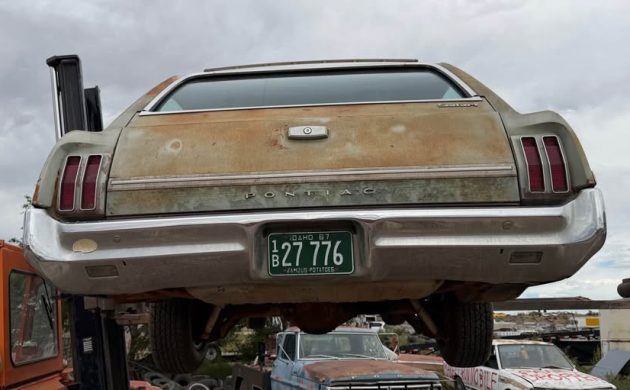
Yes, old station wagons are a hot collectible property right now, and Pontiacs of this era don’t make the scene too often, despite having been produced in healthy volumes (54K in total in ’67). This one has possibilities, but the aesthetics, with that ruined fake wood, will require a lot of work to make it presentable. I’m thinking that $6,950 might be a bit ambitious; how about you?

The old tree 🌳 limb hoist J.O ⛓️ 😎 👍
I like this wagon. One could carefully remove all the Di-Noc woodgrain and repair the sheet metal. Put the Di-Noc back on, or paint the lower in an accent color. The full length stainless body molding has a plastic surround that could be covered in a contrasting light woodgrain, or painted. A friend had ’66 Caprice wagon with similar set up, he painted the surround in a plain brown (Photo Credit: BAT)
One of the strangest front ends I have ever seen.