

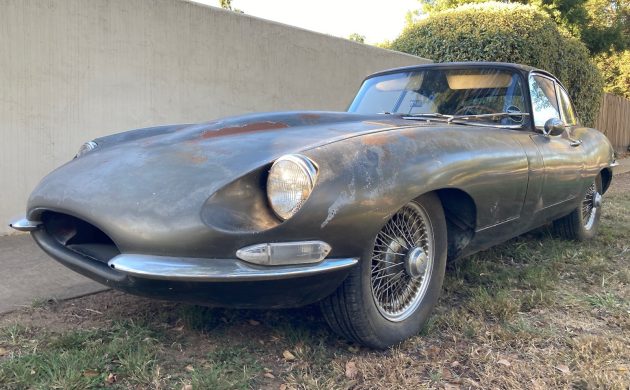
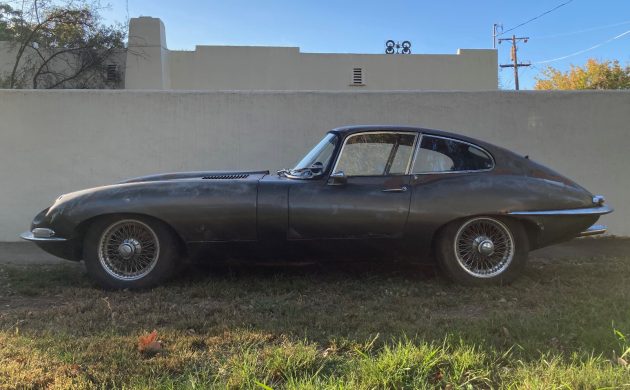
We’re often told that we shouldn’t meet our heroes, because disappointment is often the result. I broke that rule many years ago when I slipped behind the wheel of a Series 1 Jaguar E-Type. I had fallen head over heels with the styling, but feared the driving experience would fall short of my expectations. How wrong I was, because my albeit short period behind the wheel has left an impression that remains crystal clear. This 1968 E-Type has a celebrity ownership history, and is a promising project candidate. It has avoided the worst of the rust issues that often plague these classics, and is numbers-matching. I must say a big thank you to Barn Finder Curvette for spotting one of the most beautiful cars in motoring history listed here on eBay in Merced, California. The seller set their BIN at $45,000 with the option to make an offer.
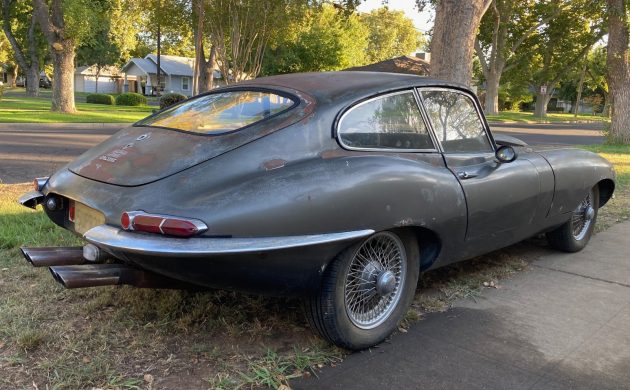
When it was unveiled in 1961, Enzo Ferrari described the E-Type as the most beautiful car ever made. Jaguar released a Series 2 in 1968, with the Series 3 emerging in 1971. Unofficially, the company also built the Series 1.5, which acted as a “bridge” between the first and second series. This 1968 E-Type is one of those vehicles, and it has a celebrity history. It was once the proud possession of the late Rick Anderson, bass player with the band The Tubes. A founding member, he remained with the band until his passing in 2022. Interestingly, he purchased the car in 2006 in its current condition and retained the car during his final years. His widow has decided that it needs a new home. She admits it underwent a color change at some point from its original Opalescent Maroon, but she holds the Heritage Certificate that will allow the buyer to perform a faithful restoration. She confirms that there is new steel in one rocker and rust in the driver’s floor pan. Otherwise, this E-Type has avoided the rust problems that often plague these classics. The trim appears restorable, and the glass is clear.
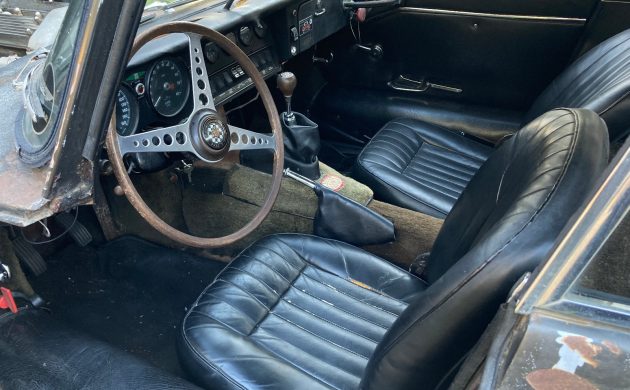
Trimmed in Black leather, this Jaguar’s interior is only missing the factory console. However, the carpet is beyond salvation, the dashpad has succumbed to UV exposure, and the driver’s seat has split in one spot. An upholsterer might be able to repair the seat, but the carpet and pad are both destined for the bin. That raises the question of what the buyer might do. The process outlined would be the most cost-effective approach, but a car of this caliber deserves a pristine interior. Kits for a faithful restoration typically sell for at least $5,500, but the long-term investment potential would justify the outlay.
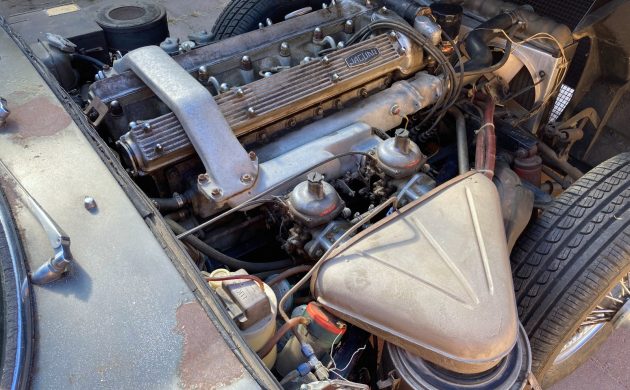
One of the most significant changes to the E-Type with the release of the Series 1.5 hid beneath the hood. Jaguar changed the induction system to meet emission requirements, resulting in lower power and torque. The motor was still the beautiful 4.2-liter DOHC six, but its output in its new form was 246hp, down from the earlier version’s 265hp. Buyers could order a car with a three-speed automatic transmission from 1966, but our featured E-Type boasts the more desirable four-speed manual. The seller states that the Jag runs and drives well, though they believe the brakes should be bled or inspected to perform at their best. Since they have already rebuilt the master cylinder and servo, and replaced the pads, there shouldn’t be any major problems. They have also reconditioned the original radiator, replaced the belts, oil pan, and cam cover gaskets, and rebuilt the fuel pump. It has a few minor needs, but this E-Type is a turnkey proposition.
I typically hold a conservative view of classics with a history of celebrity ownership. Unless the person is inextricably linked with the car, such as Burt Reynolds and a Starlight Black Pontiac Trans Am, I question whether it adds to the car’s value. That isn’t belittling the late Rick Anderson, because anyone who remains an active member of a rock band for thirty years deserves our respect. I simply don’t believe that history increases the car’s value, although it is an interesting talking point. However, with values steadily rising over the years, the E-Type is a sound long-term investment. The seller’s price seems slightly optimistic, but if someone can negotiate a lower figure, they will become the proud owner of an appreciating asset providing an unforgettable motoring experience. That sounds like a winning combination to me.

I don’t see E-type values steadily rising. Rather see them declining a bit over the last ten years. Nice project, but search carefully and you will find a good example for around 60-70K.
That isn’t what I have seen at all. Values rose steadily for the last 5 years or so until about 9 months ago. Now they are falling like a rock.
Still looks good for a driver – how much for a good brake job ?
Values are simply ALL OVER THE PLACE. Last year a major on-line article supported what you said about values declining…and suddenly Hemmings had a big article saying that E Type values were on the way up. What I am noticing is that condition and what type of condition are what it is all about. There is restored that looks very nice and checks out as nice (could even have been done by one talented individual), but there is also “retestored” by a restoration shop with lots of gravitas…that can result in a BIG increase in worth. Then you have E Types restored by Jaguar’s own classic restoration shop, which can easily set you back half a million. Furthermore, you also have something fast disappearing that also makes E Types extremely valuable…and that is the rare, provable low-mileage original that runs nicely and looks very presentable. Those too are going for a premium, as the decades continue to roll further and further away from the 1960s. Things have become so splintered that each car needs careful evaluation on its own individual merits. The days of generalising about values are gone. Given that E Types are considered by most–but not ALL people–as the best-looking car in history, adds an emotional dimension that means that while prices can go down a bit, at times,, they will never be low and the general trend will always be in the king’s ransom category for truly nice ones.
I was looking for the duke in Brannigan is a 1975 UK action thriller film with the Jaguar scene…
Oh well.. i will “talk to you later 🎶”. The Tubes ..
I prefer Jaguar Verts.. 😉
Even in this condition- “She’s A Beauty”
Beat me to it!
I see what ya did there! ; )
Maybe Rick Anderson the Periodontist?
Yes, this is a 1.5. On the S1 & S2, the automatic was available only with the LWB 2+2 body. The “transitional” S1 cars built in 1967 happened in two phases: (1) the 1.25, the main marker the loss of the headlight covers and (2) the 1.5 that got rocker switches and twin Zenith-Stromberg carbs. The 1.25 & 1.5 designations were never used by the factory and were created by JCNA (Jaguar Clubs of North America). It’s not difficult to make a 1.25 visually indistinguishable from a “pure” S1 and to do the same to a 1.5 is a matter just of more parts, time and money, the ethics of both ventures being transparency; once modifications are disclosed to a potential purchaser, it’s up to them to decide if originality is critical; the JCNA’s originality police will not be fooled. I do remember “Don’t touch me there” and an association with a lyric like “the smell of burning leather” deserves to add a few $$ to the car’s value.
WPOD!
..and I was going to check the car for rust, but it said “Don’t Touch Me There”…
sorry…
Broderick Crawfords cruiser, Tod and Buzz’s blue corvette, Andy’s cruiser, Barney’s Police bike, Daisy’s Jeep, Boss Hoggs Caddy, Bo and Luke’s Charger, Burt Reynolds Trans Am, Jerry Reeds Kenworth, the Saints Volvo, Maxwell Smarts Sunbeam Tiger, those are celebrity cars, maybe John Boys Model A? Is that a stretch?
$35K, Maybe. I would paint it the maroon it came in. Straight six and 4 speed is the best. Fix the rust a MAN could do easily, New interior kit and Bob’s your uncle. Marc.
It will take a lot to return it to a presentable running form, but it’s a solid example. Personally I cannot understand changing it from the more desirable Opalescent Maroon. And, originality be damned, I’d be putting triple SU’s on it, and let that big 6 roar.
Yeah, I know color is a very subjective matter of taste, but sometimes you see color changes that just make you wonder what the heck somebody was thinking. This would be one of them.
Just a few degrees of separation: I saw Rick Anderson performing, seeing the Tubes in SanFran in the `1975 at Bimbo’s and met another band member/dancer long after that. But, that is not quite enough motivation to try and pick this one up even though there is an active British Motoring Club locally.
I like this car very much, although it is out of my price range for what it needs, if there is any significant drop in the price please let me know. Thank you
We’ll be sure and do that, Gary.
WPOD!
Where’d you get it? You gave it to us!
Beautiful car that’s a tad bit overpriced. I would recover the driver’s seat, replace the dash pad and carpet, and find the correct console, then have it painted in the original Opalescent Maroon, which is a great color. I love the E-Type ~ always have. But a history of celebrity ownership means very little to me.
Look carefully at the picture of the engine. Despite what your eyes tell you, those two Zenith-Strombergs are actually DOING THE JOB OF THE 3 SUs! How can that be? Remember, the SU carb was patented OVER A CENTURY AGO in 1922. While SUs are simple to work on, they are also very primitive, unlike the similar-looking ZSs. So HOW can three two-inch SUs be no better than two 1.75 inch carbs? Here is why: A) The Zenith-Strombergs atomise the fuel into a finer emulsion. B) The Z-Ss are thermostatic. This means that there are valves that are temperature-sensitive. When the motor gets hot on a sunny summer day, the calibrated temperature valves open up to allow the right amount of oxygen to enter, therefore negating the need for the three bigger carbs. However, there is still one more factor at play. The ’68 and upwards North American E Types have more powerful distributors than the Series 1, which zap the emulsion in the hemispherical combustion chambers more aggressively, to create more powerful detonations. Don’t forget that the emulsion is already finer to begin with…so the combination of the three factors working together is what creates the same power, albeit while giving better fuel consumption (5-7%) but not LOOKING quite as sporting. So how come power was down from 365 to 246 ponies? Because of that crossover pipe you see in the picture. It takes hot exhaust fumes from the rear manifold only and carries them over to the intake manifold, where it HEATS the mixture entering the motor…which is good for meeting lower emissions but lousy for performance. To have an unrestricted ’68 or 69 E Type, all one really needs to do is remove the pipe, if your local rules allow it. By 1970 the anti-pollution strangling of the XK six started to increase by leaps and bounds and the last ’71s were down considerably in the ponies department, to an estimated 210-215 at the crank. Yes, Zenith-Strombergs are highly misunderstood carbs. If you drive a Canadian ’69 which has them but no crossover pipe, it is not possible to tell any difference in power over the three SUs. By the way, the ’68 Canadian 1.5 E Types had the triple SUs, except for cars sold in Ontario, which were identical to the American specification cars.
ERRATA: I meant to say 265 horsepower, not 365.