

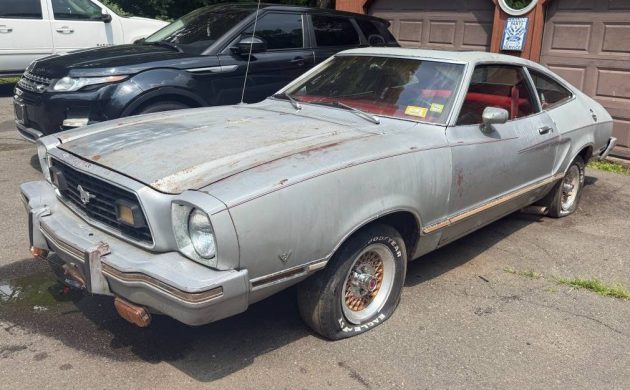
By 1973, the Ford Mustang had become big and bloated, and its sales numbers reflected the buying public’s disappointment. So, the car was reinvented in 1974, losing 20 inches and at least 500 lbs., as it was now a subcompact billed as the Mustang II. The changes were well-timed with the OPEC oil embargo that resulted in fuel shortages and rising prices that played into the Mustang’s hands. The seller’s 1978 edition is a fastback that may be an ordinary Mustang with a Cobra engine installed later. Though it runs, it needs restoring, and can be found in Waterbury, Connecticut, and is available here on craigslist for $5,500. A nod to Barn Find Barney for the tip!
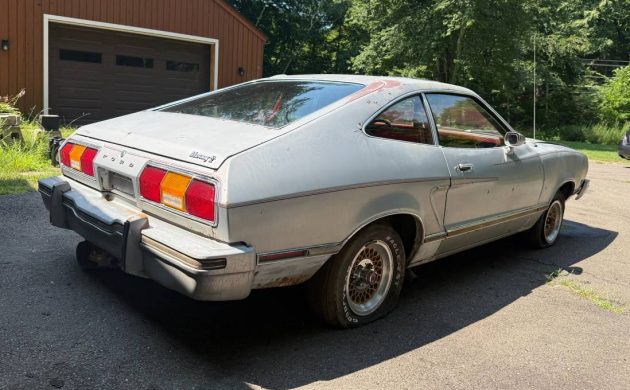
The Mustang II enjoyed a five-year run, replaced in 1979 with the Foxbody design that would carry the car into the 1990s. Because it was a subcompact, a 4-cylinder engine was standard, with an optional V6 as the only other choice in 1974. In 1975, the 302 cubic inch V8 could be had with the Mustang, and versions would be found in the Cobra II and the 1978 King Cobra. The seller’s time-worn car doesn’t appear to be either one, so we assume it was a regular I-4 or V6 with a Cobra engine added later.
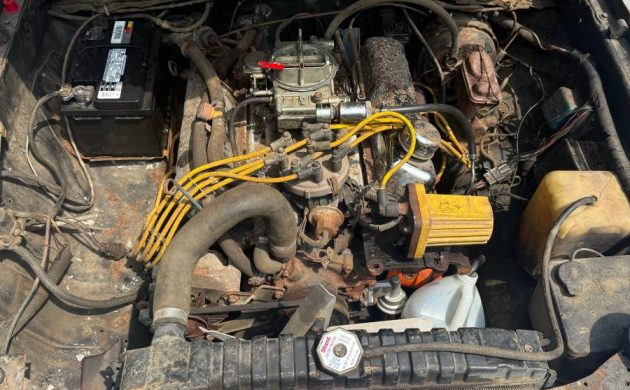
The Cobra II 302 V8 wasn’t exactly a barnstormer with 134 hp rated SAE net. But it may have put the smaller Mustang II on similar footing with a 1965 Mustang, which was a 289 2-barrel. According to the seller, this Ford was in hiding in a barn for 20 years. It has recently been extracted and made to at least start up. We’re not told what that required or how much more is needed. The 302 is paired with an automatic transmission, and the odometer reads 99,000 miles.
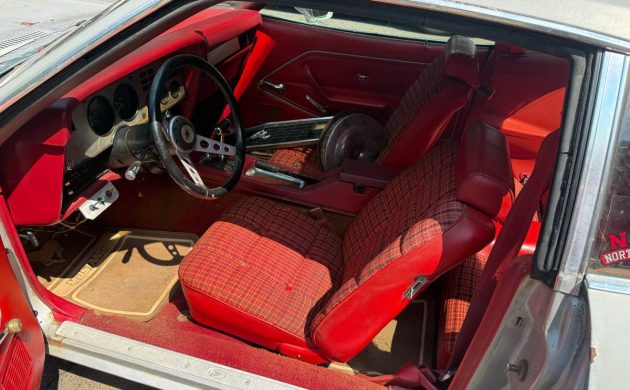
From the outside, the body and silver paint are a little rough, and we assume that part is worth saving. The red interior is surprisingly nice considering it may not have seen daylight since the early part of the century. Assuming a non-Cobra Mustang II with a Cobra V8 is worth restoring, would you invest the time and money?

Russ, the 5.0 was available across all model lines in 1978. So coupled with the V8 badge on the front fender, I’d say this is a regular 2+2 fastback with a factory 5.0. Of course, it could be on its second engine.
I’m not surprised the paint is gone. The silvers and light blues of this era were particularly frail. That red interior is quite flashy.
Pretty rough, but perhaps someone will find it worth improving.
In the day, none of us wanted these. Time passes and the pedestrian Pontiac station wagon you posted the other day starts looking attractive. There’s something special about the pedestrian, boring cars we grew up in. Yes I’d buy one today, but would much rather have that station wagon.
In the day, literally a million people wanted them. That’s how many sold.
The Mustang went from “big and bloated” in 1973 to small and bloated in 1974. It looks like a water-logged Pinto and its taillights are way too big for a car this size. These cars were ugly when new and have not improved with age.
Only the King Cobra included the V8 as standard. The Cobra II could be had with any Mustang II engine, including the base 4-cylinder.
Weren’t these built on the Pinto platform? Yikes.
That often comes up in a discussion of the Mustang II. Technically, the answer is “no.” We could get into a detailed discussion why that is the generally accepted answer, but suffice to say it is not correct to use that term in the same context as (for example) saying the original Mustang was based on the Falcon platform..
👍
This, as noted previously, is in no way shape or form a Cobra. Just a V8 2+2 StenchStang of the “I can’t believe they built that” era. Sorry, not sorry! My Mom got one of the V6 “Ghia’s” back in the day. Utter piece of crap. Build quality was horrible, spent more time at the ford dealer than at home…….not a fan of these in any flavor!
Our new, 1974 V-6 2+2 went through 4 drivers in our family, and besides the crap Firestone radials that were on the car, with the belts slipping inside the tires? We had one(1) mechanical problem with the car, in 160,000 hard miles.
solid 2k car. cobra or not it needs a lot of work.
IIRC, all of the 302 V8’s of this era were two-barrel intakes only. So, step one is to upgrade the intake so the engine breathes better. I’d go with a port fuel injection kit, simply because the kit includes the new intake manifold and throttle body, along with a new distributor for the electronic ignition that integrates with the engine control computer. When you add up the cost of a new intake manifold, TBI setup and new distributor separately, the total cost is probably pretty close to the cost of the port injection setup. The port injection will also improve the drivability over any anti-smog legal carburetor for 1975, along with improving emissions to boot! Headers to lower exhaust back pressure and dual exhausts will work wonders. A final touch would be to do some work on the cylinder heads, to restore the lost compression the EPA took away.
Other work on the fuel system will be necessary anyway, given how long the car has been sitting, so a new fuel tank, with new fuel lines and an electric fuel pump will be part of the deal in any case. Adding a return line for the fuel injection would be easy as part of the fuel system upgrades.
The Good: The body looks relatively rust free, it starts, interior looks good. The Bad: Paint, tires, brakes and fuel system after a twenty year sleep. The Ugly: The pile of crap sitting in the passenger seat. The Verdict: A good restoration candidate if you are close by, but the shipping costs for any distance make it much less attractive for those of us on the East Coast. Some more and better pictures would be nice, including pictures of the underside. Oh and removing the junk and vacuuming the inside would be nice, LOL! GLWTS in any case.
Robert- The ZIEBART sticker offers some encouragement.
Travesty.
I like the Mustang II! There. I’ve said it. Yes, this one is rough, but it can be saved, and it should be. The V8 helps, even though it isn’t stock. This one was swapped in, the four-barrel intake and Duraspark distributor are dead giveaways. What’s up with that Clorox bleach jug in the engine compartment, though?
Robert- temporary fuel tank.
This is a potential victim for the hook
What makes you say it’s a Cobra II ??
What are all those things “Mister Gadget ” has added under dash on drivers side ? Rear flammenwolfer , smoke dispenser, tack dropping device etc, etc Interior looks nice if you throw out all the trash
Good call on the v-8 fender tags Bob. Nice that it’s a factory 302 car. Would be even nicer with a 5 speed backing it up though. Curious as it looks like it only has 4 lug wheels. Axle # on the door tag says 3, which after a quick search denotes an 8”er out back. There is also a factory tach in the dash. Solid details for sure.
$5,500 seems a little rich as this thing still needs a bit of work to get it road worthy, even as a simple daily driver. Plus I’d have to get comfortable with driving a mustang 2. Maybe, if I could find a good Pinto wagon body, build a V-8 mustang wagon …? Hmm.
If I recall correctly, all Mustang II’s from the factory were four lug wheels. And all came standard with a tachometer.
Interesting that a tach was standard in all these mustangs, especially with an automatic backing the 8!
You guys seriously need help writing articles on Mustang IIs, because your lack of effort in research shows in every article about them. The Mustang II could get the same V8 in every model: Base, Ghia, Mach 1, Cobra II, King Cobra. No difference. It’s also the same 302 in the ‘73 and ‘79 Mustangs 😱. If you need a factual article written about them, let me know. I’ve owned 6 and they are great cars. Like every mid 70’s car they were underpowered by today’s standards, but comparable in their time.
True, especially about the power, but that was largely due to the EPA anti-smog rules in place at the time. Detroit was still learning how to deal with the new rules, so the cars got Band-Aid fixes just so they could legally be sold. The result was what you would expect for a jury-rig, poor gas mileage and poor drivability. As Detroit got better at meeting the rules and new technology in the form of electronic ignition and Electronic Fuel Injection (EFI) came along, both drivability and power improved, and emissions got lower than ever. Detroit was late to the party, largely due to institutional inertia and an extreme antipathy towards Government intervention in their business, but once the Big Three got fully onboard with the new technology, things got much better. The good news is that the aftermarket now has the same tech available for retrofit on the aftermarket, so you can fix what the Feds broke fairly easily!