
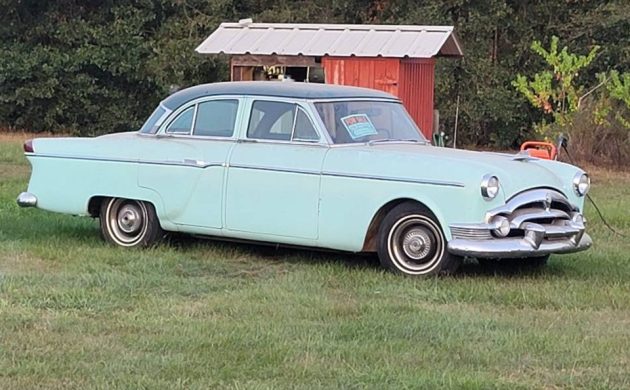
The year 1954 was a time of change for the U.S. automotive industry. American Motors was created as a result of Nash and Hudson merging. Later in the year, the exalted Packard Motor Car Company acquired Studebaker, in what seemed like a Mutt & Jeff combo, and created Studebaker-Packard Corporation. Both marques were struggling, so perhaps there was a strength in numbers belief that would help stave off the GM-Ford-Chrysler Corp. juggernaut. Last week, I covered this 1952 Packard 200, and it engendered a lot of good comments. So with that thought in mind, let’s move it up two years to 1954, the year of the merger, and examine this clean Packard Clipper Deluxe sedan. It’s located in Waller, Texas, and is available here on craigslist for $7,100.
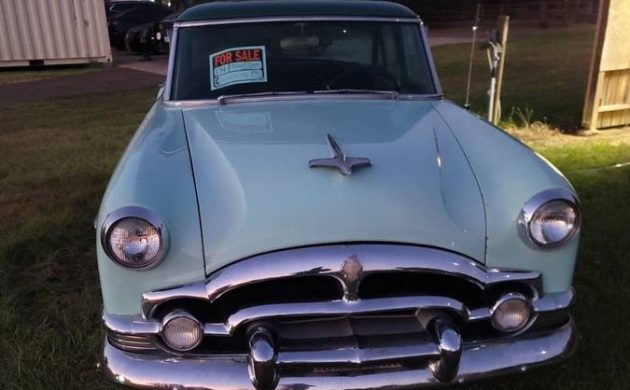
Packard’s Clipper, considered a medium-priced car, covered a lot of bases in ’54 with the Panama two-door hardtop residing at the top, followed by the Super Touring four-door sedan, then the Clipper Deluxe in two and four-door sedan body styles (our subject car), and finally the Clipper Special two-door sedan in the caboose position. There was also a Clipper “Sportster” two-door sedan, a lower price trim level aimed at younger buyers. Packard came in sixteenth place in the 1954 domestic automobile production race with just 32K copies. Of that total, 7,600 were Deluxe four-door sedans – not exactly rare but hardly common either.
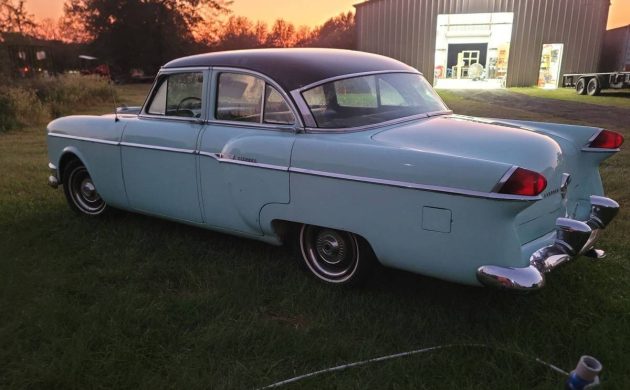
The seller tells us that he purchased this car as a project, but actually, it looks pretty good as it sits. The body is described as being in great shape with just some surface rust. The finish is reasonable, the chrome bits are strong, and the stainless trim is all still in place and shines as it should. To my eyes, the styling here isn’t much changed from the 200 model that was offered in ’52. Of course, I imagine Packard was capital-constrained, and nothing evolutionary was going to occur in the styling department.
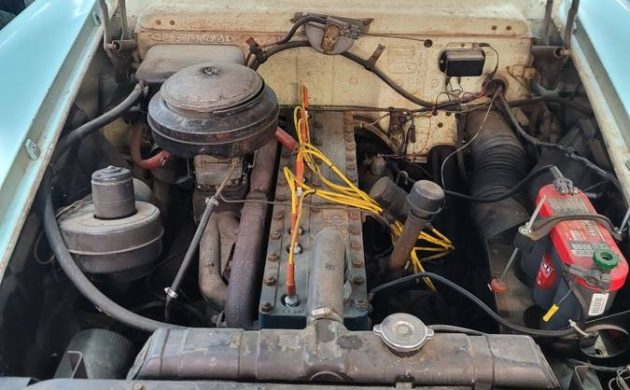
A 165 gross HP, 327 CI straight-eight flathead engine occupies this Packard’s engine room, and the seller claims, “runs and drives,” not exactly a ringing endorsement. The engine compartment does reveal itself as being original and unmodified. An “Ultramatic” automatic transmission makes the rear wheel connection.
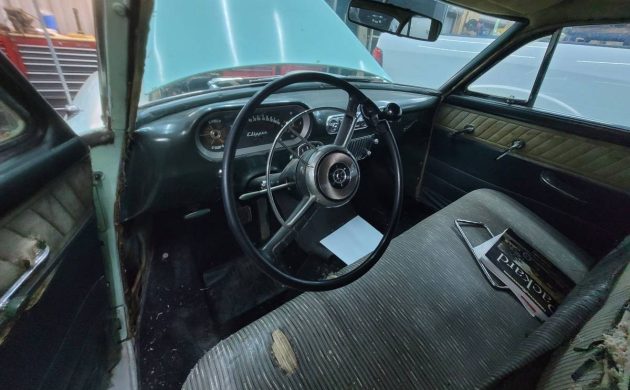
The interior has its troubles; the front seat looks like it hosted a WWE Smackdown and is going to need some serious help. The door panels are iffy, and the seller admits that the headliner has seen better days. The dash (no dash pad) and instrument panel show well, however. The dash is pretty typical for cars of this era with its big, center-placed chrome-plated grill, but I’d offer that the entire affair is more subdued than what one typically finds in medium and better-priced cars from the mid-fifties.
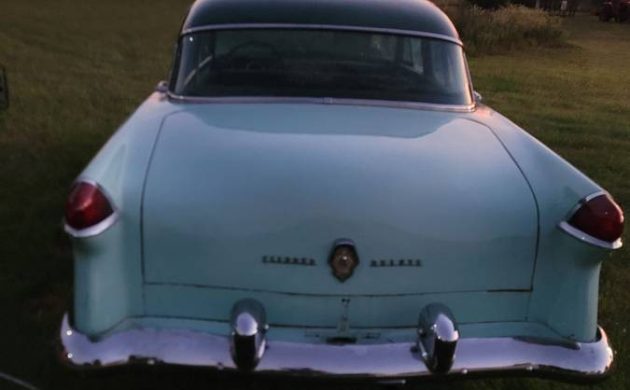
The seller refers to this Packard as a survivor, and I’d agree for the most part; it looks very original, but I think it’s a repaint (note under the hood). Still, that doesn’t exclude this car from being considered as a sound collectible. The mileage listing is recorded as 43K miles, but there is no authentication offered. Still, this Packard appears to have been gently used and well-maintained over its 71-year lifespan. What’s your thought, for $7,100, a worthwhile endeavor?




Great write up Jim. I liked the ’52 you had as well. Theres something about that big Packard Straight 8 that just appeals to me. These to me ( I wasn’t around then) seemed to be a solid good high quality car that would last you many years. This particular color combination looks nice. I’m guessing it was white originally? As Jim
already pointed out in his article. I like it, and hope it gets to a good new home.
Jiiiiiiiiiimmmmm, sorry, you hit a nerve there. The Packard-Studebaker merger was NOT a Mutt and Jeff combo. It was the merger of 2 of the best cars made, and by rights should have succeeded. Mutt and Jeff suggests, one normal and one odd, and that just wasn’t the case. Take this car, as outdated as Beatle Boots, and the “Clipper” moniker, a mere shred of what a fantastic car they were. Not to sell this car short one bit, it was all Packard, a name still associated with greatness, Studebaker needs no mention. Both cars were top of the line in my book. Too bad the mainstream didn’t see it that way. I only wonder what would have happened if Studebaker and Packard were part of the AMC deal.
This is a nice, typically 50s car, and an AUTOMATIC,,,yay, okay, a shady one at that, but still will stay alive thanks to it. Could use P/S, it was available, but a pricey option, besides Packard had a unique steering design and was actually very easy to turn. I read, the ’54 was facelifted ’53, that dealers had thousands of unsold ’53s, and Packard was the last to use a flathead 8, and cost them dearly. Wonderful car, hey Jim,,,peace, eh?
Studebaker’s massive debt was a major reason for Packard’s demise.
Much has been written about the Packard/Studebaker merger and the consensus is that Studebaker hid their financial woes from Packard, only to be discovered after their sale was complete to their chagrin.
Remarkable cars, both, in a post war economic readjustment IIRC.
Packard could probably have survived if they just dropped the complete car thing and concentrated on selling only the tail light assemblies. Late series Packard tail lights were a hot item in the 50s/early 60s customized car arena. Should have bought stock in Packard and forced management into just the tail light market. Oh well missed another great opportunity, maybe I can find a bridge for sale and just live off toll revenues.
I love those too, Terry. Someone should start making repops like they do the ’59 Cadillac tail lights.
Friend had inherited a ’53 convertible, with the Ultramatic. Was a home garage restoration, interior in the right color red vinyl, rather than leather, points off for that, but he did not care. Acceleration was very adequate for getting on to an interstate type highway and taking it up to 65 mph, at idle you could only tell engine was running by gages, and exhaust note if top was down, no vibration at all. On the other hand, as a kid, a friend’s mother had one, she drove us around a lot, I usually sat in front and watched her skip 2nd because she was short and she could not reach up far enough with ease. I was maybe 13 or 14 and a car guy, and she explained that the 8 had enough torque in 3rd not to use 1st or 2nd at all, but it was tough on the clutch from a standing start to do that.
Price is good for a four door imho.GLWTS.
I’ve said before *Last Days In The Bunker * gives a great account of Packards final days and the politics of the merger. If you’re a Packard afficionado, it’s a must read. IMO any Packard is worth preserving as a symbol of an automotive era never again to be seen. I hope everyone is enjoying a great Labor Day and not laboring to much.
I never liked/appreciated these or Kaisers. I always considered them heavy and daughty. I loved the late 40s early 50s Oldsmobiles and Hudsons. Not sure why a youngster would feel that way. (I was a gearhead from birth) As time as passed,I have learned some respect for the Packards. I still don’t like their style. Even though they front-end is not much different from a Hudson. But their engines in particular were amazing. I happened across a rat rod last year that had a Packard straight 8. It ran smooth as glass. It was amazing. The builder had a,small turbocharger on it (not alot of RPM available) but with the extra boost it would fry the tires for a block. I have also had a chance to be under one that was on a lift. THAT CAR WAS BUILT! Naturally, it was old school technically, but compared to a same year GM or Ford it had twice the strength and durability. (Also probably 50% more weight) So they built them to last a long time. When the public wanted the newest, greatest thing. Great vehicles (and the same could be said for Studebaker to some degree) that were left behind the desires of a younger people who really didn’t appreciate “strength and durability”. Also, their style was behind the times.
Love those50s+studes aero sleek with a nice v8 and great gas mileage the older packards absolutely classic beauty
I have always been partial to Packards; that said, the latter day Clipper (as opposed to the elegantly-sporty prewar model by that name), was a well-meaning marketing mistake. In the prosperous post-war era, Packard needed to move back upscale in superiority to Cadillac, after entering down-market into the mid-priced area had helped them to survive the Great Depression. The 200 in 1951 was Packard’s “bare bones” model, designed to compete against the likes of Oldsmobile, and this became the new Clipper. It was, on the one hand, such a fine automobile that it unintentionally pulled sales away from the much more expensive senior Packards which were not all that different under their skin; then, on the other hand, too “plain jane” to give the mini-luxury brands such as Oldsmobile and DeSoto, even Mercury, much of a hard time. They were aimed at the man who wanted a Packard but could only afford an Oldsmobile — bad for both Clipper and Packard. What Packard desperately needed on the Clipper, was a seemingly non-Packard front end, to take the public perception of Packard’s prestige away from the Clipper and launch the Clipper as an entirely separate brand with Packard engineering and its own decorarive trim: perception and “image” are vital to marketing. Preserving the true Packard identity to only their senior models would have helped both the Clipper and the Packard, I think. And the elegance and opulence of the 1955 Packard was perfect, had not other factors led to Packard’s demise [they should have bought the Briggs Coachworks and not Studebaker!]. The 1955 Packard, despite being a heavily face-lifted 1951, set just the right tone of classic enduring dignified luxury, married to superior advanced engineering, to justify restoring Packard’s sterling reputation as THE PREMIER American automobile, making the ’55 Cadillac seem ordinary, ostentatious, and flashy by comparison.