

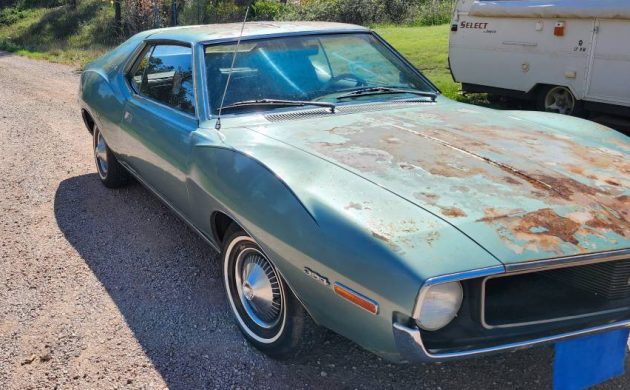
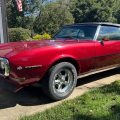
American Motors joined the “pony car” frenzy in 1968 with the Javelin, whose roots were based on the AMC American. The car received its only rework in 1971, and AMC exited the market in 1974, at the same time Chrysler did. This 1971 Javelin SST (fancier trim) has been in the same family since new and was sitting inside and out for 17 years. The seller has gotten it running with some new parts, and it’s available here on craigslist for $6,500 OBO. It can be seen outside of Rapid City, South Dakota.
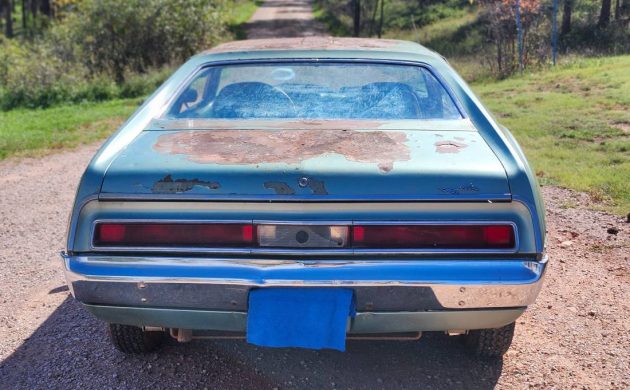
With the Javelin’s refresh in 1971, the most noticeable change was the “risers” or “humps” over the front wheel wells. I suspect they were for looks only. In an unusual twist, the Javelin outsold the Plymouth Barracuda that year and roughly tied that of the Dodge Challenger. Both cars saw sharp declines over 1970 figures as the shift in the muscle car market spilled over harshly on the two Mopars.
The SST model with a 304 cubic inch V8 and an automatic transmission was the Javelin’s biggest seller in 1971. That was in addition to the base model and the AMX, which was no longer a separate 2-seat GT car and now the performance version of the Javelin. The seller’s car has that drivetrain pairing, at least according to the fender emblems. Since the seller describes this AMC as a survivor, we assume the paint is original and (to me) goes beyond what patina should be. If this car isn’t repainted, the lack of protection will turn to rust.
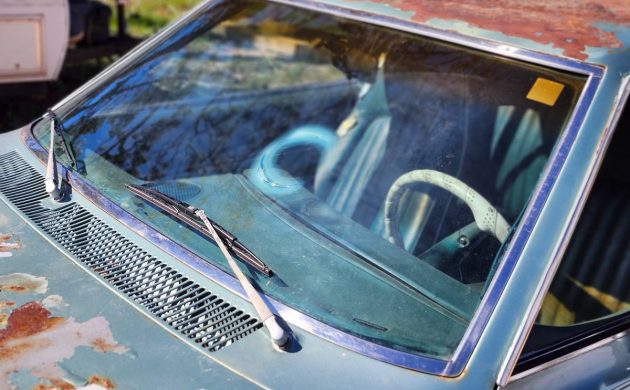
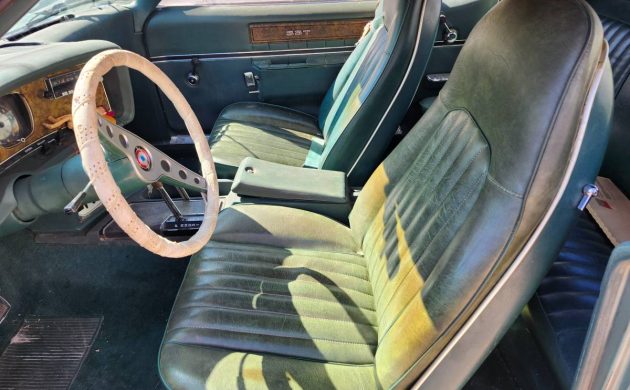
Before the seller got involved, this car had been languishing since 2009. He replaced some seals, repackaged some bearings, replaced the starter and fuel pump, and cleaned out the fuel system. So, it’s a runner now, though we suspect it will need more than just a new paint job and the interior spruced up. The odometer has turned over, reading 37,000 miles (add 100k). Once again, Barn Finder Barney hits us up with a fresh tip.

The “humps” on the front fenders were actually put there for TransAm racing. It was so drivers could tell easily where their front tires were. Pretty clever!
Worked well enough for the “big” ponycars where long hoods were part of the marketing formula; in the 2-liter and under class the hot ticket was a short nosed shoebox sedan.
AMC chief of design, Dick Teague, had his team secretly go and buy a Corvette, which they went over completely, as engineers do. The hump design was inspired by, and taken from the Corvette. They did actually function by helping with the wheels, tires, and suspension, on the Trans Am Javelins which won the Circuit in 1971.
I think these cars would have looked so much better without the front wheel hump. I know it was there for the Trams Am races, but I wish they would have made some without the hump for the general public to buy.
It comes down to cash on hand, and AMC had little to none. Kinda cool to think of the possibilities, as I very much preferred the earlier flat fendered vehicles. Younger me would take this on.
The front end swap to the 69-70 none hump clip is frequently done there’s a few YouTube vids where they show the process
Wow, I have never seen one. I’ll have to search YouTube. I had (2) 1968 Javelins, both V8 343 engines. One was an automatic & the other was a 4 speed. This was in the early 1970’s.
What exactly is or more precisely how do you repackage a bearing? Dad taught me how to repack a wheel bearing, is that what is meant by “repackaged” bearings? Are we that lazy to let autospell misinterpret the term or meaning, or is repackaged bearings really a thing?.
Wasn’t a fan of those fat fenders over 14″ wheels and f78’s but with modern wheels and tires, they get sexy.
AMC block is unique in that its SCALEABLE – its the same block 273 304 360 390 401 – there’s a ready made 4bolt main Gridle that can be machined in – Factory left enough metal in main webs to do so.
The Factory internals are ALL STEEL FORGED unlike Ford GM Chrysler who used Cast Iron.
By Swapping out the Crank & Rods you can easily Bore & Stroke upto 427 CI – I’d run a Shorter stroke 360 crank with a bigger bore – run the European Valve springs-Higher rate stronger metal double springs.
If you can source it the European Dash gauge set – RARE hard to find.
AMC sold these cars as Knock Assembly Kits in Europe there’s a very few rare PRISTINE examples – one man in Switzerland has an SST all European Specs but wants a BOAT LOAD of cash for it.
This car in Rapid City looks like it came straight off the Indian reservation & most likely did by its rough rusted patina.
COULD be made good – it’ll cost ya a solid 50k in parts & labor for a 35k car
The seller says it runs, and I have to assume drives. It looks straight and the bumpers look OK. I don’t see a big $ outlay for parts, and I don’t pay anyone for labor. It takes time, but you can get show quality paint on it for about $3K. You just have to be prepared to spend the time. Have someone do it for you, and I’m sure you could easily spend $50K.
As i have often written, i do not have any patience left to deal with the alcohol, drug and laziness infused body guys .These cars deserve to be modernized like a lot of the pony cars right now !
I would LS it , 6 speed trans with paddle shiffing and the whole suspension and big brakes , my easy way to achieve this , i go and buy a corvette but the younger, stronger, talented should get a hold of this diamond in the rough!
Looks like moisture collected under the plastic tarp and caused the rust blisters. Cars body looks straight . The sun filtering into the interior picture makes the interior look probably worse than it is. Worth checking out.
Thanks Joe S for that piece of history. As a past SST owner I’ve wondered about that styling change for years. I would have given you a thumbs up but for some reason I can’t. Print the post!