

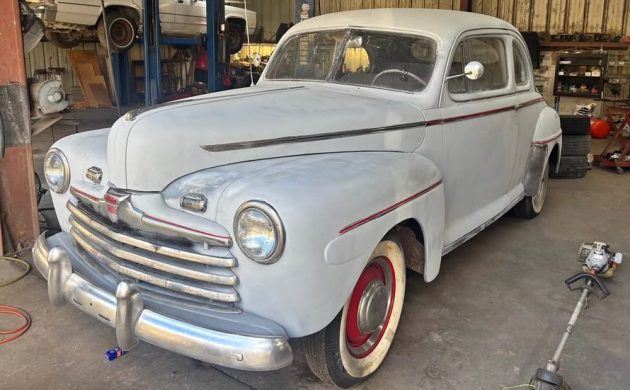
By 1948, Ford’s prewar styling was entering its final lap, but the flathead V8 was still very much in the game. This Lake City, Florida, coupe is offered for $7,500 or best offer here on Facebook Marketplace. The seller reports 80,000 miles, says the car runs and drives, and claims it is rust-free, a tempting combination for anyone hunting for an honest old Ford with strong hot-rod potential.
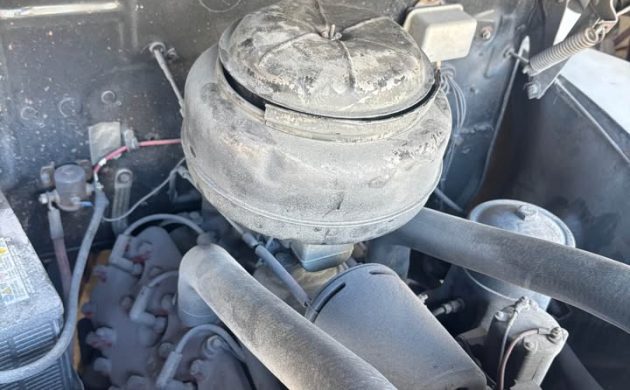
The heart of the car is its flathead V8: 239 cubic inches and a factory-rated 100 horsepower for 1948. Those numbers may sound modest now, but the flathead’s unmistakable look, low-end character, and deep roots in traditional hot rodding give it an appeal that goes well beyond the spec sheet. The postwar 59-series blocks are especially familiar to enthusiasts, thanks in part to their block-mounted water pumps and updated construction. The listing does not confirm this engine’s casting number, but simply having a flathead between the fenders gives the coupe genuine period flavor.
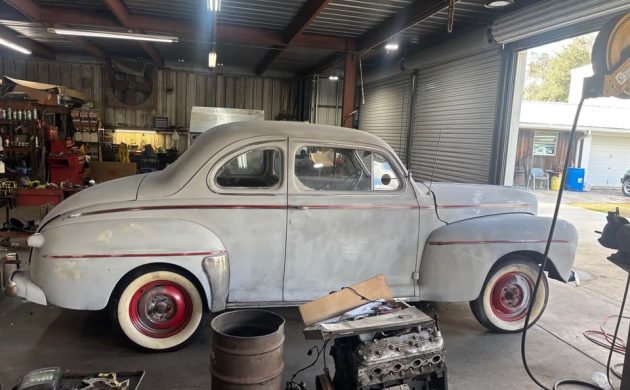
The body appears to be a Club Coupe, identified by the shorter rear side windows that separate it from Ford’s other coupe profiles. Unlike the three-passenger Business Coupe, the Club Coupe made room for five, giving it extra appeal as a practical weekend cruiser for friends or family. Its rounded fenders and flowing lines also mark it as one of the last old-shape Fords before the lower, cleaner 1949 models arrived and earned the “Shoebox” nickname. As the final year of the earlier design, the ’48 carries the end-of-an-era character Ford enthusiasts appreciate.
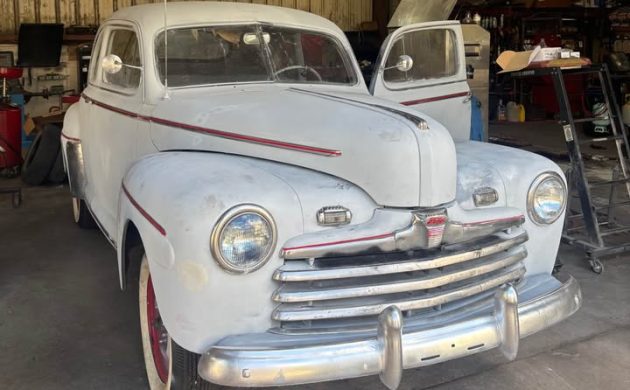
Production figures add another layer to the story. Ford records list just 5,048 Deluxe three-passenger coupes for 1948, compared with 44,828 Super Deluxe coupe sedans. That spread shows why the exact body style and series matter when rarity enters the conversation. This car appears to be a Club Coupe, but whether it left the factory as a Deluxe or Super Deluxe still needs confirmation. An important detail for any buyer who cares about provenance and originality.
There is a pop-culture connection as well. The famous “Greased Lightnin’” from Grease was built around a modified 1948 Ford Deluxe convertible. It is a different body style from this coupe, but the shared model year is a reminder of how naturally these late-1940s Fords fit into custom-car and hot-rod culture.
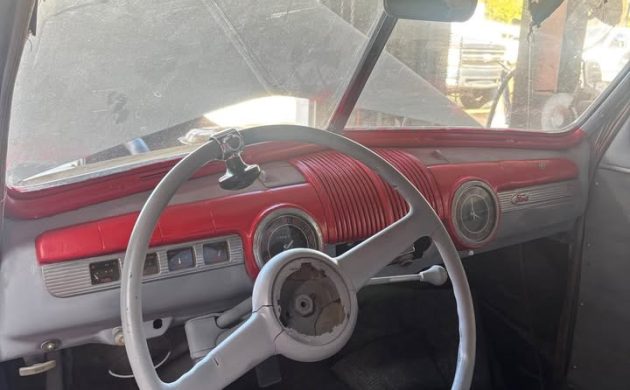
The seller says this Ford runs and drives through a “three-on-the-tree” manual transmission. If the rust-free claim checks out underneath, the coupe could be a compelling foundation—either for a sympathetic restoration or a traditional hot rod that keeps the flathead front and center. That is the real question for the next owner: preserve its late-1940s Ford character, or lean into the period-correct hot-rod attitude? Which way would you take it?

If the weed whacker comes with it, I’m in.
Call me a sentimental old sap, again, to some, just a frumpy old Ford, but this car was what GIs slogging through the trenches of France, ( or so it was told), dreamed of when getting back. A new V8 Ford coupe, with a radio and a little fan on the dash, yes sir, and auto racing was just the thing for action weary GIs. Once again, the ’48 Ford coupe practically defined this up and coming phenomenon called drag racing, and again, how this car escaped becoming a Gasser, we’ll never know. A ’48 Ford coupe defined the term “Gasser”, and where most ended up. An amazing find, for sure.
Nice car but the park lights say that it’s a ‘46. Ford used the type that’s on this from ‘42 to ‘46 and Mercury used it from ‘42 to ‘48. Anyway, I wouldn’t turn this one down if it showed up at my place.
Club coupe, flathead V8, what’s not to like?
High school friend came up with a ’46 like this one. Helped him change the transmission and put on dual exhausts. Dead simple and fun to drive. I’d probably make a modest street rod out of it. Bit of lowering, dual carbs, dual exhaust and good paint and the original hub caps. That would keep it in the era it originated in.
As of 11/1/2026 at 4:30pst the ad is no longer available, according to Facebook it has either been sold or the listing expired.
Steve R
I was gonna say ’46, but Geo beat
me to it. Reminds me of the IMC
model kits where you could build
your model as a ’46, ’47, or ’48 model Ford coupe or convertible.
Had a couple of them and they were very detailed kits to build and had a host of tiny parts that required tweezers to install them on the finished car. And if you did
things right, everything worked! The hood, doors, and trunk opened, the backs of the front seats tilted forward, and the front
wheels were steerable too. And if you wanted a hot rod, they gave you a 427 side oiler V-8 that would make any of your friends ooh and ah with awe when you opened that tiny hood. As for the real thing, in my hometown, you saw these everywhere. Even as far as the late ’70s, you still saw them on the roads and all that told you was that these old Fords
had staying power and if you played your cards right, you could
pick one up for less than $250 in
running/driving condition! Just try doing that today! And if the car hasn’t sold yet, some lucky buyer will score themselves a fine
older Ford to drive and enjoy.
No question it is a 46. Window trim is a one year only. 1946. There are other indicators, but no body back dated the 47 and 48s to look like a 46. I like the car and the price. If it is sold it was a good buy.
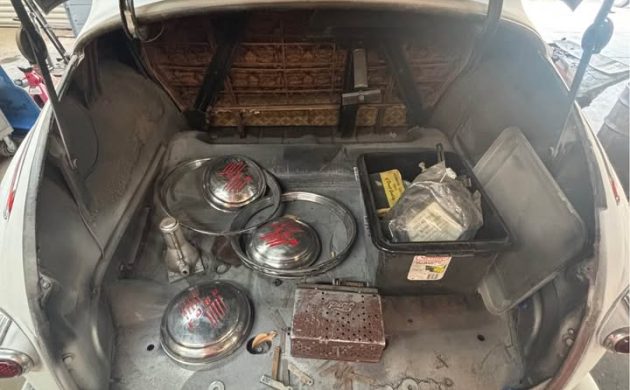
This definitely appears as a 1946 Deluxe, and not a Super Deluxe. The hubcaps in the trunk are 1946. The parking lights are 1946; however the grille horizontal bars are 1947-’48. You didn’t show the trunk lid, so I cannot comment on the year there. But the dashboard gauges identify this car as a ’46. The lack of a horn ring identifies this one as a Deluxe (unless the horn ring was removed). The lack of a Super Deluxe badge under the left headlight also identifies this car as a Deluxe. Of course, this COULD be a ’48 that had a ’46 donor car whose features an owner preferred, leaving the grille bars intact. The vin number would tell us how this car began life. Having owned and driven a 1946 Frord Super Deluxe flathead V-8 Ford for 27 years, I KNOW these cars. That original flathead has plenty of power for this car, without hot-rodding it; so, restoration is very possible here, or just drive it as it is. The Super Deluxe interior was grey with blue and silver accents, and the Deluxe was earth-toned. Nothing revealed about that here. One caution I will give: if you intend to drive this care on the Interstate, you had best have Columbia Overdrive, or she’ll.struggle with high r.p.m.s and likely overheat. But with the Columbia, this car will coast along at 70 m.p.h. just fine. This car has ’47-’48 bumpers
Harrison, Nailed it he knows his stuff! I agree it this car is mostly a 1946. As for the Columbia, I don’t totally agree, yes Columbia is the best and most money. I grew up in Colo and most sold there had low rear ends 4:11 there are 3:78 and much better. The fact is these are not great highway cars with traffic and the speeds people drive. I have had several fat fenders but the stock ones, I did not drive on freeways.
Joe, mine had Columbia Overdrive from its birth, and I could drive it on the Interstate all day long, no problem. But there were two rhings I had to watch out for on those trips — both related to over-heating. In warm weather, if there were an accident stopping traffic up ahead, I needed to pull over to the side, shut the car off, open the bonnet [hood], and wait it out — because, when idling, a flathead will boil-over quickly. My car hated Garden State Parkway toll-booths, for that same reason: rush hour traffic could be a nightmare — you had to be able to KEEP GOING: you couldn’t creep along in a 0-5 m.p.h. stop-and-go situation, or you’d rapidly over heat. And on a long Interstate trip (or any time you would drive an entire day), bring an extra coil with you, a thick cloth to protect you, and the simple tools to change it. Because the coil heats-up to the temperature of a hot stove and it will still produce sufficient spark… until you need to shut the car off (such as stopping at a service-plaza). GOOD LUCK IN RE-STARTING THE CAR!!! You need to change-out the coil and put a fresh and cool one in, and put the hot one in a corrugated cardboard box in the trunk, to cool-off and be your spare for NEXT time. Also, clock your miles and don’t forget one drop (no more) of oil in the generator bearing, and in the fan-bearing when called for in your owner’s manual: you don’t want to get cought OUT there, 1,276 miles from home, with a seised generator bearing: you won’t find a new 6V generator of that exact type around the next corner at AutoZone!
Are the Northeast toll roads in the United States??? I am glad I live out in the boondocks!!!!!
I like this car!!! Just like it is!!! NO hot rodding… Maybe paint it a different color and get rid of the red stripes and dash. And add the dual exhaust so that everybody can old flathead Bark.. With some TLC and detailing the buyer will have an excellent cruiser and show car.
Howard you need a calendar or a history class, WWll ended in 1945. I doubt GI were dreaming of 48 Fords maybe 32 Fords. I would also never think of a fat fendered Ford as a Gasser, maybe a Custom. I will give you a break the army did have staff vehical’s that could have been 42 Fords, like a 46 to 48, but the didn’t look very good cosmetically.
I looked again: from the side view, I see that the trunk is a ’46 and the rear bumper is also. But the front bumper and grille are ’47-’48. I’ll bet this is a 1946 Deluxe which at some point hit the rear of another car, damaging the grille and front bumper. And they located a 1947 or 1948 donor car in a salvage yard and just swapped-out the damaged parts. Then they re-painted the car.
My very first car was a 48 Ford 2 door sedan when I was 12. Bought it for $50. My brother helped me fire up and drive home from a barn in Buffalo Montana. Towed it around in a hay field with a 49 International pickup. Still have that car!
Harrison, I know the years of these Fords are very hard for many people to understand, not that it really matters that much. But, for those who do care, coming from someone that knows, you are absolutely 100% correct!
Side bar, you didn’t mention close pins on metal gas lines, great for vapor lock!
Joe, I confess that I never knew that one!.But with the removable little glass gas reservoir with brass-mesh filter, vapour lock was easy to cure and be on your way. Many claim.that these cars are not truly roadworthy any longer. But if you know how to treat them, and you do not expect modern “just drive it” motoring, an old flathead Ford will reliably take you anywhere.
Aha! I knew they were using clothespins to stop vapor lock even then! I had someone call me out on the clothespin thing last summer when that commenter told me that clothespins on a fuel line to stop
vapor lock was an old wife’s tale.
And it’s nice to know that it was indeed a verified practice in the past to keep your car going on hot summer days. And the coil thing? Dad never said much about that and I’d almost forgotten it until you guys brought it up. I know that the Columbia rear axle was standard on some Fords but there also used to be a Halibrand quick change setup that did the same thing as the Columbia unit, but you had to physically change the
gears by hand as opposed to pushing a button on the dash. I used to read about the Halibrand
units in Rod & Custom Magazine
in the late ’60s. And there were
even some.guys that installed transmissions from old Lincoln
Zephyrs just for the overdrive units that Ford never offered on their low priced cars. And if I remember correctly, you couldn’t
get overdrive on a Ford until “49
or ’50. But even so, this is still a
really nice Ford priced right for the right guy that will appreciate it for what it is. And I wish that guy was me!
Ken, Your comments are good but not exactly correct! As for clothespins, you could ask my mom,she couldn’t figure out who was taking hers. The coil thing, I don’t know, but Harrison knows his stuff, so I will go with it. Nine times out of ten if your flatmotor just died, put a new condenser in it! Your info on Halibrand Q.C. is a little off it was after market designed for racing, such as Bonneville. Very few used for street use. Recently they have become very popular with Hot Rodder because of the looks and history. I have had them in street cars and they are loud, even with modifications. Q,C. maybe, depending on your definition of quick. Columbia yes, but very rare and expesive option. Zephyr gears I never did it and didn’t think it was that great. For different transmission swaps La salle and Packards were used but mostly for racing. The overdrives in 49 to 51 Fords not so much Bellhousing was a problem. Then what happened is time, there are so many other ways with late model 4 or 5 speeds, and even Automatics, there is no need to chase oid rare parts. I have had the 5-speeds and have driven the automatics and it is all so much better than the old stuff. I have had my 34 5-window 63 years and I have had it all and it has an S-10 5 speed now and I love it! I have had lots of fat fendered Fords and I loved all of them, as for this listing I would pass.