

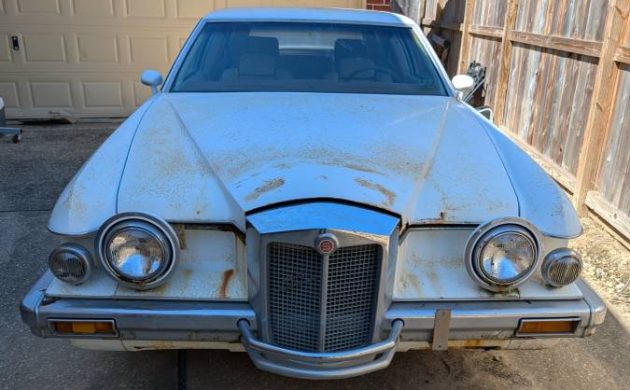
What do you get when you blend Virgil Exner with a celebrity-loving Wall Street banker? You get the “revival classic” Stutz Blackhawk. The story began with Exner, who wanted to build a new Duesenberg; he approached James O’Donnell, owner of a private investment bank, hoping to receive funding. The capital never came, but O’Donnell became convinced that space in the US market existed for a custom-built, luxury automobile at a premium price. The pair decided to resurrect the Stutz nameplate. So it was that in 1971, after an expensive, globetrotting effort, the first neo-classical Blackhawk was produced. Instantly purchased by Elvis Presley, the new car became an overnight celebrity magnet. Dean Martin, Liberace, Debbie Reynolds, Frank Sinatra, Mohammad Ali, Willie Mays, the Shah of Iran, and countless other luminaries became Stutz owners. Here on craigslist is this formerly swanky 1979 Blackhawk, one of an estimated 600 produced, with an asking price of $8000. Appropriately enough, it’s located in the big state of Texas, near Bay Oaks. Rocco B. sent us the tip – thanks, Rocco!
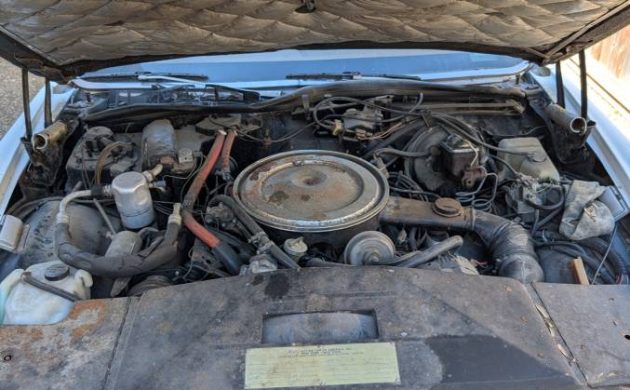
Before spending a dime, O’Donnell asked Exner for an outside opinion on the venture. The pair visited John DeLorean at Pontiac, who agreed to cooperate by supplying Pontiac Grand Prix platforms and drivetrains as raw material. Asked by O’Donnell why GM didn’t make the car instead of leaving the niche to Stutz, DeLorean replied, “While you are making one prototype, I will have sold one million Pontiacs.” Undeterred, the intrepid Stutz-ers shipped chassis to Italy to hand-build the body that Exner designed. The first cars were equipped with a 455 cu. in. V8; later, many engine options were available. This one is a 350 V8, paired with an automatic transmission; the seller notes that it needs work to run and drive well. Heavy gauge steel contributed to a curb weight of 5300 lbs, so we’re talking about a car to be seen in – not a curve-carver.
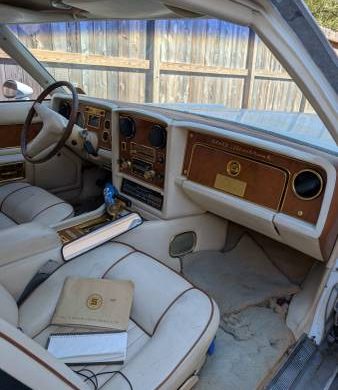
Interiors were decked with the finest materials money could buy and customized routinely. Leather, burled wood, gold-plated trim, even mink carpets – nothing was off the table. This example features a Prince On-Board computer, an elaborate trip tracker that was considered a luxury accessory. The Blackhawk came standard with power door locks, cruise control, an electric sunroof, and myriad other features.
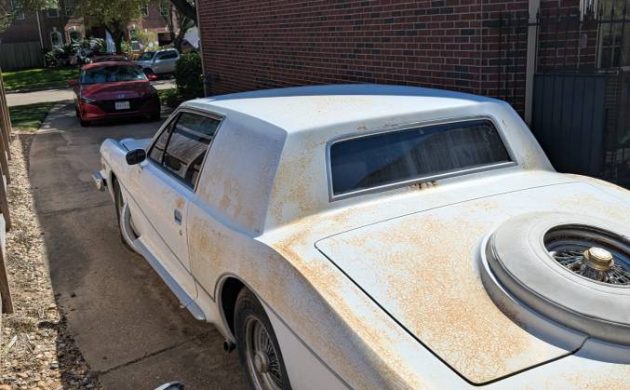
Exner was in love with the toilet-seat spare. Other controversial styling elements were the enormous C-pillar, sharp-edged sheet metal, and faux side pipes. Up front, the headlamps are proudly unintegrated into anything, and the protruding radiator grille dares us to complain. On their own, these components are slightly insane, but somehow, blended together, they make sense in a Halloween-type way. The seller’s price might be on target, as nice examples are selling north of $50k and occasionally for as much as $75k. What do you think – would you own a neo-classic?

I always thought these were neat when I was a kid. Especially the front ends. Still do. I like how they used Pontiacs as the base too. I’m just wondering how difficult it would be to restore this? The Pontiac drivetrain parts I wouldn’t think would be a problem, but the body and interior parts? This was certainly something else when it was new. It’s sad it’s gotten to this condition. But who knows??? Maybe someone will try restoring it. It seems to be complete which is a huge start. Thank you Michelle!!!
I had the 1979 Hot Wheels version. I always thought two square headlights, or four square headlights (in chrome pods, of course) would have made more sense. But this car isn’t about making sense…
Gaudy then, gaudy now. I know some people like them, but they give off an aura of desperation, by trying too hard to project an image of success.
Steve R
How much of a Grand Prix did GM ship? Was it similar to what GM did with cars that went to coachbuilders to convert to hearses, or something else?
A fellow in high school once told me he had a hearse shifter in his Mustang!!!