

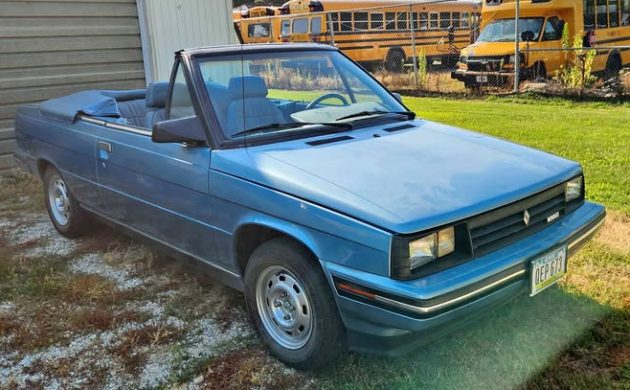
You’re looking at the car that American Motors hoped would bring it back from the brink. AMC’s tie-up with Renault in the late 1970s was a last-gasp effort at self-rescue. In the midst of the second energy crisis in five years, AMC’s 2% market share amounted to sales of fewer than 200,000 cars, while the Big Three were selling that many units of a single model. AMC was sinking fast. Renault saw an opportunity to expand its distribution to the US cheaply, so it stepped in with a loan, taking an equity share at the same time. In return, AMC would manufacture an Americanized version of the Renault 9 compact sedan and sell Renault’s other models in its US dealerships. The Alliance was launched in 1982 to benefit from a market still responsive to fuel-efficient cars. Here on Facebook Marketplace is a 1987 Alliance DL convertible with an asking price of $4,000, located in Washington, Iowa. Thanks to Zappenduster for finding this rarely seen Franco-American!
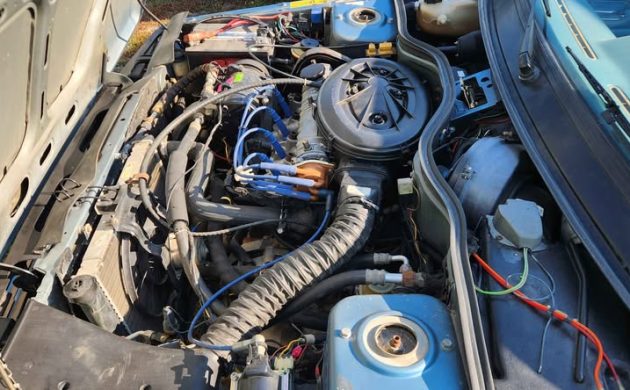
While the Alliance was made in Kenosha, Wisconsin, the car’s engine and gearbox came from France. The base model received Renault’s 1.4-liter four-cylinder – the same unit fitted to the Le Car. By 1985, a 1.7-liter fuel-injected four coupled with a five-speed gearbox was offered as an option. Neither was known for performance; instead, AMC touted the car’s excellent gas mileage. By the late 1980s, though, gas prices had declined, and buyers were moving on, seeking more luxurious finishes and better acceleration. This example has seen regular maintenance, but no mention is made of its running condition.
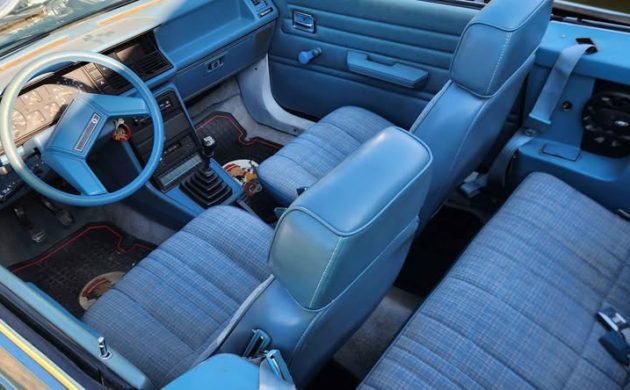
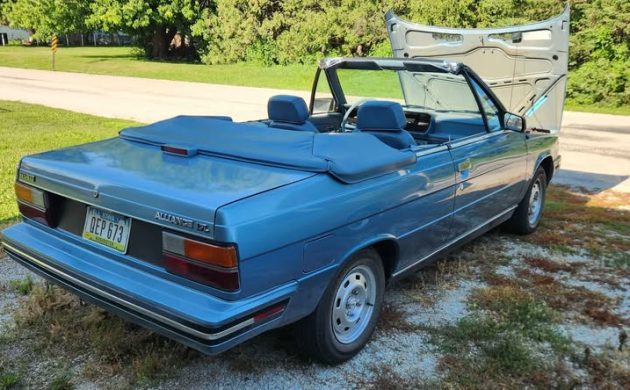
Before we move on, let’s give a nod to the car’s owners – who have kept this Renault in remarkable condition. Ok, the engine bay needs help, and I think I see rust peeking through the cracked undercoating beneath the car, but this interior and the sheet metal are nearly pristine. And thanks to the seller – for cleaning the car inside and out, and taking decent photographs. Now back to the cabin: the Alliance was offered in several trim levels, from the base L to the mid-range DL, on up to the Limited. The DL offers a few extra accessories, including a clock, rear ashtrays, and extra trim. The front bucket seats are set onto rocker-shaped sliders, allowing for a wide range of adjustment. The seller notes that the convertible top mechanism works, but the windows do not.
The Alliance didn’t save AMC. Early reviews of the car point to a weak gearbox, variable idle speed, and other faults. Quality control was a recurring issue at AMC in the 1970s and early 1980s – and Renault wasn’t much better. Price-wise, you could do worse than a quirky convertible for $4,000, but I wouldn’t bite until I saw the car in person. What do you think of this Franco-American affair?
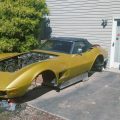

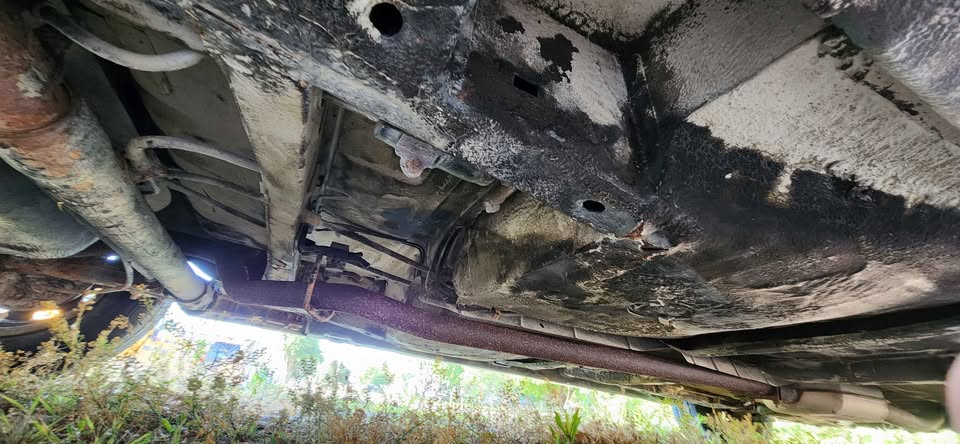
I am going to admit. I didn’t pay much attention to these Renaults when I was a kid. But this one caught my eye. It even has the convertible top boot that appears its in great condition. The car, up top looks terrific, that interior looks very comfortable too. I like the color too. And its a stick. It seems like a fair price, but you’d have to really hook your peepers on that underside to make sure rust isn’t an issue. Hopefully it goes to a good new home.
I don’t know Michelle, antique Cat Crawler one day, Franco American drop top today!! Thanks Michelle.
Nice one, Michelle and Zappenduster! A convertible is always a fun option. I loved my ’87 GTA; it was trouble-free, and lots of maintenance parts were still available on RockAuto and other sources. It needed a turn signal cam (for canceling the turn signals after you make a turn) for the steering hub, and they actually had one. It was a super fun car to drive, the rocker-type adjusting seats were as comfortable as almost any car I’ve owned, and the shifter was solid.
I totally forgot you had one Scotty. That looked very clean. I’m guessing a lot of fun being a GTA with a stick.
Waiting on Howard to comment . I kind of liked these when they were new. Now one would make a fine first car for a teen or second or third car for a family. That rust is concerning but on the other hand that picture shows a stout looking frame rail. Should be possible to modify that engine for a little more horsepower.
Thanks, pal, I knew SG had one, and my brother had an early one, and was the 1st car we had seen with an “oil level” gauge.(later discontinued?) I don’t think Milwaukee had anything to do with these cars, I believe all came from Kenosha. I had heard, disgruntled workers knew the end was near, and purposely sabotaged the cars, although that was never proven, they were just that bad of a car. A sad end to what we considered some of the best cars, reduced to this. It was not a happy time.
Hopefully that rumor isn’t true about the sabotaging pal. Most of the Union folks I’ve worked with were very competent and professional, and wouldn’t consider such malfeasance. Always liked the looks of these little cars. Great front end.
Worked at an A/J/R store from ’86-’88. Had the ’85 doppelganger to this one on the showroom floor until 7/86. Never drove a 1.7, but we had several ’87 GTA’s with the 2.0 – sprightly performer for the day. The convertible tops on these were lined and sealed up well. This example with a little noodling on the price looks like some economical fun in the sun, although around here (MO) there are several ’80’s Mustang droptops for just a little more, and the parts situation would be much better with them. But you will never see yourself on the road with this one, the tin worm finished virtually all of them many years ago. Hopefully I am correct in spotting an A/C compressor in the engine shot . . .
I owned three of these cars. My favorite was the 1984. It was the Aztec gold color with matching interior and the DL trim. It was a pretty little car. It was a two door. I liked all three of these vehicles that I had. I never had mechanical issues, and they rode great!
These cars get bashed a lot these days on car forums, I often think unfairly. I rented one in IIRC around 1988 to drive to up to LA from the San Diego area. It ended up developing some kind of weird and concerning engine grinding noise during the trip and I suspect the motor was likely shot by the time I got the car back it the agency. I never found out what the issue was but I think it was some kind of internal part failure because other that that, it drove really well. Was peppy and handle well, seemed well put together In any case I think had these had better support in the US they would’ve been more successful.
I think it would be a fun little toy I would be a little concerned about maintenance parts but without researching it. On a lot of older cars like this it’s really hard to find available parts
I had an ’86 4-door sedan and it was a great economical work car. Sadly, an electrical fire under the hood ended it’s life.
If this was a GTA version, that’d be something really worth going after. The GTA’s are pretty scarce, and I can imagine a convertible one would be even tougher to find.
This is pretty clean looking car. People will walk up and smile at the local Cars and Coffee for this. A GTA would have some of them way more interested, if not almost shocked.
After my wife graduated from Chico State, in 1985, she said to me, “We have to get a new car. That ’64 Valiant is embarrassing…” Yes, we sold our ’64 Valiant that had served us faithfully for 5 years and bought a Renault Alliance- “The One To Watch!” The fuel pump failed on the way home and we had to pay 1/2 of the price for a replacement. Plastic window cranks broke off and the sun visor mounts made of plastic also failed and making them useless and an annoyance. And don’t ask for a warranty replacement- it’s not covered! Head gasket at about 10,000 miles and the engine failed at about 32,000 miles- Had to fight with Renault to get 1/2 assistance on a replacement there as well. We finally traded it in on a 1987 Honda Accord. When I brought it home I asked my wife, “Do you like the color?” She said, “I don’t care about the color, does it run?” “Quality control was a recurring issue at AMC in the 1970s and early 1980s – and Renault wasn’t much better.” NO- Renault was far worse than AMC at that time. These cars were junk then and they are junk now…
These sold quite well initially, at least by AMC standards. Then the word got around about the quality problems and mechanical issues as well as the flimsy construction and overall fragility of these cars.
It also didn’t help that equipped the way many Americans wanted them (with automatic transmission and air conditioning) the standard 1.4 engine was grievously underpowered. (As the gas crisis faded people were less willing to put up with this for the sake of gas mileage.)
These were also recalled for a severe problem with the heater core which could blow out, showering the passenger compartment with hot coolant. This could result in serious burns for driver and/or passenger requiring hospitalization. Whoever buys this thing might want to check that the original heater core has been replaced.
https://youtu.be/LIZBUBnfvG4
I had an Alliance as a rental back in the 1980s and it could barely get out of its own way, though the seats were comfortable and it otherwise rode well.
Haven’t seen an Alliance in ages. Most of them were gone decades ago.
These sold quite well initially, at least by AMC standards. Then the word got around about the quality problems and mechanical issues as well as the flimsy construction and overall fragility of these cars.
It also didn’t help that equipped the way many Americans wanted them (with automatic transmission and air conditioning) the standard 1.4 engine was grievously underpowered. (As the gas crisis faded people were less willing to put up with this for the sake of gas mileage.)
These were also recalled for a severe problem with the heater core which could blow out, showering the passenger compartment with hot coolant. This could result in serious burns for driver and/or passenger requiring hospitalization. Whoever buys this thing might want to check that the original heater core has been replaced.
https://youtu.be/LIZBUBnfvG4
I had an Alliance as a rental back in the 1980s and it could barely get out of its own way, though the seats were comfortable and it otherwise rode well.
Haven’t seen an Alliance in ages. Most of them were gone decades ago.
Never owned one of these, but back in the ’80s I was doing a lot of traveling for work and I frequently rented them (they were a cheap rental, kept the finance guys off my back)… thru Budget IIRC. I found them to be OK. Certainly no drag racer, but they seemed well built, were comfortable and handled well. Never remember having trouble with any I had… and I can’t say that about other cars I rented. I actually will occasionally see ones still on the road in my area… which I find amazing for an 80s economy car.
I have owned a trice of this car for 20 years. Really nice performing car and with 5 speed, I get 35 mpg. With a top that goes down, who needs A/C?
Only caution is the timing belt. Mine broke and the engine “went to hell”: interference engine. Bought another ,wrecked for its engine and installed it with new belt. Runs perfect. Need to change belt every 3 years or 30 K miles.
Also working on the roll up front windows. Probably breakdown of plastic wheels. I am working on it.
What’s worse than a Chevette?
This car. My opinion. (I used to sell them.)
These were and still are horrible cars, you knew you were never going to sell another vehicle to the person getting the head gasket replaced on a car you sold them 3 months before
The 1400 engine blew head gaskets the 1700 engine did not but was an interference engine quite common in 1980;s cars.
I rebuilt the cylinder head for a co-worker’s 2-door hardtop version after the timing belt snapped in the interference engine, bending a few valves.
That horizontally-mounted distributor cap had to be broken off – it was glued on and for some reason I couldn’t remove the entire assembly from the head. A new cap was something like $65 back in ’90, which was outrageous; The new cap & rotor came with glue.
Aside from the insane parts prices it seemed to run well, and he liked it well enough.
This one is in fabulous condition, but I’ve already satisfied my itch for quirky French vehicles with the ’68 Solex I got through this site.
Ok, a,whole new saga for these. In 1985 SCCA (Sports Care Club of America) Started a “spec” class. Meaning you bought the car (about $10,000 at the time) and and it was ready to race. The engine, carburetor, ignition and transmission was sealed. So the only thing you were allowed to “.monkey with” was the alignment settings. Since AMC sponsored the series. The cars used the 1.7 engine 67hp? and the stock 4 speed wide ratio gear box parked behind the driver. The suspension (for the time) was fairly high tech with cantilever (meaning the coil over shocks were actually inboard) reducing the unsprung weight by alot. All 4 suspension uprights, wheel bearings and brakes were standard issue front Alliance parts. The car weighed about 1,200 pounds and was like a large go kart. They very slippery fiberglass body made for a top speed of 130 mph with a very long straight away. But man did they handle. The SCCA didn’t want engines coming apart on the track and wanted to keep the racing inexpensive. So the pistons were flycut to allow for valve clearance incase of timing belt failure. Needless to say compression dropped affecting horsepower. So they installed a hotter camshaft to get about 75 horsepower out of that setup. It became the most competitive and popular class which still runs today. However, they are on Generation III cars with Genetation II & III using Ford engines and gear boxes. They now have approximately 130 horsepower with speeds at Daytona reacing 155 mph. They still use the front Renault uprights, and brakes. My buddy amd I bought a Gen I car and used it for track days. We eventually found a well worn GTA convertible and rebuilt the engine with more carburation and the close ratio gearbox from the GTA. What a difference! We ran the car for 15 years with never an engine brakedown except when I missed a,shift and it saw over 9,000 rpm. The clutch let go and sheared the flywheel bolts. The engine suffered no damage! I really miss that car and being on the track. We also improved the “original” brake cooling and never had any brake fading. In fact no one could out brake me! If you want to know more about the class Google Ford Spec Racer.
Wow! Look at how many comments good and bad this car has gotten, you would think it was an old muscle car. I love to see these types of cars show up they remind me that not everything was perfect and that there were people who would take care and appreciate something for what it was, not what the was just popular.
I have one of these for 30 years, Had a new one in 86 and picked my 87 up years back. Mine looks much better than this and the windows work. At 160,000 miles I can say these were not bad cars at all. I also had the GTA version that was a hoot to drive.
It is a cute car. Great color and they were comfortable. I heard of all the troubles people had with them. A girlfriend was given a slightly used one for free to drive. After a year of troubles and back and forth to the dealer we gave up. The dealer didn’t know how to get it to run and suggested we go to a Shell station. We understood why the car was free but gave it back and paid for a Buick compact to replace it.
A few points about the Alliance convertible: 1.7 motor was standard in convertible (unless you mean the GTA with its 2.0). Trim levels for convertible were L or DL; never made a Limited other than sedan.
This example has some questions. The body side molding is missing (possibly a repaint?) and the grill is puzzling (should have a body color insert) plus the taillight extensions aren’t in place. However, the stereo appears to be the desirable top-of-the-line with equalizer.
Assuming the timing belt and idlers are new, well worth the money.
Only the GTA had a body color grille and not all of the cars had the tail light extensions. May have been for the DL upper level cars.
Tail light extensions were standard for DL in 86 & 87. This must be a DL as it has a tach; L did not.
And as I said, a body color insert should be in the grill – not a body colored grill.
How do I know?8 My 87 is one of the last made, and it still has the window sticker.
These were junk as new, head gaskets would go in 3 months
When I finally got a decent job, I decided to by my first new car. My economic situation left my choices to Chevy Chevette, Renault Alliance or a Ford Escort. Took all three for a long test drive. The Chevette was cheaply made and the interior was weirdly proportioned. The Alliance was comfortable inside, but the fit and finish was terrible. The biggest drawback for me were the super thin and lightweight doors. The salesman practically begged me to buy it, too! I felt bad for the guy, but said “no thanks.” The Escort won out. But that tells you the state of the entry level automobile, circa 1984.
I had TWO Renault’s a very long time ago! Both well used when I bought ‘em. Neither was the “Americanized” version. The first was a ‘68 R-10 I bought in the early 70’s. Nice little 4 door sedan with a water cooled rear mounted 4 cylinder. In the 1st 6 months it blew 2 head gaskets, found out the heater hoses leaked and ran the cooling system outta water! Had to have the heads milled, installed a new head gasket AND replaced the 16 feet of heater hoses. Car had really comfortable seats, rode good on New Jersey’s crappy roads and in ‘76, I drove it to Florida. Surprisingly, I got 42 mpg driving 65 – 70 mph on I-95 for that 1,100 mile trip! In the late 70’s, I traded for a ‘73 Renault Station Wagon, another well built car, BUT it was the 1st year they went to front wheel drive and it was impossible to keep seals in the transaxle. The straw that broke the camel’s back was when the bolts holding the valve cover broke at 50 mph and had to be towed 20 miles to a shop that knew how to fix the French mistake. Promptly traded for a new ‘79 AMC Concord, but that’s another story…
everyone says the 1970s was the malaise era , but the 80s had the 70s beat in that aspect !
Nah… I lived thru the malaise era… the mid to late ’70s was definitely the bottom…