

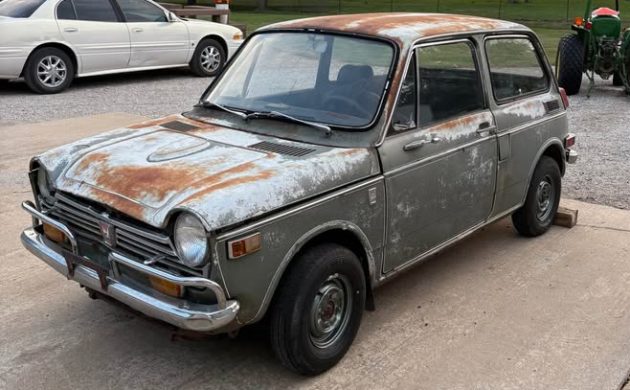
I remember the early 70s fairly well when it comes to cars. At 14, I was already car-crazy, and after seeing the great cars of the sixties, I was even more excited to see 1970 Chargers, Mustangs, Javelins, Chevelles, and the like hit the showroom floor. I couldn’t wait for my license. In 1972, gas averaged just 36 cents a gallon. Of course, just my luck, by the time I got my license in 1974, it had almost doubled to 53 cents a gallon. Around that time, America saw a real uptick in small Japanese cars that got amazing gas mileage. For example, the 1972 Honda N600 is available here on Facebook Marketplace for $4,600. It is in Chanute, Kansas. And Zappenduster, thanks again for a great tip!
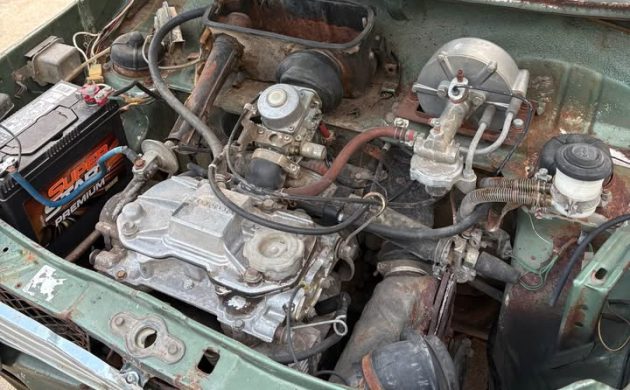
The heart of an N600 is the Honda 598 cc engine, or a mere 36.5 cubic inches. This mighty mite produced about 36 to 42 horsepower, and pushing that through the 4-speed transmission could get it up to 77 MPH. The big thing at the time, of course, was that it got 35 MPG in the city and a whopping 40 MPG on the highway, if you were brave enough to take it. American cars at the time averaged an amazing 13 MPG, which was incredibly efficient. The engine on this example car isn’t running great. The seller says it starts and runs but dies after a while, and they aren’t sure why. However, the transmission is said to have been good during the limited time they could drive it.
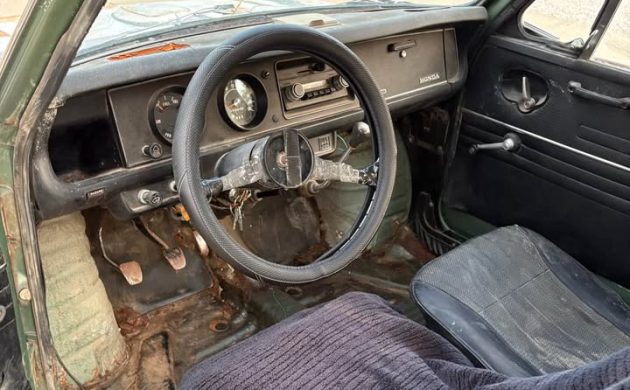
The interior looks like it has seen better days. I think it will need considerable work to be acceptable. Being a front-wheel-drive car, the interior benefits from a flat floor and no transmission tunnel. This gave passengers a roomy feeling despite the small exterior. The original vinyl bucket seats and back bench show considerable wear, and the original black nylon loop carpet is gone. Without it, though, you can see the rust on the floorboards and maybe make a more educated guess about their condition.
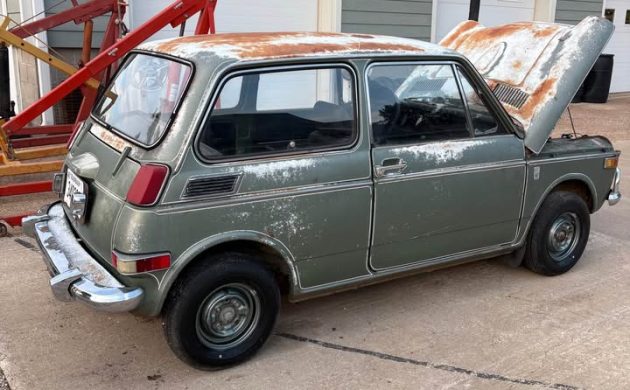
In 1972, you could pick up a brand-new Honda N600 for a tad under $2000. Today, depending on condition, you can expect to pay between $7,500 and $8,200. I’m not sure whether the patina is a selling point or a detractor. The body seems to be in decent shape, but would a clear coat on a 1972 N600 be the same as on a 1950s pickup truck? I’m not sure. What do you think?

That was my first new car. It cost all of $1395 in 1970. When I replaced it with a 600Z a couple of years later, that one set me back $1795.
Sadly, parts are incredibly hard to find, although working on a 600 is pretty simple. The only failure I ever had was a bent valve (no doubt from winding the daylights out of that little powerplant), and I replaced it in my parents’ driveway.
Most of the 600s I’ve seen in recent years were either Roach Motels — many even worse than this one — or restored, usually by Merciless Mings in California. Not really ready to shell out almost $5K for one that needs just about everything.
And I’ve looked. I’d really love to have another. They were great fun and economical all at once. I racked up over 100K miles on the two of them, and never stopped smiling.
I still think it’s amazing, these big car companies today, and what they started out as. The Subaru 360, early Datsuns and Toyotas, and these, just a novelty and never taken seriously. Despite the rise in gas prices, we still continued to drive our gas guzzlers, and even a Pinto was better than these. That all changed when gas prices doubled yet again, ’79-’80 when gas went to $1.19, we took notice and cars like the Civic, and B210s changed our perception of Asian cars forever.
Does anyone remember the hoaky, yet entertaining CHiPS episode where Rosie Greer gets pulled over in one of these, and tears it apart at the side of the road? Classic.
A friend of mine’s Dad had one of these.. bought new or nearly new. I thought it was ridiculous. But he drove it for years and years.Turned out to be a really good car. When it finally wore completely out, they towed it 25 miles to the,Honda dealership…parked around the corner, and drove it in for a trade in.
Awesome patina!
Not sure it’s patina. Bought my Chevrolet Matiz in 2006 and roughly 5 years later the paint started to peal out although the undercoat remained in place. My mechanic for the X1/9 had the same problem with his Mitsubishi he bought around 1995. He applied pressurized water to clean it and the paint went off. Maybe the Koreans (ex-Daewoo then Chevy) were using the same material as the Japanese. Also the profile similarities with my 1976 Lancia Autobianchi A112 are noticable. Probably another case of X1/9 versus Toyota MR2.
I remember seeing one circa 1983, metro Detroit area, and in those days, although it was sort of at the tail end, there was a LOT of hate for these little Japanese cars. But I was intrigued, and I stopped to talk to the kid who owned it. And, being a teenage showoff, he lifted the rear of the car by himself. I have to say, I was impressed…
My best friend in high school had one of these, and I bought one right after graduating college in 1981 for $900, in great condition. Outstanding, well engineered car. I owned several early civics (73-74) as well – all great little cars. Handled like go-carts!
I always wanted to drop a larger engine in one, but did not have the skills at the time.
This one, however, is at best a parts car. Start with a good one – they are out there!
I thought that Honda first entered the auto world in the mid-60s; it seems that I saw an ad in Popular Mechanics about then. The first Honda to ever grace our home town with its presence was a Civic, and that was around 1980.
It took a long time for any Japanese vehicles to make any significant inroads to the Chinook Belt. I think I was one of the first with a Toyota pickup in the fall of ’70 and I wasn’t very popular; there was a very strong anti-Japanese sentiment in my hometown and there’s still a lot of “Buy American” today.
Anyways, this car. The first thing I see is the rust. There’s a rather rough railroad crossing not too far from work. I’ve seen (2) vehicles go over it and break in two. Both were Japanese; one Corona and the other a Civic. Both were rust buckets so it wasn’t surprising, and I might add, anything that rusty would’ve broken in two no matter where it was built.
Railroad crossings and small wheels don’t make out well in the Chinook Belt…
Coppola owns one!
Bought one new in 71, paid $1700 for it, regularly got fifty mpg, drove it to Seattle from Arizona three times at 75 mph. I think we spent about thirty five or forty dollars for gas, round trip, I auto crossed it, and my brother in law even took it down the drag strip for laughs, gave people time to get a hot dog, and be back in time to watch it finish. Think it was 22 or 24 seconds. Sold it after five years of hard use with 48 thousand miles. New owner complained that he had to do a valve job on it.