

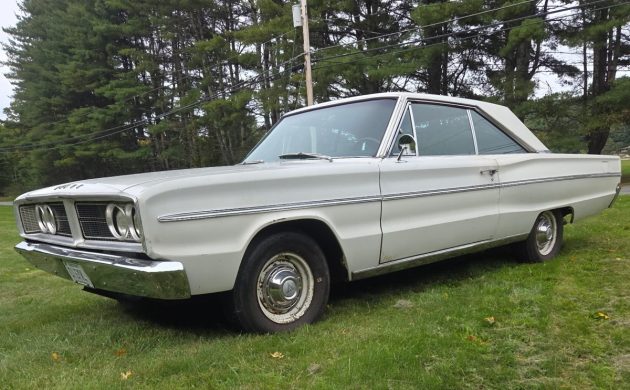
This 1966 Dodge Coronet 440 could be close to the ultimate sleeper. It is tidy without being striking, and it would have blended into the background when it rolled off the showroom floor. However, an almighty secret hides beneath the hood: the first owner ordered this Dodge with the fire-breathing 426ci Hemi. Not only is it rare, but the seller claims the 11,300-mile odometer reading is genuine. They have listed the Coronet here on eBay in Pittsfield, Massachusetts. The current high bid is $32,600, which is below the reserve.
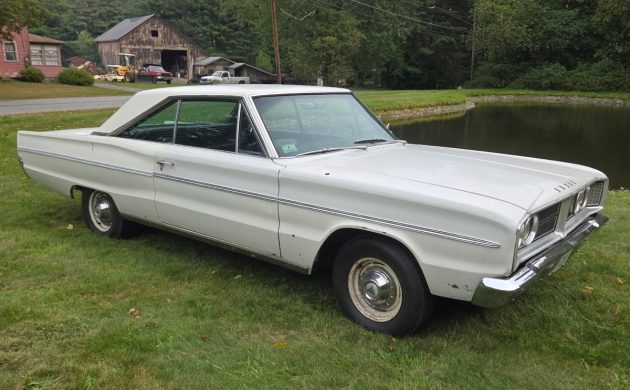
After a five-year break, Dodge reintroduced the Coronet badge to its model range in 1965 with a Fifth Generation that remained on sale until 1970. It was an instant hit upon release and the most popular Dodge passenger car that year. It received a significant redesign in 1966, giving a relatively young vehicle a fresh, bold look. This Coronet is the 440 variant, which sat one rung below the 500 in the price range. It presents as a genuine survivor in Code W White, with the seller stating that approximately 80% of its paint is original. The images reveal chips and scratches, and the antenna is missing from the front fender. The panels look quite straight, with only a few spots of visible rust in the lower extremities. These appear confined to the lower door corners and to the rear quarters just behind the wheel arches. The underside shots are promising: while some areas have heavy, dry surface corrosion that should be treated to prevent deterioration, there is no evidence of penetrating rust. The trim looks acceptable for a survivor-grade classic, and the glass is in good condition. However, this Coronet’s highlight hides beneath the hood.
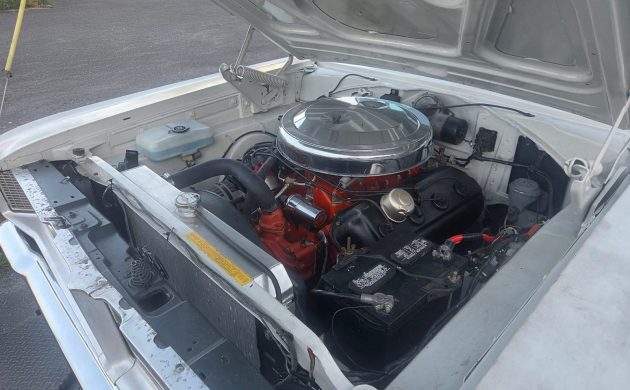
The big news for 1966 Coronet buyers wasn’t the cosmetic facelift. For the first time, buyers could order a Coronet in any trim level with the legendary 426ci Hemi, opening the door to genuine sleepers. This car’s first owner paired the Hemi with a three-speed TorqueFlite transmission but chose not to add power steering or power brakes. Most muscle car enthusiasts can quote the Hemi’s power and torque figures from memory, but for the uninitiated, it delivered 425hp and 490 ft/lbs. That resulted in serious performance credentials for a vehicle tipping the scales at around 3,800 lbs. The first slice of good news is that the seller holds documentation tracing the Coronet’s history to Day One. That suggests that the mileage claim should be verified. They don’t explicitly say this beauty is numbers-matching, but their emphasis on originality suggests it is. Someone has installed an aluminum radiator, but it’s worth asking whether the original is available. If so, it could potentially be restored and refitted to give the engine bay a genuinely authentic look. The embedded video confirms that the Hemi runs beautifully, and potential bidders can consider this Dodge a turnkey proposition.
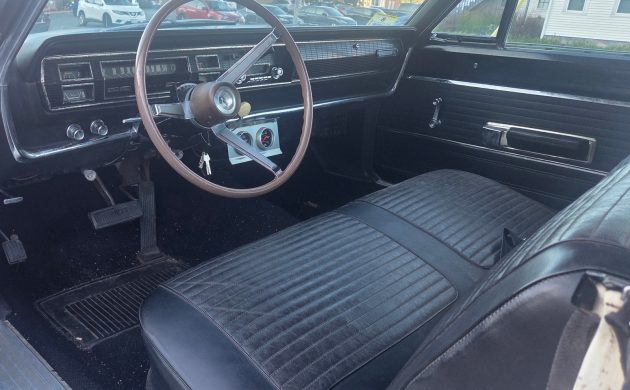
Trimmed in Black vinyl, this Dodge’s only obvious aftermarket addition is the under-dash gauge cluster to monitor the Hemi’s health. The presentation is comfortably acceptable for a survivor, with no ripped or split upholstery. The carpet should look nice once hit with a vacuum cleaner, while the dash and pad are impressive. The equipment levels suggest that the first owner focused primarily on performance because, apart from the pushbutton radio, there are no creature comforts.
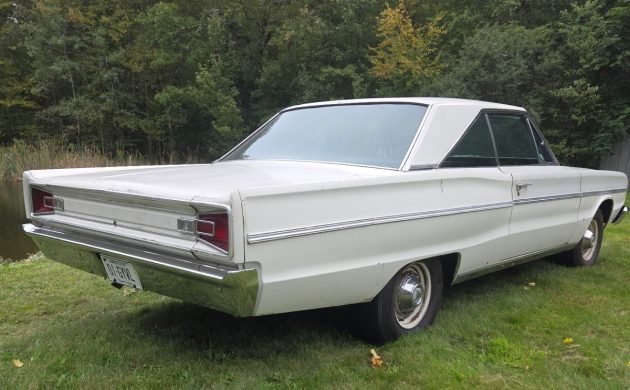
This 1966 Dodge Coronet 440 is what I would describe as honest. It has chips and imperfections, but it looks like the seller hasn’t tried to hide its shortcomings. Some enthusiasts would see it as a prime candidate for a cosmetic restoration, but I’m not sure I would go that route if I were the winning bidder. I would probably treat the minor exterior rust and underside surface corrosion to prevent further deterioration and preserve this classic in its current form. It would command respect as a genuine survivor, receiving growing admiration when people discover what hides beneath the hood. Do you agree, or would recapturing this Coronet’s youthful good looks be irresistible?

Gorgeous car, this is what a sleeper looks like. It will be interesting to see where the bidding ends.
Steve R
No engine call out badges. An early hemi should say HP2 I believe. Of course that was only for several month, then all got the 426 Hemi badges to intimidate the competition. Am I just not seeing a badge? What is the story here, ordered without or later removed? No mention of an axle ratio. Quite odd. If the number of miles traveled is to be true, this was only a track car or a street racer. The lack of badges and standard hubcaps might be on purpose. A low rear would be expected, as I doubt the highway comfort was a concern. I would be wary of this sale, too many questions from what one would assume will be a high dollar car.
Pinto’s questions are the right ones, and one of them has a paper answer. On a 1966 Mopar the fifth character of the VIN is the engine code, and H is the 426 Hemi, so the first thing to ask the seller for is a clear photo of the VIN plate and the fender tag; that same code repeats on both, and again on the broadcast sheet. But all three are Dodge’s own ink, and two of them are bolted to the car, so they identify the car rather than prove what was built into it. The record that slept somewhere else is the Chrysler build record and the original dealer paperwork. The engine itself checks by casting: the ’66-71 426 Hemi block is 2468330, and the casting date read against the car’s build date is the tell. On the odometer, a five-digit drum means 11,300 and 111,300 read the same, so mileage only exists if the paper carries it. And the room is already pricing his doubt: Hemi Coronet comps run about $28k to $76k, and a $32,600 bid with the reserve still on says the buyers see the same missing badges and axle code he does.
All that is in the Ebay ad…..does anybody look ????
“a $32,600 bid with the reserve still on says the buyers see the same missing badges and axle code he does.”
with 3 days left in the auction plenty of time to bring money..
Fair point. Reserve not met at $32,600 only means the seller hasn’t said yes yet; it doesn’t cap the car, and I overstated that.
What the bid does say is that nobody has yet paid Hemi money for a badge-less, code-less car, and those are the two things the market argues about. The check that settles it is the block. 2468330 is the ’66-71 426 Hemi casting, and the casting date read against the car’s scheduled build date is the one tell that isn’t Dodge’s own ink on Dodge’s own body. If that engine is the one the build record shows, the reserve gets met; if it isn’t, more days don’t fix it.
It does have the fifth diget correct, the K-memeber brace and the rear spring brace….badging could have been removed….we had an older guy here in Dallas that finally just taped over the “Hemi” on the side….was sold that way and new owner brought it to it’s first show like that…..this would be a car that needs to be inspected reguardless – with that one negitive feedback out of 6 sales….
Good points, Pinto. Maybe all the badging was removed so it would make it more interesting if this car was challenged to a race at the track. Lots of cars back then and even now take off the emblems so the person they are racing won’t know what engine is under the hood.
Jay Leno did a forward for a muscle car book I have and he was mentioning how when someone saw the HEMI badges on the side of the car, they would just cruise by and look for another car to race.
A few miles from Pittsfield Mass heading west on Rt 20 is Lebanon Valley Dragstrip, the potential for a pure stock Hemi Sunday race car back in the day is there,keeping the mileage low. That’s what I would have done with that car. Pure stock was a fun class back in the 60’s early 70’s when I ran my car there.
All that power to go fast, but still has a single pot push and pray master. Scary
Reminds me of a long ago friend that had a 65-66 Coronet 440. Instead of a hemi it had a slant six. Meanwhile the rich Corinthian vinyl dash and seats were a mass of cracks and sun damage. If it’s still in existence the car could be sold on barnfinds.com with no reserve!
So did Chevy with the 427 cars….all would go to dual’s in 1967….a buddy run’s a 1966 Caprice with a big aftermarket big block – 496? – and aluminum heads on the track with a single pot factory M/C…..he says it just takes a good foot to slow it down to a stop…..
Does anyone know the purpose of the large plastic button above the gauges? (Parachute? Ejection seat? I’d say nitrous, but that’s obviously unnecessary.)
That could possibly be a shift light.
Looks like one of those ad-on horn buttons; maybe the original steering-wheel button failed.
Horn button
Wild guess is that it’s a horn button that got Mickey Moused when the factory horn on the steering wheel died. I remember seeing those type of buttons way back when.
Very cool but mysterious car.
My Dad drove a white 1965 Chrysler Newport, in the mid 1970s. I don’t remember why he sold it. I thought it was a neat car. Nothing fancy, just a stock car, I guess.
My mom had a ’66 Coronet 440 (no hemi). There have been some cosmetic alterations to this car. There should be a, “Coronet 440,” script on the front fenders, above the side molding, near the door, a, “V-8” emblem on the front fenders, just ahead of the wheel opening and the Chrysler pentastar on the lower part of the front fenders, just ahead of the door. There should be, “DODGE,” in block letters across the trunk lid, between the backup lights. It’s possible that it is present, but it is not readily visible in the photo. The grill also looks off. Each side looks like it is designed in sections. The Coronet grill I remember was a uniform stamping.
It’s not uncommon for an owner to have stripped all model and branding id from a body. Just easier these days as most are now attached with adhesives. The filled holes could be part of the 20% non-original paint.
need to see some docs on this 1 and not just an old black /white pic.
Paper work on Ebay……
As a friend used to say, make sure you have it pointed straight before you step on it. Cool old Dodge.
What a great body to hide a hemi in. Awesome.
This is the only way I’d want mine.
Great questions asked in comments above about the veracity of this one. One can hope for the best. And like Steve R says, will be interesting to see where this one ends up.
Right in my backyard but not right for my wallet. 😂
You better really want it.
Should have Coronet script above front fender trim towards the doors. Also should have the 426 Hemi emblem under the fender trim in front of the front wheel well. It seems to have the large front sway bar. The brake pedal pad seems to be milage consistent as far as wear. Title serial number is consistent to a Hemi Coronet. It looks like a low mile car as far as the trunk condition, engine compartment condition and interior condition. In person inspection is in order and i mean spend time looking at every nook and cranny for over spray, abnormal wear etc and scrutinize the paperwork. I personally do not care for 66-67 Chrysler B Bodies but If it could be bought for 50-60K it would be a buy.
Freaking sign me up!!!
There is one downside to this car for me.
I understand many will say you are quicker drag racing with an automatic. But really, where’s the h-d 4 spd? You go get a hemi and you take it with a column shifted automatic?
The Mopar automatic with an adaptor was already being put behind GM motors before GM got it together with the Turbo 350 and Turbo 400.
I was at a car show at the city park in the early 90’s and a guy from Fillmore had a 66 hemi coronet with a 4 speed there. White just like this one, he had the window sticker for it displayed and if memory serves correctly it listed for 3500 or so. As i was looking at it some guy asked if he would take 10 times the list price for it and the owner said no, I thought he was nuts. The price guides were listing these cars at 25K or so back then in nice condition. What I thought was interesting about the car was it was the only Hemi car sold through McCarty Motors in Savannah MO. They also only sold one 63 Plymouth with the 426 cross ram motor, at least that’s what the old timers were saying 30 plus years ago.
Auction ended, reserve not met at $59,100.-