

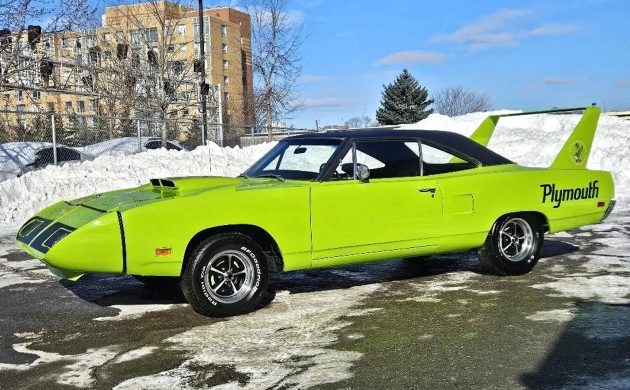
There seem to be quite a few Plymouth B-Bodies running around that have either been cloned into a Superbird or turned into a tribute, and at this point, I’m wondering if the number may have now passed that of the 1,935 or so that are thought to have originally been produced by Plymouth and Creative Industries all those decades ago. Some of these builds have turned out better than others, with this 1970 Plymouth Satellite here on Auto Trader in Toronto, Canada, appearing to be a very respectable effort. It also costs less than the real thing, and the seller hopes you’ll see $79,900 CAD worth of value here. Jack M., thanks for finding this cool winged Mopar and sending us the tip!
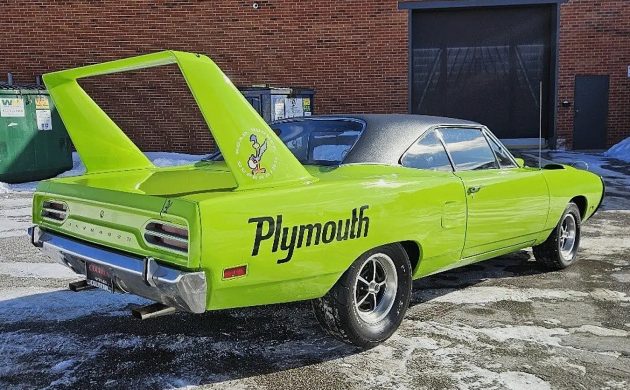
This one is reported to have begun life as a 1970 Satellite, but beyond that tidbit, we don’t get much more information about the car’s past. Not that it particularly matters anymore, as there’s little left that would indicate this was ever anything but a bona fide Superbird. However, those with a keen eye will notice a few inaccuracies, including the front fenders not being the proper modified Coronet components, and the absence of steel A-Pillar caps on each side of the windshield. That’s the advantage of a tribute over a clone, as a visionary has the choice of taking a few liberties here and there. One thing that is true to the original form is the fit of the nose cone, as it’s not lined up perfectly, but many of the originals weren’t exactly right either.
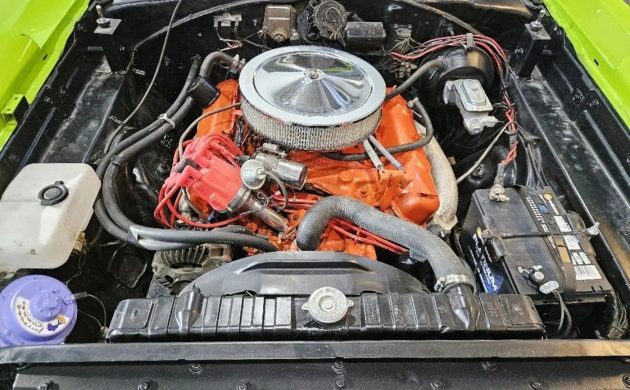
It’s not specified which engine originally powered this Satellite, but in the bay now is a 440 with a 4-barrel, which was indeed one of the possibilities for the Superbird in 1970. Beyond its size, most everything else about the big block remains a mystery, including the date code and where it came from. That’s an aftermarket scooped hood as well, with no springs and four pins holding it down instead of the customary two that would ordinarily be found here, so it lifts off for easy access. It’s nice to find the proper horn here: a purple unit with the correct decal reading “Voice of the Road Runner.”
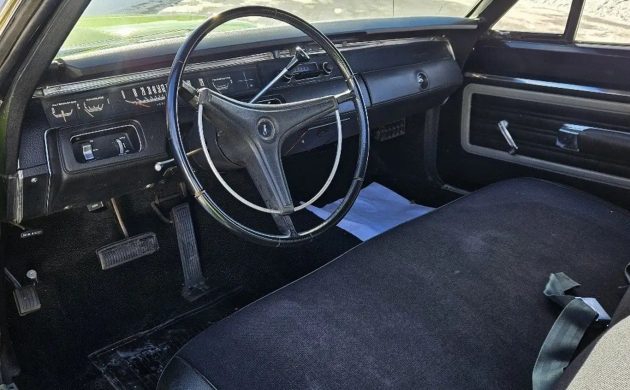
One advantage of starting with an actual Road Runner for a tribute or a clone is that you get the conventional round-gauge layout, and many of these transformations retain the less-sporty Satellite instruments, as can be seen here. However, numerous legitimate winged cars came equipped with a front bench and a column-shifted automatic, so that’s not unusual, although I believe the factory upholstery was a bit snazzier than the material covering these seats. This one appears to have turned out pretty well overall, and I’m a fan of it being 440-powered, as a few of these transformation examples have kept the 318 under the hood. What are your thoughts on this 1970 Satellite in Superbird clothing?

Nice work, Mike! I love how you called out the Satellite dash and other features. I still really like this car; it’s probably not much worse than a fiberglass “Ferrari” on a Fiero chassis, a “fake” Shelby Cobra, or any other number of tribute cars. I’m guessing this one would draw a nice crowd every time you stopped for groceries or gas.
True….it’s not much worse, because they are all terrible.
Scotty,
You are just way too polite.
$80,000 -YEAH RIGHT – I don’t even think Bare***Jack*** could get that kind of money for this so called tribute.
$58,500 U.S. dollars.
Tribute = counterfeit.
Why do people do this?
Originally Plymouth took one of their cars and made a Superbird. So also did this builder take a car and make a Superbird. It ain’t perfect but 98% of the people seeing it won’t know the difference.
That’s why they do it.
So you support counterfeits. Got it.
Also cuz like 98% of the people on this site, can’t afford an authentic one. So a clone is just as good, just as fast, handles just the same if not better etc etc.
Because even if you could afford a real one, you wouldn’t dare drive it on the street. I’d much rather have this car and drive the hell out of it!
Part of the definition of counterfeit is the intention to deceive.
In no way is a seller calling their creation a Tribute a counterfeit. No claim of originality is being made.
Lifting a VIN from an original and attaching it to a clone and then selling it as an original = counterfeit.
They were far from perfect, I’m talking about most American made muscle cars from that time, not a critique, I liked that about them, so when you get one thats even over restored I believe you’re wasting your money. As for clones, tributes, I’ve heard them referred to as clown cars, fakes to be kind, keep the language clean. I don’t personally have an issues with them because they’re not trying to pass them off as legit. This hobby was about enjoying these cars, driving them, it morphed into buying a fantasy, over paying for them because someone else says they’re worth it, that’s what we should be angry about, the lie. It’s just a car.
Most of these sat in dealer showrooms for months, they couldn’t give one away back then. If we only knew back then what we know now.
I remember back in the late 70s somebody took a 1970 Plymouth Road Runner that was nose hit and found a Superbird that was damaged and made the Runner in a Superbird. It look great and many thought it was the real deal. Back then we call them fakes. But it had a 440 begin with. It was just taking apart the nose and putting it on the Runner etc etc. It looks so original it was hard to tell until you looked in the trunk how the wing was mounted. This Supersatellite needed to go further with the dash and molding around the windshield. And correct hood. Plus anything else. Yes it takes work to get it right instead of half fasted!!! Also what about the torsion bars? Are those from a 318 or was the Satellite a big block car. It does look nice 25 ft away. I would pass on it. Even at American money $58,000 is alot. Good luck to the seller. 🇺🇸🐻
It needs the 70 Coronet front fenders to match the nose
Yep, just was going to mention this.
Every time I see one of these “Tributes” I wonder if the builder has gone the extra mile and added the Coronet front fenders.
Fiberglass replicas of the fenders are available, most likely because the stock ’70 Coronet fenders were modified a bit.
Yeah, sure. Maybe this is a first attempt to get it to another home.
Take the base car value and add $15 K for parts and labor, and that’s what these tributes are all worth, max.
I’m a Mopar fan, and I never saw any sense in the Superbird. The Dodge/Plymouth dealership where I lived had one on the showroom floor, and all it did was gather dust – to the point it was embarrassing. I guess the price was too high or most Mopar fans saw it as I did – ridiculous. — The nose looks “stuck on” like the fake hood scoops people would put on their cars back then. If the gasket was color-coded with the body color, it would have looked a bit better – I guess.
And the clothesline spoiler looked super-ridiculous to me. If the cross member was functional and adjusted with speed, or had a razor sharp stainless steel leading edge for trimming low-hanging branches then “maybe” I would have thought differently about it. I thought it could be a good place for teenie-bopper guys to display their stolen panty collection through town, but otherwise – just an irrelevant eyesore add-on.
And I think you’re correct; there’s more clones of the Superbird now than there was original production of them, and that boggles the mind too. — The asking price; over $58K American is probably going to do as much for selling it as the price of them new did for getting them off the showroom floor.
But – that’s just my Mopar fan opinion. I guess there’s some former 12 years olds that drooled over them when they were new for there to still be a market for them. We’ll see….
I was that kid drooling over the Superbird in 1970 when they came out, except I was 16. One of our local dealers had an Alpine White one. I tried to convince my mother she needed it, her response was she’d “never have trouble finding it in the mall parking lot.” It was actually only there for a week or two before it was sold…or went somewhere.
You may be a Mopar fan, but you may not understand the Mopar winged cars reasons for being. Chrysler didn’t build them because they were practical, or because they would be popular. They were made with one purpose in mind, to make the nose and wing legal for NASCAR racing. I don’t think Chrysler cared if they ever sold a single one, they just needed to build enough of them to homologate them to race. The Superbird and Daytona weren’t built to be pretty and no one cared if the rubber seal around the nose cap was large and unpainted, they had one purpose and one purpose only, to win NASCAR races. It wasn’t intended to be a sales success. Everyone at Plymouth knew it wasn’t going to sell well, the Daytona didn’t sell well the year before, but they weren’t building them to sell. Sure the rear wing looked ridiculous, but so did the wing on Jim Hall’s Chaparral’s, and unlike the thousands of wings on all the Toyota’s, Honda’s and Mazda’s running around today, the Superbird’s (and Daytona) wing actually worked.
If you weren’t aware, in early 69 Dodge released the Charger 500 with a flush grille and flush rear window to improve speedway racing aerodynamics. Ford immediately countered with their slant nose Torino Talladega and Cyclone Spoiler II, causing Dodge to up the ante with the winged Daytona. Plymouth wasn’t happy that Dodge had the Daytona, and wanted to get Richard Petty back from Ford for the 70 season so Chrysler management agreed to let Plymouth build the Superbird. Plymouth made Road Runners and GTX’s to sell, they built the Superbird to race.
As a kid I loved racing, I followed racing, I later got involved in racing, and I continue to be involved still today. I knew why they built the Superbird and Daytona and I understood why they looked like they did. I also loved all the other racing specials the automakers made in the 60’s and 70’s. The Z11 Impala’s, the Charger 500’s, the Torino Talladega, the Cyclone Spoiler II, the Z/28, Boss 302’s and 429’s, the Monte Carlo Aerocoupe, the Grand Prix 2+2 and others were all built for one purpose. Many of these cars were awkward looking. None (including the Z/28) were ever built with the intention being a sales success, that wasn’t point. They were all only built to legalize mechanical and/or body parts for racing. They were special then and still are today!
Do I like this car, no but I still like real Superbird’s and Daytona’s.
Yes – I know all of that! — My post was about the looks of the car – not the reason it was built in the first place. — There’s body design alterations developed for stock car racing I would not want on my street car. The Superbird is a very good example of that – functional on the race track at 200mph+, but looks ridiculous on the street — similar to a Bonneville salt flats racer that functions very well for attempts to break the sound barrier on the ground, but I would not want a version of it as a street car – it would look ridiculous on the street – and besides – where would you park it?
Are these “clones” really pulling that kind of money? I don’t have a problem with the creation itself, it actually appears to be fairly well done, but 58k seems like a bit of a reach to me.
I don’t know, but I think a lot of people forget the fact that these were made for NASCAR homologation compliance and only aerodynamics would get these cars to the speeds they wanted. These weren’t made to go to the mall or get groceries. These Superbirds along with the Daytona Chargers were designed by engineers at Chrysler to break 200mph on the track. One was even used by the EPA to take air samples of airplanes taking off in runways due to the high speeds these cars could attain.
Call them fakes, clones or whatever, for those who like these cars, it might be the only way they’ll get their butt in the drivers seat of something remotely resembling an original Superbird. The costs of “collectibility” has ruined this hobby and made some cars made of “unobtainium”. I’ll take a fake Shelby Cobra any day of the week and drive it like I stole it because I don’t have a million dollars sitting around to buy an original. Someone might like this car because they done have $300,000 for an original Superbird.
Unless you’re doing a 150+mph,the wing and nose don’t much in the way of aerodynamics,but the car is a head turner for sure,100% pass for a Superbird at first glance or to the untrained eye….
Someone I knew drove several of these cars and even at 100 MPH he felt that compared to a standard B-body Mopar, the rear wing made the car much more steady.
this really looks bad to me. its fake that’s that. those tires sure are sweating it
All that work and it has an automatic on the column?
I’m not a Mopar expert, but I believe that the automatic on the column was fairly common.
Yes it was – and besides the looks – on the column or on the floor an automatic tranny functions exactly the same. If it was a manual tranny, then “yes” – a floor mounted shifter provides an advantage over a column mounted shifter. But with an automatic – no difference.
If you see a real Superbird at a car show, you are more apt to see a column shift automatic 440 bench seat than anything else. That’s because a vast majority were built this way. Most of the hemis were 4 speed manuals. but as we know very few of these were made.
I was surprised when I saw my first Superbird up close and saw that column shifter.
I’ve no problem at all with this build (well, maybe the hood) including the column shift. How many Camaro SS, Chevelle SS and Eleanore clones/tributes have graced this site with nary a whisper about their provenance?
Remember that the Road Runner was a bare bones car with a big motor. The SB was the same with the body kit to homologate it. As for the interior, a neighbour had bought a brand new 68 (or 69) RR with column shift and bench seat for drag racing. Possibly it was lighter.
How undesirable were these cars when new? A relative worked at Chrysler and was required to take one as a company car.
What didn’t help was greedy dealers who thought they had a hot property and jacked the prices up beyond what the potential market could afford and the insurance companies were killing the muscle car market. By the time they realized they screwed up, it was too late. NASCAR had restricted and then banned the winged cars.
From what I understand, these cars were not desirable when they were new. Many sat in dealers unsold. Some were even converted back into regular Road Runners by taking off the nose cone and wing from what I have read in the past.
If you guys remember a gentleman named Big Willie Robinson, he was given three 1969 Daytona Chargers. It may have been because they had surplus of those cars and maybe they thought he could draw some attention to Dodge? No idea…
The people who own these tributes are the ones who love the look but can’t afford or really want to own a real one.
I saw one at a car show painted this same color and people were flocking to look at it. The owner kept telling people that it was not a real one, but that didn’t stop the love of looking at it.
I’ll take you automatic but on the floor I would never have a genuine muscle car with an automatic on the column it’s just not me
Obvious difference in looks, but what’s the difference in performance? — None.
The actual winged race cars are pure demons. It took lead ones to drive them. There is at least one on display at Talledega.
They had very little of the roll cage of modern stock cars and were bare-boned beasts in every aspect. They were also on the ground, with huge tires and slightly re-worked bodies to fit the tires. Real race cars.
The street cars always looked goofy to me. They sit way too high, with too much ground clearance and not enough rubber. There was no street purpose to them except to qualify as race cars.
Exactly!
Correct. These Superbirds are a bit like the Model A Ford, there are more of them still on the road than were ever produced originally!
“This one is reported to have begun life as a 1970 Satellite”
And it should have stayed as one.