

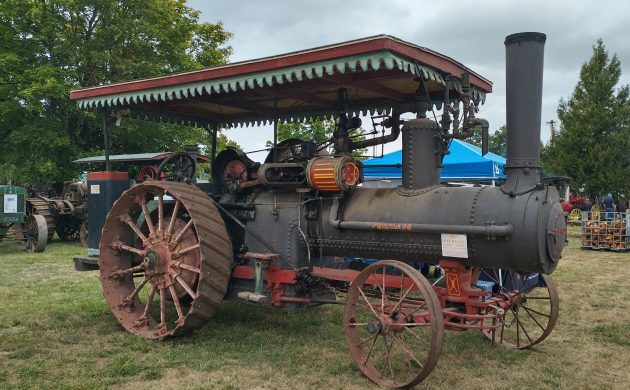
Every time I attend the Steam-Up, I am reminded of the innovation, ingenuity, and sheer brawn of America’s beginnings. Early inventors overcame so many obstacles in our underdeveloped country to bring us the machinery of progress. It’s events like these that hone my appreciation for our forebears. So let’s take a tour… This first machine is a 1914 J.I. Case 9×10, which refers to the bore and stroke of the single-cylinder engine. This guy’s boiler is wood-fed and runs at about 150 psi. That wheel is about as tall as me, 5’6″, and this whole contraption tips the scales at over 21,000 lbs. These tractors were made until 1923, and like most in their day, they could function in many ways, from threshing to running a belt or hauling a plow.
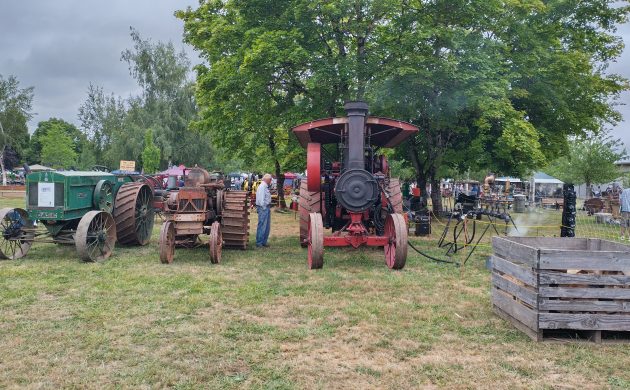
The two tractors on the left here were for display only, but the one on the right was steaming away, getting ready to take a turn around the track in the parade. Boxes hold cut wood so owners can feed the beasts throughout the day. The air was filled with the burned-wet-wood smell particular to these engines, along with the mesmerizing sounds of “pop-pop”, whistles, and hissing.
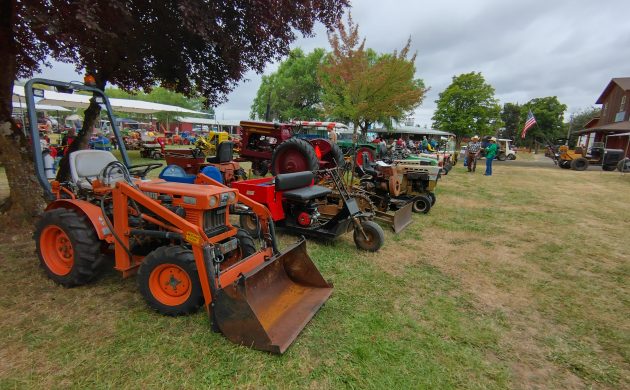
If you are a tractor fan, you’ll faint – there’s so much to see. This group was a fraction of the “vintage garden implements” section. Around the corner, kids sat on their hopped-up garden tractors, getting ready for the tractor pull. Some featured elongated frames and wide tires.
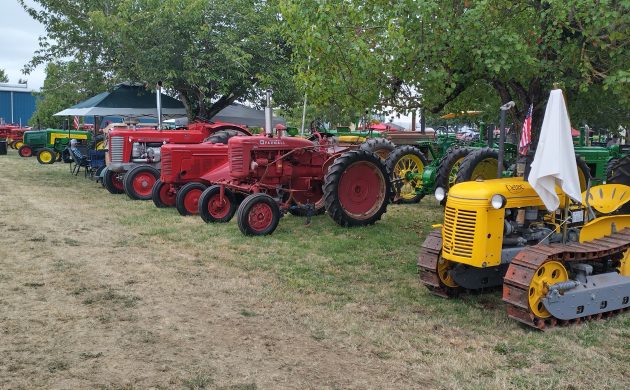
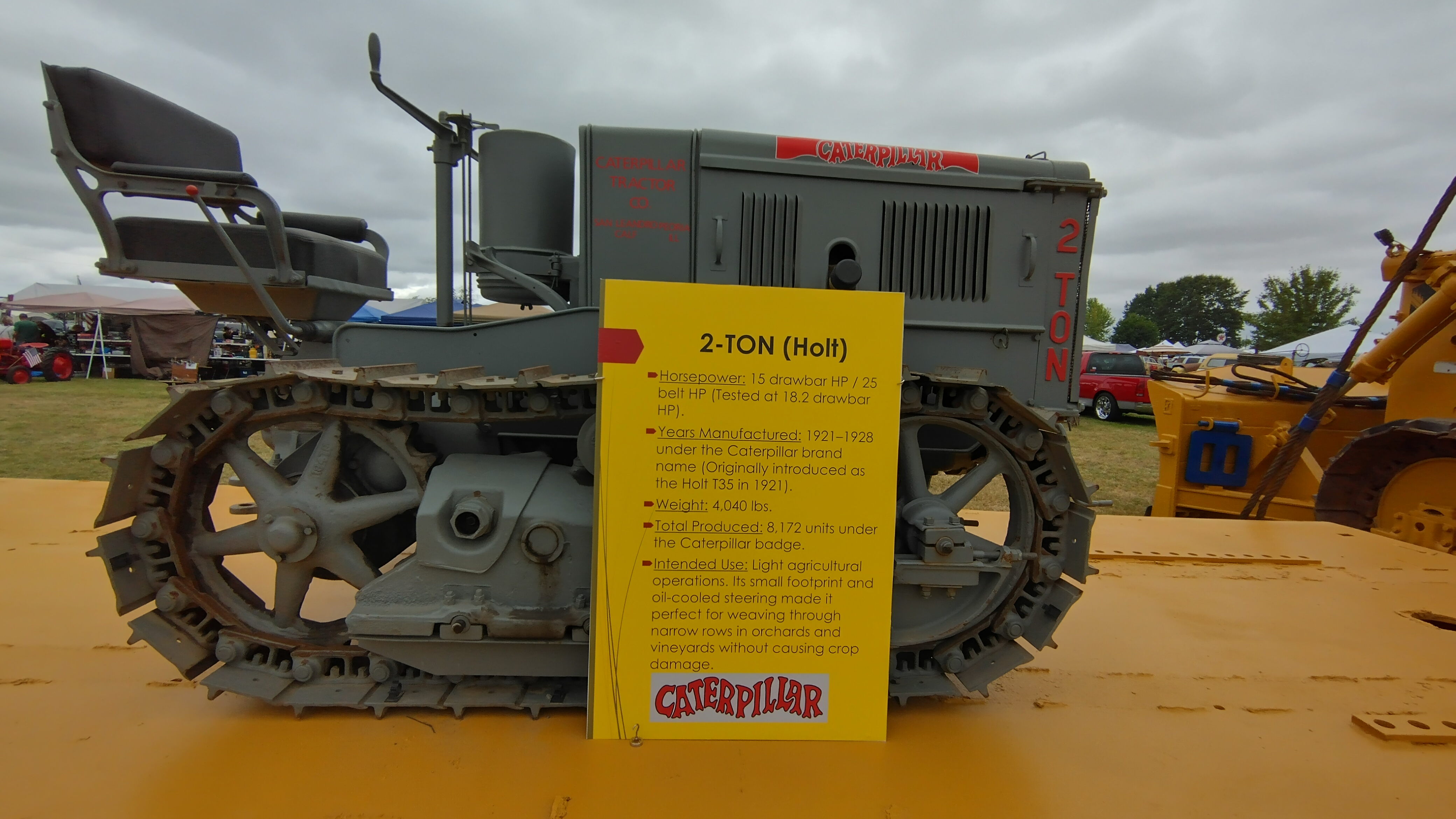
Here are the big-boy tractors, about a tenth of the display, and this doesn’t even count the multiple museums. Caterpillar brought a couple of giant modern tractors with a yellow beam slung between them, and on that steel beam sat Cat’s earliest machines, from Holt and Best. This early Cat was from its “grey days” before it began using yellow paint. It’s a two-ton, introduced in 1921 under the Holt name.
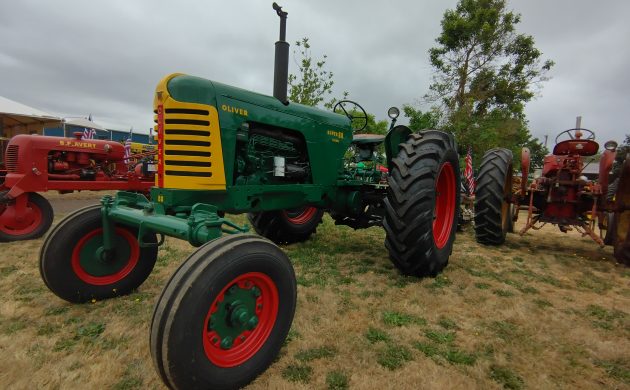
I love Oliver tractors, and here’s a beautifully restored Super 88 diesel. These were made from 1954 through 1958; this one is probably a ’56 or later, when the wheels were painted red (before that, they were green). The engine is a 4.3-liter six-cylinder throwing about 52 hp to the drawbar; the gearbox has six forward speeds and reverse. The “Super” referred to several improvements made over the original 88 launched in 1951, including a heavier frame, stouter axles and hubs, and disc brakes. The PTO is operated via a hand lever by the driver, and it can turn independently of the tractor’s movement, which means you can turn it on or off, whether the tractor is moving or not. Sweet! This was a beefy, reliable tractor with a great reputation, very collectible today.
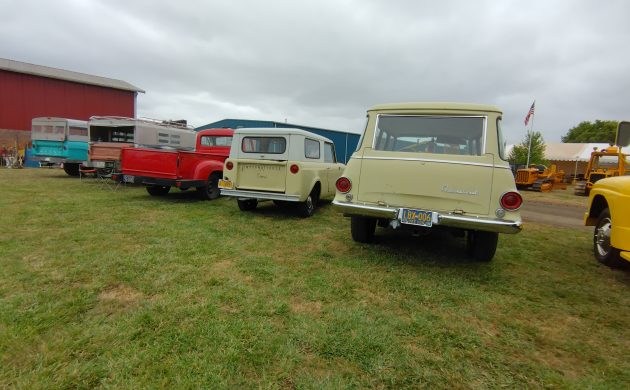
Trucks, oh sure. Here’s a flock of farm vehicles. Didn’t see a Diamond T, unfortunately, but just about everything else was there.
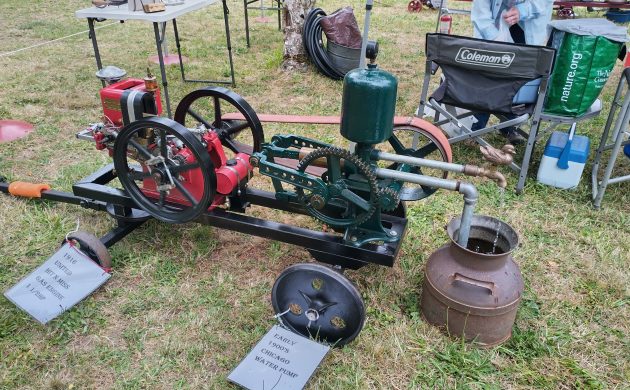
It’s hard to know where to stop throwing up photos …. Here’s a terrific hit-and-miss engine display, one of dozens. The hit-and-miss engine skips combustion cycles as a way of regulating its speed. If you’ve never heard one – well, you need to put the Steam-Up on your “to do” list for that reason alone. It’s a hypnotic sound. This particular hit-and-miss was busy pumping water. It was perfectly restored and tended by its owner. A few feet away, a guy had three of these set up: one to shuck kernels of corn, one to grind the kernels into poultry feed, and one to shred the cobs into forage for livestock. Another guy was using an engine to saw a 24″ log. Fun!
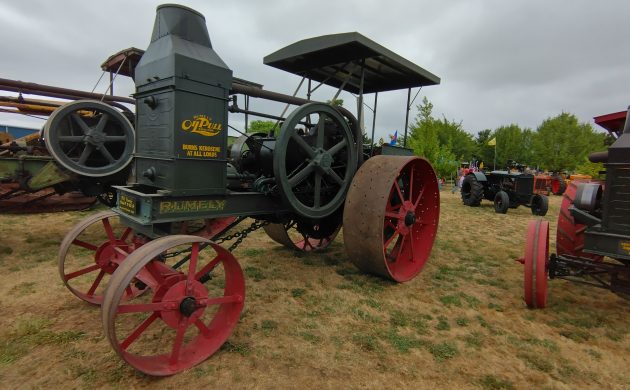
Ok, just one more photo. This majestic guy is a Model F Rumely Oil Pull made in 1913. The Oil Pull cools its giant single-cylinder engine with oil, not water, allowing the engine to burn kerosene at high temperatures. That big tank on the front of the tractor contains the “radiator”: exhaust from the engine is piped into the tank’s top, and since the exhaust is hot, it rushes up out the stack, creating a draft, which draws air up through the tank’s bottom past the radiator. The engine delivers 15 hp to the drawbar, 30 to the belt, and it produces scads of torque. These tractors weigh about 8.5 tons. The starting procedure involves spinning that flywheel with the operator’s body weight, and leaping back to the cab to adjust the choke – oh, and there’s a lot of fiddling with the fuel too, to coax a start. I’m just as happy to watch the action from the sidelines, and there’s plenty of it at this premier event!

Wow!!! Where to begin. This is great Michelle. And I now have another event I would like to get to one day. Its just fascinating all the early technology, the use of steam, diesel kerosene, the hit and miss engines ( very good on gas usage). That 1914 Case is a monster. And seeing it parked next to a couple other tractors and the gentleman standing there definitely emphasize the size. Thank you Michelle. This is great.
Well, ( anytime it starts with “well”, better settle in), filter permitting. I logged out and in like the boss says to do, but still having issues. But a testament to the Barn Finds sprit, to keep trying. Dave beat me to it, and probably the only other human up at this hour, going to work, I presume, please be careful today.
It’s clear, this event surely put a nickel in the author, HOWEVER( oh, here it comes), where is everybody? I see a couple guys in the 3rd pic( been farmin’ long?), but not many attendees. I’m trying desperately to “stay with the program”, but am inching closer to that recluse in the UP, because, I can still involve myself in this culture. Heck, some of my friends still use some of these tractors. It’s something I could see our own Scotty G camped out at the gate, 1st in line,,no wait, 2nd, behind Ms. Rand. The small town I left in N.Wis. Phillips, had a Case steam tractor much like the 1st pic. This will test the filter, I found out what the term “balls out” meant and not near what I thought. There’s a device on the top of the boiler, that spins and has 2 round shaped objects, that with centrifugal force, spins out and releases steam. So a governor, of sorts. It was on display in a local park, donated by a family that homesteaded the area. Naturally, it had fallen into disrepair. I was told by the city, 2 older fellas kept it looking nice, well, you know where this is going. They died and nobody replaced them.
I certainly don’t mean to be the wet blanket here, we( all 8 of us) yearn for this stuff, but I remember shows like this were PACKED with attendees. The steam ones are incredibly dangerous in the wrong hands, and I’m sorry, most of those “hands” are gone now. Be like me at a computer show, no big deal.
Have fun with the future, folks, generally, the kids of the owners of these machines had something to do with the restorations, and the show, but some kid today, unless otherwise shown, will have no connection. Sound familiar? Thanks again.
Thank you Howard. I most certainly try to be careful. And yepper up at 4 am every day for work. Its not to get on here during the day. And Michelle again this write up is phenomenal!!! Thank you!!!
I’ve been retired for 6 years but always had early morning starts but to this day i’m up between 4 or 5 am,but i don’t get BF till 7:30 on my phone.
My father – still with us – graduated from high school in Phillips, WI in 1955. It’s the kind of small town that after having breakfast in the diner twice, on your third visit the waitress will ask, “The usual?” The ‘fuzz mill’, as Dad calls it, is no longer but the locals have ambitious plans for the footprint. The Elk River chain is delightful, and the area doesn’t receive the same pressure (SHHHH!!!) as nearby tourist traps. Too many other great memories for here, but I appreciate your roots, Howard! At 88 Dad still enjoys a good steam show.
Howard,
Time to appreciate we still have these shows and more importantly, the people who want to showcase these wonderful machines. Just like the folks in aviation, who continue to fly and maintain airplanes older than some of the tractors. The world, hopefully, is starting to wake up to the fact that analog was wonderful, and produced these amazing machines.
Hi Howard, just a note here from the person actually on the grounds. I had to wait 15 mins in line (on the early side, too, shortly after the swap meet opened) to get a ticket. My administrative assistant at my company helps run the kiddie railroad out there, they had near-record 1700 admissions just on Saturday for that exhibit. The show itself grew so popular that a few years ago, it was extended to two weekends from one. When I arrived, the lines waiting for the RR were long, the swap meet was packed, and the museums were simply impossible to navigate. That left the stationary exhibits fairly open. However, in some cases I still waited several minutes for folks to clear from the photo frame before I took these shots. I would say this show is as crowded as ever.
That is really great to hear, Michelle, thanks for sharing that. One does get tired of the naysayers.
And btw, fantastic write-up!
That is very encouraging Michelle. One day, I’m hoping my wife and I can make those lines 2 people longer for sure. Thank you again for this.
Hey Howard, I’ve got a few minutes between regular chores and digging taters and read your comment. Son, you have got to get out more! The Bridgewater show I mentioned below has gotten so big you have to park at the high school a mile out of town and take a shuttle bus to the show! A good portion af the tractor owners are in their teens and twenties, the steam engine owners are older, but those machines require more time and money. You should be here in May for the Drive Your Tractor to School day and watch the parade past the house. The County Fair circuit has started and if you want to see young people involved in Ag and Ag machinery come to the Valley!
Hi Howard! The term “balls out” or “balls to the walls” came from Jolly Old England with their governors on steam locomotives. They traditionally had 3 balls suspended that flew out farther as speed increased. Most actually used them as speedometers as the distance covered was rarely enough to get “the old girls breathing hard” !
Excellent article Michelle. Terrific machinery. I’ll second your observation about the ingenuity it took to develop this machinery… without a computer in sight.
Great stuff Michelle!
While you are there, make sure to check out everything Powerland has to offer. There is vintage EVERYTHING there, including trucks – but also trains!
Imagine the steam cars from this same era. There was a fellow back east who restored and sold Stanleys, but I could not afford one. I remember steam car owners claiming they never had to slow down going up the Grapevine, a steep stretch of I5.
Michelle, what a great write up!!!!! These shows are great to observe the improvements in agriculture over the years. This is obviously a west coast show.. There are many of them in the country, especially in the upper midwest, so at this point I will throw in a plug for a similar show in the east. The Dacusville SC Heritage Assn (GPS Easley SC) farm days on Labor Day weekend. Well over 300 farm tractors, steam engine, sawmill, Trucks sponsored by the ATHS Palmetto Upstate chapter, Cars displayed by the local chapter of the Early Ford V8 club, hit and miss engines with a couple turning ice cream freezers with ice cream cones for sale, kids activities including a pedal tractor pull, flea market and music.
There is an Old Thresher Days in Mt. Pleasant, Iowa which has some of the same tractors on display, there used to be a meet just north of Cedar Falls, Iowa but don’t know if it is still going!
This is fantastic, Michelle! I’d love to attend that show someday. We have a big one in Northwestern Minnesota as well.
https://rollag.com/
https://rollag.com/about/attractions/
A lot of farming states have these steam thresher/tractor shows, and 40,000-80,000 people visit the MN show over Labor Day weekend. It’s fun, and dusty, and smells like coal smoke, and has great church “stands” with fantastic food, not to mention a steam train giving free rides around the perimeter. 2027 has to include Steam-Up in Oregon!
The Bridgewater Va steam and gas meet was 2 weeks ago, haven’t been in years. Usually draws 2 dozen steam engines and probably 100 tractors plus lawn and garden stuff. Saw milling, threshing, tractor pulls (grudge matches drawbar to drawbar!) Years ago they even had a steam shovel. Good times!
Very COOL(haha) write up of the steam powered vehicles!!
Love reading about these!!
I remember one summer I had my 65 Cadillac in the car show at Granger fair in Mechanicsburg Pennsylvania and they had a small steam engine running and a young boy asked the owner how much horsepower it had and of course it was very low for the size of it. He looked at the old man, he said “you should put NOS on it”.
It was kind of funny.
Are the steam boilers inspected/certified in Oregon? It was a long time ago, but one exploded during an event in Pennsylvania and caused fatalities. They’re old and cool, but are they safe?
Yes…these have to be inspected every year by some officials from the State of Oregon.
There was a recent article about a mobile steam calliope that blew up enroute to a fair!
Awesome job Michelle , if anyone can make it the 69th annual Northern Illinois steam power club show is August 13-16 2026 in Sycamore Illinois. It’s a neat place to step back in time , a steam whistle goes off at noon to notify everyone that’s it’s lunch time . Good family friendly show .One year our model A ford club traveled from the south suburbs of Chicago to Crown point Indiana for there steam show another very good time . Seems these large steam powered tractors were used in the west to bust the sod and after a few years became obsolete when smaller tractors were invented . It’s pretty neat to watch a Rumley started as mentioned turning that large flywheel and then hearing the puff puff when it fires and the smoke . And also if you get a chance to see the power takeoff huge belt thrown on the power takeoff wheel it’s amazing to watch . Just imagine how many lives were lost or injured back in the day ! Some shows have a dynamo that owners can hook up to there machines to check draw horse power , when a load is put on an old tractor it’s neat to see all the carbon start to be removed through the exhaust .
Sorry to go on for ever here but it’s a neat experience
Passion for these mechanical beasts is a beautiful thing! I deeply appreciate everyone who can add a little color to the past. So go on and on if you like, you guys make these stories come alive.
Did you see the newly restored Best steam logging tractor? Roots of Motive Power was attending.
No dang it, as soon as I got into work this morning, Jennifer, my train loving assistant, asked me the same thing. I don’t know how I missed that monster, but there’s always next weekend!
These events are all across the country in late summer. Biggest one in the Midwest is the Midwest Old Threshers event in Mt. Pleasant Iowa, a 5-day event ending Labor Day. I’ll be there with ’64 IH Scout, 61 Case forklift, ’40 Oliver Model 60, & a 1/4-scale Advance Rumely steam tractor. http://www.oldthreshers.org
Actually that is how our Dacusville show started. 50+ years ago The McConnell family went to Mt. Pleasant Iowa to that show and came home and told the neighbors “We can do it TOO!!!” and we have had a show in the Greenville SC area ever since..
Many years ago we went to the Porter County (Indiana) steam up. Back then (1980?) They supposedly had one every weekend during the summer. They used steam to run a saw mill. They had a 3 cylinder Shay steam locomotive. (3 vertical pistons turning an external crank side running beveled gears on the right side ) A very cool thing to see. (I believe that the Roaring Camp Railroad in Scott’s Valley CA has one also) The Porter County event also had a good many hit and miss engines. A great way to spend the day!
That Super 88 Oliver is too cool 😎 🚜
I too have enjoyed Steam-Up. I remember seeing a Ferrari! But that company was headed by Carlos, not Enzo, and no, they were not related. There were a couple of Lamborghini’s. One was a crawler. Lamborghini still makes tractors… and the occasional sports car. Also a few Porsche’s, from before he likewise decided making sports cars was more fun, than making tractors. But the stand out of all of them to me, was the Field Marshall Tractor. Three moving pieces in the entire engine. A piston, a con rod, and a crankshaft. A 255 CI, single cylinder, (6″ bore x 9″ stroke), with no electrical system, no starter, and will run forwards, or backwards. It is started with a 12 GA shotgun shell, and could be made to run, at 0 RPM. If the engine is running, but the crankshaft never makes a complete revolution, in either direction… it makes 0 RPM!
But, Steam-Up also has a functioning steam saw mill, a flour mill, a Caterpillar Museum, a Semi Truck Museum, Threshing Machine demonstrations, a full size, a miniature, and model railroads, and a HUGE Swap Meet. Plus, plus, plus… it is impossible, to see it all, in one day!
While other events seem to be faltering or losing their core, the Oregon Steam up is the exception. Wonderfully curated with so many enthusiasts venues, great overnight trailer parking, evening get togethers, a massive swap meet and clubs that are easy to join and participate in.
I went to steam school there before I had my own Case and was able to drive mine and others that were residing at the park as they had more tractors than engineers.
It is a throwback to the type of events that existed 30 years ago but have largely disappeared. Fantastic event.
Perhaps we could have a BF meet and greet there some year?