

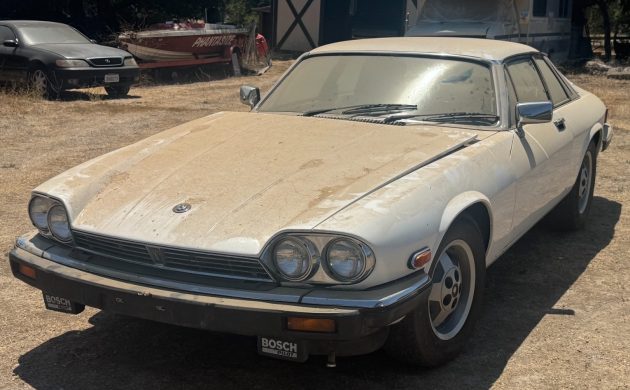
The accumulated dust tells part of the story. This 1984 Jaguar XJ-S is a genuine barn find that recently emerged from fifteen years in storage. It doesn’t run or drive, but life in a favorable climate has protected it from the rust issues that often plague these classics. The seller purchased the car at an estate sale, but with too many projects on their plate, they have decided the Jag needs a new home. I must say a big thank you to Barn Finder Steve H. for spotting the XJ-S listed here on eBay in Buellton, California. It has received a solitary bid of $200, and with the seller following the No Reserve path, this British classic is guaranteed to change hands in a few days.
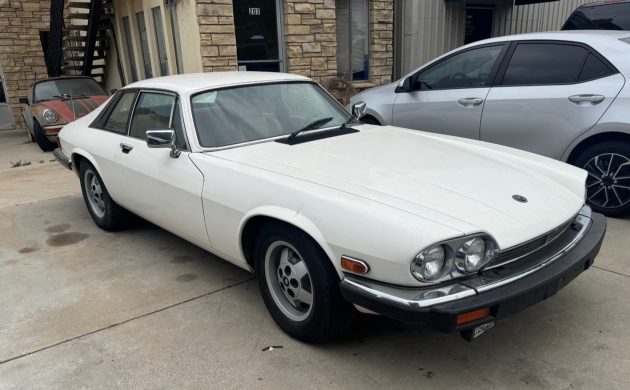
Conceived as a replacement for the venerable E-Type, Jaguar commenced initial development of the XJ-S in the late 1960s. These were tumultuous times, especially since the company formed part of the backbone of the strife-torn British Leyland behemoth in 1968. Design delays were inevitable as the company grappled with financial issues, industrial unrest, and galloping inflation. The delays meant that the first XJ-S didn’t leave the Coventry line until late 1975. The issues previously mentioned forced an extraordinarily long production life, with cars still available in showrooms over five years after Ford assumed control of Jaguar in 1991. This 1984 example recently emerged from a barn when its enthusiast owner passed away. Finished in Tudor White, the seller believes its paint is original. That suggests it is an unrestored survivor, and although it has a few cosmetic shortcomings, it remains quite presentable. However, the most crucial news lies beneath the surface, as this baby is rust-free. Tinworm could be a problem, but the winning bidder can leave the grinder and welder safely tucked away in this case. I honestly believe that since the trim and glass also look nice, detailing and polishing the Jag might be all that is required if the buyer wishes to slip behind the wheel of a genuine British survivor.
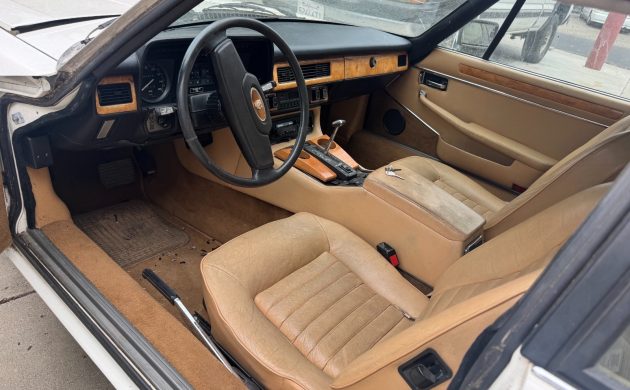
Jaguar focused heavily on luxury when designing the XJ-S. Therefore, it is unsurprising that many cows and trees laid down their lives to deliver a sumptuous interior. The fact that this Jag still presents so nicely suggests it has been sheltered from moisture and UV exposure. The leather shows age wrinkles that add character, but there’s no evidence of significant wear or deterioration. The carpet is in good condition, and I can’t spot any issues with the timber trim. The dash looks excellent, and I believe that the entire interior would present extremely well following a deep clean and application of a leather conditioner. I can’t spot any additions or modifications, with the car still housing its factory four-speaker AM/FM radio/cassette player. Add the standard air conditioning and power windows to the equation, and life aboard this XJ-S will be extremely comfortable.
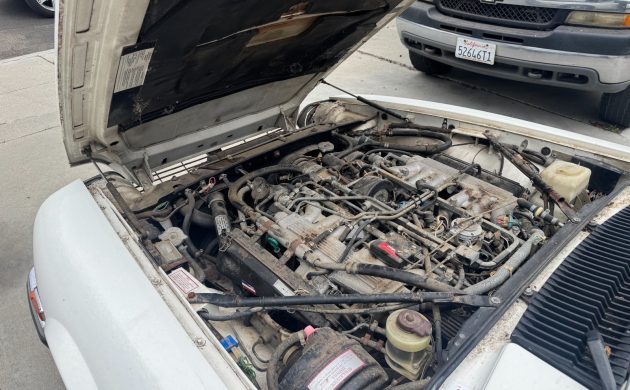
I have seen experienced mechanics whimper when they’ve tilted the hood forward because the XJ-S engine bay is a pretty complicated environment. Beneath seemingly miles of hoses, tubes, and pipes, hides the company’s 5.3-liter V12. It produced 263hp and 290 ft/lbs of torque from the factory, with the ponies fed to the independent rear end via a three-speed automatic transmission. Standard fare included power steering and power four-wheel disc brakes, further emphasizing the car’s luxury leanings. The seller confirms that this classic doesn’t run or drive, and suspects it last did so approximately fifteen years ago. However, the car rolls and steers, and the engine turns freely. Only an in-person inspection will reveal how difficult the revival will be. Still, it is worth noting that bolting a Chevrolet small-block under the hood is a common practice, which might make ongoing maintenance and sourcing parts easier if the buyer isn’t focused on authenticity. It won’t appeal to everyone, but it is food for thought.
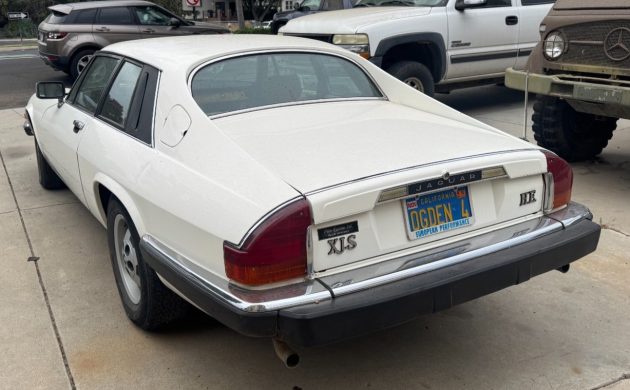
The Jaguar XJ-S was a victim of timing. The development process took longer than anticipated, and the car hit the market at a time when British Leyland was experiencing industrial issues that impacted production totals and build quality. Originally envisaged to remain on sale for under ten years, the production cycle extended to almost twenty-one years. Rust claimed many of these cars, but this 1984 example is a survivor that has avoided that fate. It may have only attracted a single bid, but the listing statistics suggest that could change. Even so, there is a good chance that it might be an affordable project candidate, but are you brave enough to revive an extremely complicated British classic?

When I see an 80’s white Jag it takes me back to the 90’s Whitesnake video with Tawny Kitaen doing cartwheels and splits on the hoods of a black and white one.
RIP
will need all new sensors electronics electrical, fuel injection? there is an engineering firm (garage) in UK that specializes in making these drivable again by replacing the aforementioned
Interesting find. Even after an inspection, this is a flip the coin decision. Good Luck.
There are several YouTube vids on fixing the most common problems with these beautiful cars. I would rather do that than putting a V8 in there.GLWTS.
Its a two door so that’s a plus I have never had the opportunity to work on one of these, it might be kinda fun to mess with and get it running again but that looks like a tight squeeze to get my hands in there and change the plugs or work on the fuel system. At the $500+ current price if it was closer I would take a chance on it.
The XJS-HE has the “anti-Hemi” (Michael May?) combustion chamber using zero-deck technology. I remember reading an article in Road & Track, of a test drive of the new “High Efficiency” engine in the heavy car, where an Automotive Journalist who’d driven previous models of the XJS was test driving the new HE engine and expecting the same old Pre HE performance. The Journalist was driving on a curved road on a damp day and entered a relatively tight curve, with the shifter in a lower gear, in order to exit the curve with authority. But with the new heads and Zero Deck Combustion Chambers, the big Jag easily accelerated (bumping the shift governor of the GM Turbo-400) and with the extra torque, broke the traction of rear tires, spun and backed off of the road at speed. Aside of a reported bruised reputation and pride, the car was OK. But Jaguar V12s once again became a force to be reckoned with.
Still, if I had the money, time and talent, I’m thinking an LS-3 backed with a 4L-80E transmission would make this Cat howl and get decent fuel Economy
I was enjoying your write up until you mentioned a certain V8. That is sacrilege.
I have owned several XJSs. While I do like the V12s, I kept one with a 350 conversion the longest (14 years).
About 20 years ago I bought a rust-free, low-mileage (32,000 miles) XJS. It had previously been well maintained, but was parked for about 3 years when I got it. I wasn’t looking for one, but a friend inherited it, and the deal seemed too good to pass up.
I later regretted buying it…….
As wally said, there were fuel & electrical issues. I got it running quickly, but not well. I fired the parts cannon at it, and there were still major, intermittent issues. I finally determined that the fuel injection module was the culprit. I sent it out to my usual “module guy”, but he didn’t have the specialized equipment and experience required for the particular unit. Relatively few shops in North America do, although some shops in the UK offer upgraded modules..for a (high) price. I ended up buying 3 used modules, all of which were supposed to be from “good running” cars before I got one that actually worked. I did complete the project, and it turned out well, but I just didn’t enjoy driving it much. It was very hard to sell, and I ended up trading it in on a ‘barn-find 69 Corvette. I know I lost money, but purposely did not do the math.
Whoever buys the white car for sale here is likely in for a similar experience.
With 80,000 miles it will also likely need:
– Bad fuel injector seals, leaking/dirty injectors, brittle injection wiring harness, vacuum and manifold leaks.
– Shocks. Fronts are easy. The 4 on the rear are coil-overs and take some skill, and specialized tools to swap.
– The rear inboard disc brakes , differential and IRS usually also need a going over. At least seals, bushings etc. Maybe rotors, UJs, and bearings too. This is a major, complicated job, and involves dropping the rear subframe.
– A/C overhaul.
Oh, and we don’t even know why the why car was parked…. If it was due to over-heating, it is best as a donor car or V8 conversion candidate.
Ls swap it through that awful. Motor in it in the dump
I’m certain there is a coherent thought here just waiting to coalesce.
But a V12 keeps the car original.
Bidding@ $1,150, right now.
It could be a really nice cruiser and head turner. Get it cheap, like under 5k. Then replace the entire drivetrain with something reliable. LS or something because trying to get it going and then keep it going is a nightmare proposition.
SOLD for $2550.
30 bids.