

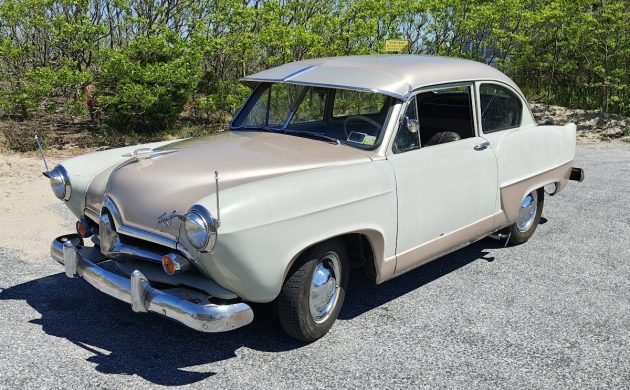
The Henry J, built and sold by Kaiser-Frazer, was perhaps the right car at the wrong time. It was developed after World War II ended and was sold between 1951 and 1954. Problem was people wanted bigger cars in the post-war era, and the Henry J wasn’t that much cheaper (remember, gasoline was 22 cents/gallon, too). So, the car came and went, just as the company itself would soon do. The seller has a nice two-owner first-year model in Deluxe trim. It needs some TLC and only has a small amount of rust. Located in Milford, Delaware, this little econobox is available here on eBay for $8,999 OBO. Thanks for the tip, JDC!
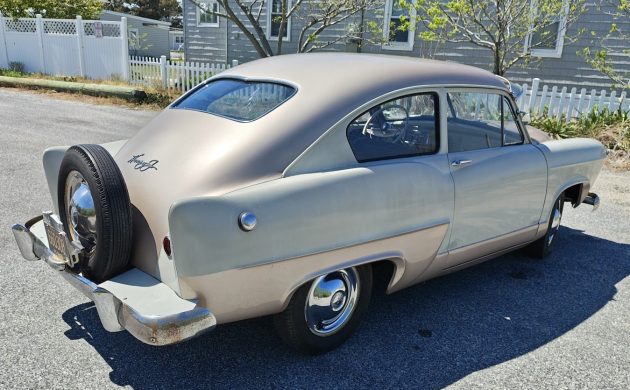
Kaiser-Frazer Corp. chairman Henry J. Kaiser conceived the Henry J and it was named after him. It was a new design but pulled from the existing parts bin to keep costs as low as possible. Both four and six-cylinder versions were offered, with the latter being in the seller’s car. Kaiser thought there would be a market for a cheap auto in the vein of the original Ford Model T, but he overestimated demand at a time when the economy was beginning to flourish. To finance the project, Kaiser took out a loan from the federal government.
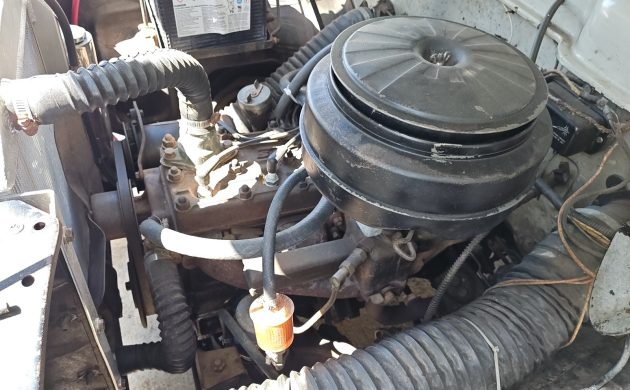
The Henry J was only offered as a 2-door sedan like you see here. It’s powered by an L-head inline-6 that displaces 161 cubic inches that kicks out 80 hp (the engines were supplied by Willys-Overland). The car never achieved more than about one percent of the U.S. auto market share, so they pulled the plug in 1953 with some leftovers sold as 1954 models. We’re told this two-tone Henry J is a two-owner car with a mere 24,000 miles.
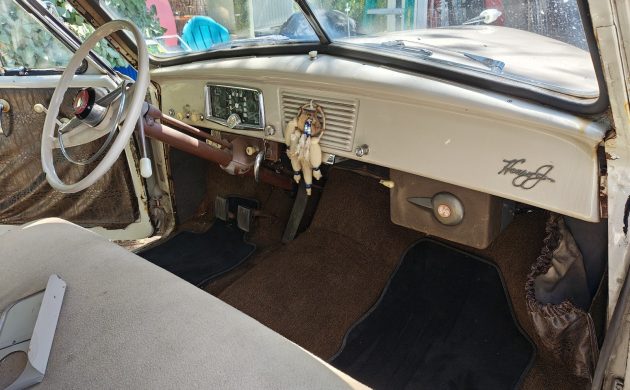
Quite a few parts have been replaced and are new, including the radiator, fuel pump, carburetor, brakes, and more – plus a switch from points to electronic ignition. The car is mostly rust-free with a touch of that stuff in the floorboard on the driver’s side and where the B.-pillar contacts with the floor (easy fixes per the seller). The interior is good, though the headliner needs replacing and comes with the car. The same can be said for one of the pieces of glass. If you’re looking for a vehicle that no one will know what it is, this Henry J could be it!

From what I heard, these cars were built well enough, but like the article says, the buying public just wasn’t interested.
There’s a guy in our region who dropped an SBC in one. No doubt it goes like a striped a$$ed ape.
For me, if I was looking for something of this vintage, I’d take my ray of sunshine over to the Ford shoebox. I’ve always been more of a fan of those…
Somebody’s gonna buy it & turn it into a gasser.
I sure hope not. That would be a shame. This is in beautiful shape and should be saved and treasured.
There are hints of significant rust in pictures 14, 19 and 21. If there is, this is a car with a lot of lipstick. It needs an up close inspection.
As for making it into a Gasser, that trend is dying. Vintage gassers, especially those that were raced are cool, many current day gasser builds often lack imagination by using a lot of cheap Chinese vintage looking parts.
Steve R
Those areas are the ones that seller mentions. I dont think he’s trying to hide them, but I’m not sure that they are the “easy fixes” he claims either.
“Virtually rust free” isn’t the wording I’d use based on those pictures.
Steve R
“Cheap Chinese.” The phrase is beginning to be a redundancy.
Once again, I’d like to thank the staff for kind of changing gears, showing us cars we can relate to, and the forthcoming comments. Hard to comment on a Lambo if we never saw one. I too am surprised this never became a drag car. Not many were spared and this particular car was well hidden. As for today, I highly doubt anyone would do that. This is a time capsule for the ages. This car is a highly optioned one, and VERY few Henry Js looked like this, and was gussied up later. The Henry J sold for about $1300, and lacked certain things like a trunk lid, glove box, sun visors, it was a no-frills car. The Allstate, a fancier Henry J, was a poor attempt at Sears selling cars, cost a little more, but had all those features. One of my 1st trucking jobs, say 1975, the boss had a Henry J in one of the buildings, covered with dust, it was his 1st car. Poor timing as usual, gas flowed like Niagara Falls, and the last thing people wanted was a Henry J. Cool find, but in my usual candor, the stick is the killer.
As a very young child in the early 1950s, I’d get excited when I saw one of these, probably because they were then one of the rare small cars on the road. I called them, simply, “Henries,” inexplicably omitting the “J.” Ah, memories.
I’ve seen nicer ones for sale – in fact, right here on BF. In November 2024, Michelle featured a survivor Henry J with the original “dragon” interior. The car in this post seems to have a “dragon-trimmed” front seat (as seen in the Ebay ad), don’t know if that was a factory option or the result of a later “refurbishment” effort.
I’ve seen nicer ones for sale – in fact, right here on BF. In November 2024, Michelle featured a survivor Henry J with the original “dragon” interior. The car in this post seems to have a “dragon-trimmed” front seat, don’t know if that was a factory option or the result of a later “refurbishment” effort.
These were cool little cars, and coming from a land barge queen, that’s quite a compliment.
I love the styling, the fastback design, the little tail fins, even the continental spare tire which I know was not standard. Howard is right, these were stripped down basic transportation.
What is with that “widows peak” on the rear glass? A nod to the Dragon?
With all the added doodles it really needs white walls.
I remember the Allstate at Sears. The one we went to was parked right by the Allstate insurance desk.
Angel, the “widow’s peak, I believe, is known as the Dutch Darrin dip, and it appears on all 1951 and later Kaiser-Frazer cars. The 1951 Frazer looks like an enlarged Henry J. But WHO would not remember the Henry J. and recognise it instantly?
It was said that the window’s peak on the Kaiser Manhattan’s front and rear of the roof increased structural strength.
@Dennis Bailey
That is very interesting.
My Dad worked for Kaiser Engineers for 35 years. He bought one of these on the employee discount as a commute car and we had it about 6 months. He and my Mom both hated it….he said it drove like a truck and was slow (I suppose it had the 4 cylinder). He sold it and went back to taking the bus. We had a nice Kaiser Manhattan as our main car.
Early in his career before the company got big my Dad had frequent interaction with Henry. Dad said he knew everything and you couldn’t tell him anything. Henry’s insistence on over producing the mainline Kaisers and this little car despite a lack of funds was a major reason they failed.
Exactly
Kaiser was warned that as GM and Ford released all-new post war models for 1949 that they should slow production, because sales would drop.
He did not listen, leaving to serious overproduction and unsold inventory.
This was one of the major reasons they went, broke and left the automobile market
It wasn’t just that “People wanted bigger cars.” GM and Ford launched into a brutal price war that drove down the costs of their full sized offerings to just a few dollars more than a “stripper” compact car.
This put unsustainable pressures on Kaiser, Studebaker, Hudson, Nash, etc……leading to Kaiser leaving the car market entirely, Studebaker’s continuing collapse, and the latter two forming AMC.
It was so predictable that you would almost think that it was the goal, all along……
Tucker went nowhere because it was underdeveloped and undercapitalized…….these were real companies that actually were put out of business by Detroit’s big two..
George B, you can also add that the “Big 2” or “Big 3”, along with Standard Oil, helped in the elimination of streetcars and trackless trolleys (ETB’s). By lowering the price of oil and of automobiles to a point that fuel and cars were king, and because it was dirt cheap, many lesser manufacturers of automobiles could not compete. The same went with the streetcars and trolleys – why be stuck on something that you could purchase a low-priced medium to full size sedan or if you had to, you could take a diesel-powered bus that wasn’t constrained by tracks or overhead wires. Cars like this Henry J were practical cars and a great vehicle to do your basic things with, which in reality is what we do anyway. People wanted flash and size along with speed to get to places. Now, you see SUV’s (although the SUV seems to be what everyone, including the manufacturers and shareholders want you to buy, regardless of the price of fuel), but there is also a small rise in more efficient modes such as smaller cars and the return of streetcars. Sometimes, the visionaries do things that were too ahead of its time, and now people are paying attention…
I kinda like it. Although I don’t think I would fit in it.
My cousin by marriage had one like this one it was a roller turned into a gasser
All aluminum big block with Hilborn fuel injection red in color. I heard it running
never got to see it running down the track. He traded it for a 1956 chevy small block with a supercharger. The person he traded it to took the Hilborn fuel injection off and put an ugly tunnel ram on it. My cousin was well known in the hot rod world hear in Washington his nick name was MR Magoo when he laughed, he sounded just like the character. In his passing his son has the 1956 car. His daughter and I (the MC) put a Memorial Car Gathering together
we had 30 plus Hot rods, cool cars, antique cars, I had all these cars follow me
for a Alki Beach Cruise Seattle Washington. MR Magoo was like my big brother. I have a picture of him standing next to that all aluminum Big Block
on my office wall.
Pretty neat car and I like the nonoriginal two tone paint, light enough to be seen by others in traffic. And it should be seen to avoid rear end accident. We see a view of the Atlantic or Bay at the Delaware shore in one photo. I think the little 6-cylinder flathead should go at least 55 to be semi safe in the right lane of I 95. Rust needs inspection for safety but maybe treatment to avoid getting worse and drive?
With the 6 it easily cruises at 70 . I don’t see that it has overdrive, it could go much faster with that.
Angel, the reason fo the “continental kit’ is that the early ones had no trunk lid. The spare was “hidden” behind the seats and a royal pain to get p
Out. When I was a put 6 years old. My Dad brought one home and I thought it was really cool! I got up one morning and wandered out to the garage to find the chassis in one bay and the body on it’s roof in the other bay. I don’t remember what happened to the body. But in short order Dad put together a very hot Oldsmobile V8 and had it installed on the chassis. We ended up moving to a place with no garage and the Olds engine was sold to a local stock car racer. And I don’t recall what happened to the chassis. 25 years ago while going through Dad’s stuff after he past away. I found an order form all filled out for a Devin fiberglass body. Dad sure loved his fiberglass cats.
Hey Wayne,
Yes, I had read about Henry Js not having a trunk until later. They were trying to make them as cheap as possible I guess.
Personally, the spare on the outside
Just like Austin Healey Bug/Frog Eyed Mark I Sprites. No trunk lid there either. Just a big (depending on your point if view) hole to shove a spare tire in.
Angel, the “widow’s peak, I believe, is known as the Dutch Darrin dip, and it appears on all 1951 and later Kaiser-Frazer cars. The 1951 Frazer looks like an enlarged Henry J. But WHO would not remember the Henry J. and recognise it instantly?
The “Darrin Dip” is actually on the side of the car, on the doors. Not sure if there was a similar name to the windshield and rear window styling..
Remember seeing these in the mid 50’s in our small town in eastern PA. Front end always looked sort of like an early shoebox Ford..
This is the kind of car I look for here, the interesting nuggets of the vast history of cars. Thank you!
Yes, the “Darrin Dip” was a styling que originally used on the Kaiser Darrin and Packard Darrin as applied to the sides of the cars. You could say that the 55 to 57 Buicks had a Darrin Dip but he had nothing to do with those.
Thank You Barnfinds ! SO COOL to see one of these uncut and unmodified! I agree with above comments on the “easily fixable” rust areas…too scary for me !! I would like one of these unmodified, and an unmodified 1940 (?) Willys coupe, another popular dragster from the 60’s, 70’s. I seem to remember seeing one on barnfinds years ago, with a 4-cylinder engine.
Wow! I don’t think I ever saw a all original one of these! This one looks too nice to make a gasser out of it, maybe a nice street machine that you could drive to shows.
I think it would drive to shows just fine the way it is. Years ago I had a friend who drove a stock Henry J all the way to Alaska, and that same car is still running strong today.
There’s a yellow one motoring around Prescott, AZ. Damn, these things are cute!
22cent gas sounds like a big deal, but using an inflation calculator for 1951 to 2026 it’s 2.82 per gallon, slightly lower than we were paying in NW Illinois pre-Iran war and actually higher than in neighboring Iowa and Wisconsin.
Be glad being where you are for fuel prices. (not for rust issues however) Being in Nevada and close to California. Getting the bleed-over from their supplies is. No fun. At least we don’t get the California taxes.
But the typical American car around 1973 got somewhere between six and 12 mpg.
The price of gas tripled almost overnight, and you needed twice as much of it to keep those tons of Detroit iron moving
A Pinto got 19mpg in 1971
In the ’80s I worked at a Toyota dealership in Baton Rouge … the owner drove a Henry J, said it was the best car he ever owned … he also drove a ’48 Hudson because he liked the step-down feature … never saw him drive a new Toyota …
I think the continental rear on this kills the cool sloping roofline.
The bumper mounted spare was probably necessary because early cars didn’t have a trunk lid.
In the ‘50s, the “continental spare” was still considered a sporty look.
They didn’t shock the eyes the way they do today, because they were real tires and not plastic chrome crap
Well who asked you, PRA4SNW?
I suppose the fins screw up the fastback roof also? Huh? Is that what you think?
Hey boo, you know I’m just pulling your chain. Nice to see you here.
I’ve seen them without the conti kit and they just look much cooler. I’m sure the people who removed them were not concerned about necessity, as the ones I’ve seen are just good looking hot rods.
And Angel, I enjoy a good old chain pull every now and then. HaHa!
You have just stepped out of your time machine and it is 1953 and you are looking at a 53 Henry J and telling people that “in the future century” these will become collector cars and they will be priced over $8,000 dollars. The people you are talking with being concerned with your mental health have you committed to the “rubber room” to help you get over your mental condition.
I said the same about common ordinary Volkswagen beetles. Actually, in comparison the Henry J is quieter, rides better, is faster, only slightly less fuel economy. And has a real heater defroster!!