

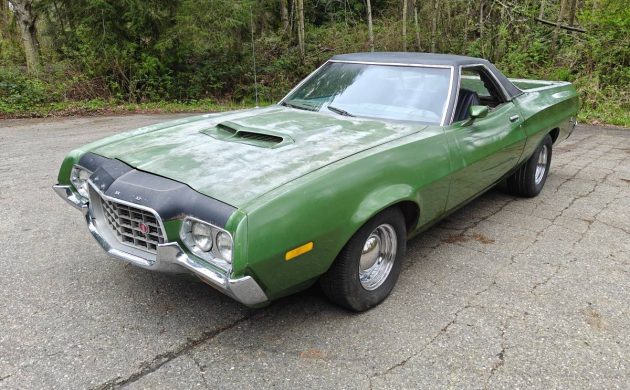
The Ranchero was Ford’s pickup version of the Chevrolet El Camino. For most of their joint lives, they were mid-sized offerings, and their roots lie with 2-door station wagons (in the beginning). This 1972 edition of the Ranchero is the GT model, which implied style and performance (in some cases). It has some rust here and there, and the V8 engine needs some carburetor work. Located in Snohomish, Washington, this “gentlemen’s pickup” is available here on craigslist for $4,900. If you guessed this tip was from Tony Primo, you’d be right!
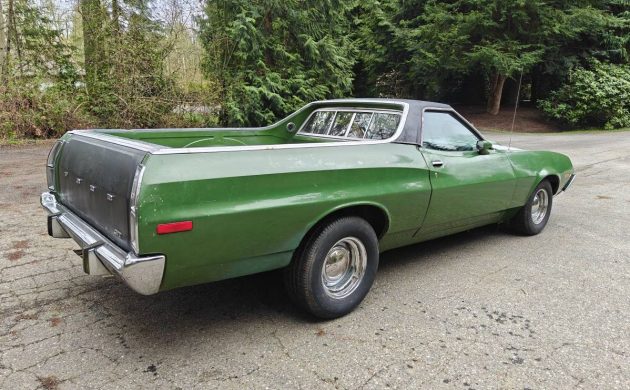
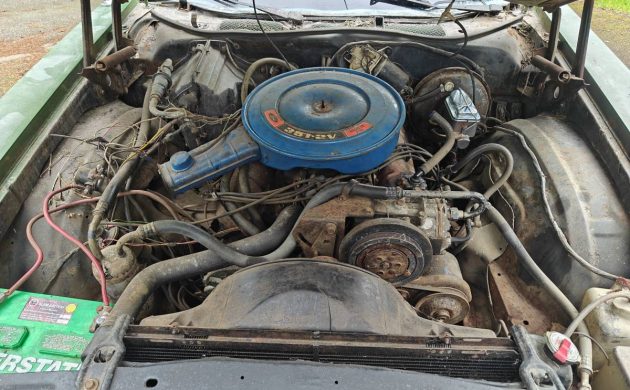
All Ranchero GTs came with a V8 engine, and this one has a 351 cubic inch (Cleveland or Windsor?) with a 2-barrel carburetor. Just like the Torino it was based on, the Ranchero received a redesign in 1972 (which ran through 1976). By then, the Ranchero had been around for 15 years, first as a full-size (1957 to 1959), then as a compact/Falcon (1960 to 1965). It finished its run in 1979 as a mid-size (though the Chevy El Camino remained on the payroll through 1987).
Of the more than 40,000 Rancheros produced in 1972, nearly a third of them (12,600) came with GT badging. That mirrored the Torino lineup, as that car also had a GT model in previous years. This was a decently equipped Ford when new, with options including an automatic transmission, power steering and front disc brakes, and air conditioning (does it still work?). This GT has seen its share of real estate at 135,000 miles and counting.
There is some corrosion in the doors and rear quarters panels. And surface rust in the bed. So, some time will be needed in the body shop to correct these ills and to add new green paint. It should be a good runner once you rebuild the carburetor and take care of a few “minor” things that the buyer will have to learn about upon inspection. The seller prefers cash, as no trades will be entertained.

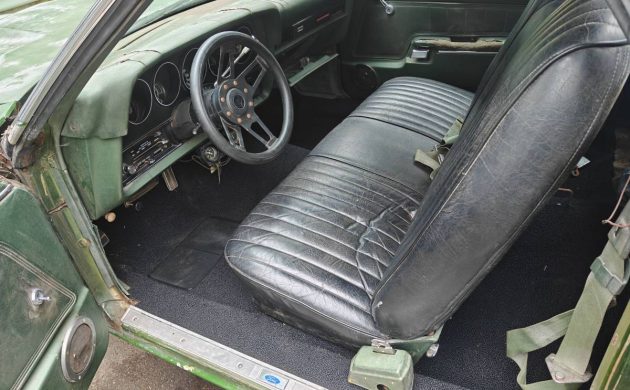
If it’s running, that seems like a decent price. The interior looks nice outside of cracks in the dash pad and that gawd awful steering wheel. I’d be tempted to get it running nicely, fix those two faults and just drive it.
I’m right with you on fixing the few things needed and getting it running solid to be put to use as is. Bed looks more than solid. Ad says 351c with the ‘c’ indicating Cleveland I’d guess. Engine bay looks like it would take the most of your work to make it a daily runner. Carb rebuilds are easy, then again why not upgrade to a 4bbl?
Last of the good looking Ranchos in my book. Too bad it’s so far away, price is reasonable.
Either a four-barrel or fuel injection, take your pick! These early anti-smog motors had numerous drivability issues, including stalling, hesitation, and Dieseling after the key was shut off. The 351, either as a Cleveland or a Windsor, was a good, solid choice, a midsized motor for a mid-sized car! The big-block would shred the rear tires off of the car, but leave the car nose heavy and thirsty. The small-block wouldn’t be enough motor to do any serious hauling.
The only thing missing on this one are the optional bucket seats and console, or maybe a split bench seat. The verdict: A solid car that can be improved as time and money permit, a good daily driver. The fact that these had a full frame from 1972 on, is a big plus in my book! GLWTS.
The first line of this article has it backwards.
The El Camino (1959) was Chevrolet’s version of the Ford Ranchero(1957).
I was onboard till I saw the engine pic. What in the world? Wires everywhere.That engine & bay looks like the car was submerged in a swamp. “A few minor things.” Does it even run?
I had a ’71 Ranchero that I wish I still had. It was a central California car with no rust. BUT this car is the first Ranchero since 1959 to have body on frame construction. Can you say heavier? I knew you could!(lol)
I like the body style of these. (The open mouth fish look) Buy really prefer the early Fairlane body. 1967. Both of the 351s were gas hogs. So if you are inclined to make a fuel upgrade. Remove the EGR plate, and install a spacer in its place and install a 2bbl. Aftermarket fuel injection unit. (Most flow 500 CFM or more) so unless you are performing engine mods. The 351 can’t really use more CFM anyway. (The camshafts on these are really mild.) So, better driveability and most likely better fuel economy and less work.
Fair point, Sir! Holley makes both a one-barrel and a two-barrel TBI unit that is a bolt-in replacement for a carburetor, just add a fuel return line to the gas tank and give it power, and you’re good to go! Well, it’s not quite that simple, but it’s close. The two-barrel unit mimics a two-barrel Rochester fuel mixer, and the one-barrel is aimed squarely at Ford owners with six-cylinder engines.
If you do choose the four-barrel route, Edelbrock makes a port injection setup that includes a new intake manifold, complete with a throttle body, a new distributor with electronic ignition that integrates with the injection control computer, and all of the wiring harnesses to hook every thing up! When you factor in the cost of a four-barrel carb, the new four-barrel intake and a new distributor to support electronic ignition, the up-charge isn’t as great as you might think! Yes, you need a new fuel tank, electric fuel pump and the return lines, but that might not be a bad idea for any car going over fifty (50) years old anyway!
My Mom drove a ‘74 Torino with a 351W. Consistently got 20+ mpg around town. Dad had a ‘71 Ranchero with the 2bbl 351C. It did almost as well. Not gas hogs in my book. 351M smogmotors, on the other hand, are best used as boat anchors.
Since both the 351M and the 400 were “tall deck” small blocks, does the 400 also fit into the “boat anchor” category? Just asking!
https://en.wikipedia.org/wiki/Ford_small_block_engine
https://en.wikipedia.org/wiki/Ford_335_engine
good project if you have time desire and money for it.
Nothing like a wiped out engine bay to get a guy salivating!
Had one in 1975- the 72 was the best looking of all the versions, with the stripes in the scallops and a slight rake to the front they had the look.