

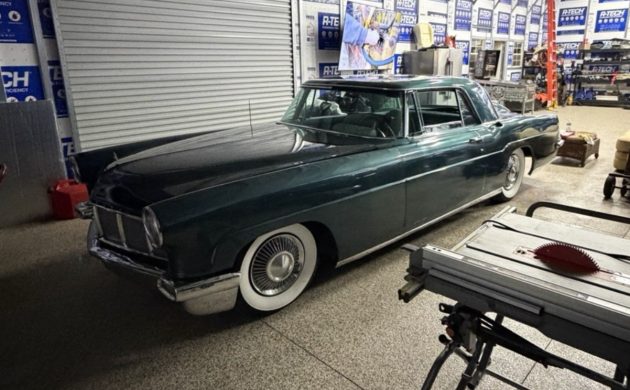
When Ford embarked on developing the Continental Mark II, it planned to produce the world’s best luxury car. Each Mark II left the factory loaded with creature comforts, and the only available option was air conditioning. Our featured Continental is one such classic, and it presents beautifully. The seller loves the Continental, but has decided to downsize their collection. Therefore, they have listed it here on eBay in Newberry, Florida. They set their BIN at $22,000 with the option to make an offer.
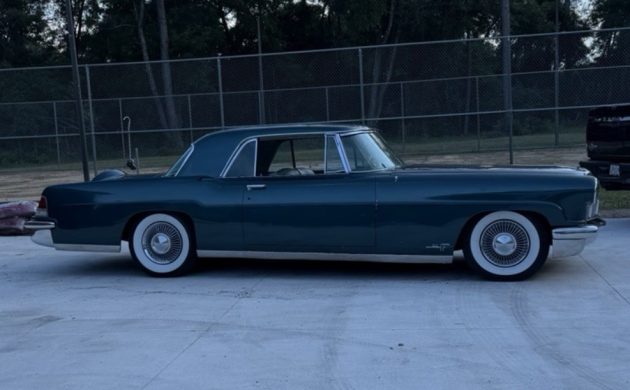
Ford created the Continental Division in 1955, positioning it above Lincoln as its most luxurious marque. It released the Mark II in 1956, focusing on a level of quality rarely seen in the automotive world. Engines came from Lincoln, but each was dismantled and blueprinted before being installed. The unique wheel covers weren’t one-piece stamped items but were hand-assembled from inner and outer sections and individual vanes. Workers installed every exterior panel to ensure perfect alignment, and then removed them before the body entered the paint shop. This Mark II is a first-year example ordered by its first owner in Forest Green. The listing image quality is relatively poor, but they allow us to make a fair assessment of this classic. The paint shines richly, the panels are straight, and there is no evidence of rust. The trim and glass look excellent, and the new Coker whitewalls add the perfect finishing touch.
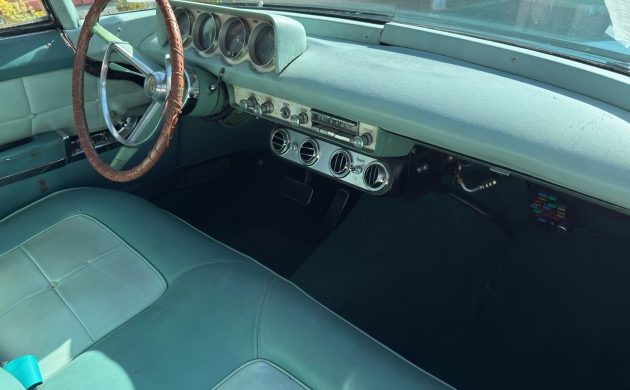
The focus on perfection extended to the interior, with Continental pulling out all the stops with the Mark II. Trimmed in Bridge of Weir leather, each piece was vat-dyed to ensure consistent color throughout the interior. Standard equipment included power windows, power vent windows, a power front seat, full instrumentation, and a pushbutton radio. The only available option was $595 air conditioning, which this car’s first owner chose. The restored interior looks as impressive as the exterior, with no evidence of wear or other problems. It appears this beauty has been treated respectfully, with no aftermarket additions. The seller supplies no engine bay shots, but every 1956 Mark II featured the hand-built 368ci V8, a three-speed automatic transmission, power steering, and power brakes. The V8 delivered a fairly healthy 285hp and 402 ft/lbs of torque. It is worth noting that since the car weighs approximately 5,000 lbs, acceleration isn’t dazzling. However, the company focused on smoothness and low noise levels, and the Mark II is often praised for its eerie quietness. The seller confirms that this Continental is in excellent mechanical condition. It runs and drives extremely well and is a turnkey proposition for its new owner.
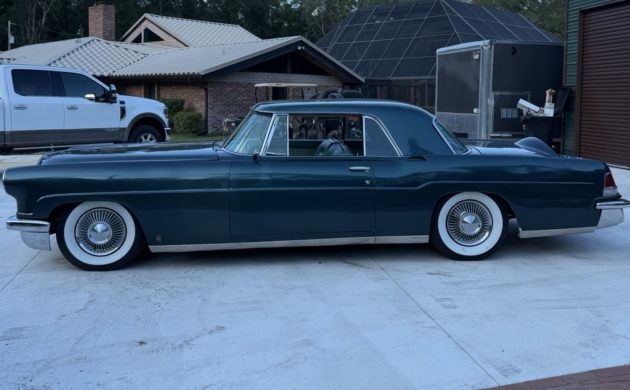
The Continental Mark II was an exercise in excellence, but that was also its downfall. No corners were cut during production, with a sole focus on quality. However, that approach meant that, for the company to sell the car at a price even remotely close to realistic, it lost money on every sale. The situation was unsustainable, and economic rationalism was required. Lincoln absorbed the Continental Division during 1956, and Mark II production ended in 1957. This 1956 example is a beauty, and with the listing heading into its final hours, it will be interesting to see if it finds a new home.

First time I’ve ever seen one of these before – beautiful car! Thanks for the insight, BF..
Would love to see this car “in person”. The e-bay pics do show several interior indicators of aging or restoration imperfections, 1) wrinkling of the dash cover behind the driver console and toward the center of the dash covering as well as an improper fit of the windshield trim, and 2) the seatback top cover of the right front seat. What can one expect for a prize seventy year old piece of true American made automotive “sculpture”? The $22,000 asking BIN price is much more than reasonable for this Continental, if as it appears, truly a bargain.
Nice car. Terrible pictures.
The under dash air conditioning unit is not factory. Factory air had the outlets in the headliner and those were fed through the C pillars by an evaporator assembly in the trunk. Trunk mounted evaporators were typical of early A/C systems. The system in this car may be fine and possibly preferable to the factory system. I’ve never heard anyone comment on how well the stock system worked with cold air coming from above.
I think it worked fine. Early A/C systems were typically mounted in the trunk, with the ducts delivering air under the ceiling. ’50s Cadillacs had cool plexiglass ducts to prevent blocking the rear view.
Early Mark IIs had air intakes atop the rear fender curve, but in road testing this proved inadequate and the factory system draws in fresh air behind the grille
In an era of over-the-top styling, these Marks are rightfully noted for their clean, subtle styling. I hadn’t really noted this before, but the interior is similarly clean and subtle. The matching upholstery and door trim is a nice touch. But please get rid of the steering wheel cover, even if the wheel is cracked.
If this car is as good as it looks? It’s one of the best deals I’ve seen in a long, long time.
Must have been a good deal, it’s sold.
Very classy, understated design compared to most mid to late 50s American cars, but I do puzzle over the rationale for someone buying a luxury barge like that and NOT having a/c. They could have simplified production and just made it standard. I wonder what percentage was built without air.
It’s a really good question.
I suspect that most people in northern climates did not want it and saw it mostly as a source of potential problems
Not every Cadillac of the. had it, and I doubt many Rolls Royces or Mercedes had it in 1955
Then again, a lot of Nash products had it because they were basically a refrigerator company
One of my favorite cars of the 50s. Timeless styling. Very expensive to work on according to an owner I spoke to at Hershey. But this car looks to be a good buy at this price.
Excellent! Very reasonable price, wrong coast ; (
The “Lost Money on Every Sale” bit is a tired old trope that has circulated and mutated for far too long.
The Continental Division was created when Ford was a privately held company. The Ford family wanted a “halo” division to burnish the company. They certainy did not want to lose money, but it was never intended to be a big profit center.
When Ford went public, Robert MacNamara came in and slashed everything that wasn’t geared to maximal profits, including the two-seat T bird and the Continental Division were quckly axed. (Mercury and Lincoln were spared, barely.) MacNamara felt that a cheaper Continental based on the Lincoln Premiere was going to be massively more profitable, and over the objections of many Ford family members, killed the project before the Mark II could have ever been profitable.
It takes years for a new product line to become profitable, given the massive investment required to design, manufacture, and market a brand new car. The Continental was in production for less that two years when the axe fell.
Another point: The standard radio was not simply “push button,” a common feature. It was a signal-seeking “Town and Country” radio, like the one in my ’56 Thunderbird.
It’s amusing to watch the radio knobs turn as it looks for a station
Didn’t last long on ebay.
Perry Mason drove this car maybe ?
A neighbor of ours bought one of these new when I was a young teen. I believe they sold for $10,000.
It was nice!
One can only assume that the car body was designed by one group of visionaries and the interior by Plan B.
I never understood how such a beautiful car had such an ugly dashboard. It reminds me of a Tucker. Narrow, thin, however you want to describe it, I feel it’s one of the ugliest dashboards with the instruments just ploped on top.
I love this! I’d rather have it than the ’57 Nomad and it looks like somebody got a great deal.. a best offer was accepted already.
J J Hunsecker rode in a ’56 Mark II in the 1957 movie Sweet Smell of Success.
Seventy years ago a car like this showed the world who you were and that you meant business.
I remember when these came out, and I HATED the LOOK: hood way too long, deck way too short, greenhouse too small and set too far to the rear. The car had nice lines; however, almost every coupe is (with a few standout exceptions such as the 1953 Studebaker) grossly disproportionate and thereby ugly. But the sheer SIZE of this elogated beast REQUIRED a four door sedan! From the rear, this car was beautiful; from the front, it was okay; but from the side it was hideous (as was the Mustang in 1964, for the same set of reasons). There were a number of beautiful cars; unfortunately, this one COULD have been, but wasn’t. SOMEone appears to have got a good deal, though.
A four-door sedan, “Berline” was planned.
Hints of its shapes can be seen in the’58 and sedans
A lot of older folks preferred a 4 door in their luxury cars. But, the 2 door Thunderbird opened Detroit’s eyes to a whole ‘nother consumer! This Continental looked like no other car in 1956. The long, low look made the bulbous, befinned Cadillac look like yesterday’s leftovers.
My problem here is more the awful proportions, even more than the two doors. Thunderbird was a different story: it was a personal SIZED luxury car, and the two passenger layout looked right. But a LARGE and LONG luxury car cannot also be a COUPE! And that long hood is ridiculous! If they wanted a luxury car that size, then they needed room for six passengers, a longer deck to provide for more trunk space, and a far shorter hood! The body lines themselves were good and nearly timeless, as the 1961 and later Continentals proved. The problem with these is, their luxuries fit the time, but no longer stand out to-day. And why drive this awkward-looking and limited practicality ultra expensive vehicle that guzzles gas, when you can have everything this offers you, and more, with far greater beauty and longevity, with a 1989 Lincoln Town Car Signature Edition? — and decent V-8 fuel economy besides!
This car is in beautiful condition. But I have never liked the body style.