

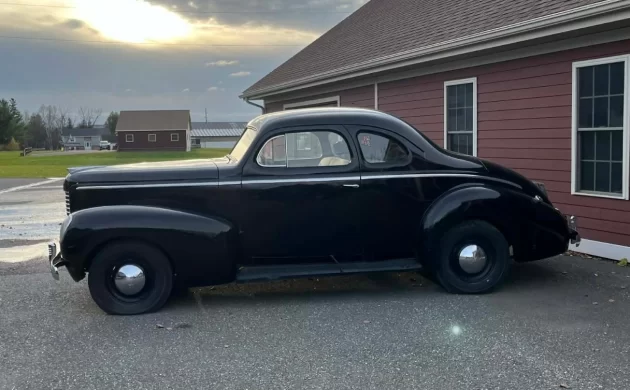
This clean and original-looking 1939 Nash Lafayette Special coupe is currently listed for sale here on eBay, where bidding has only risen to $1,525 so far, and there’s no mention of a reserve. The Nash can be picked up in Presque Isle, Maine after you’ve successfully won the auction! Let’s examine this unusual find more closely.
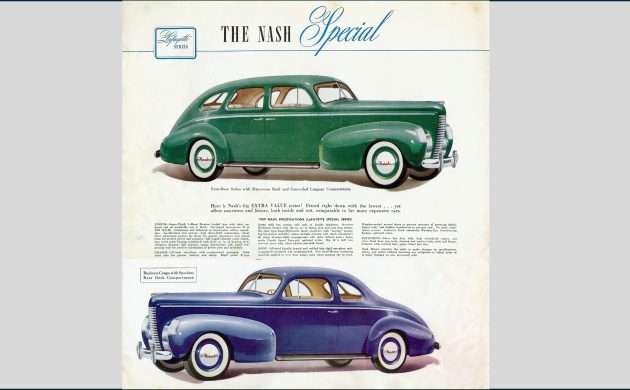
The Nash Lafayette Special, despite the glamorous name, was actually the lowest of the four trim levels offered in the 1939 Nash. All Lafayette Specials featured the 99-horsepower “Super-Thrift” inline-six engine with dual downdraft carburetors. The big marketing news for Nash for 1939, besides the styling updates, was the availability of the optional “Weather-Eye” thermostatically controlled conditioning of the ventilation air. We don’t know if this car has it, as the available picture of the dash isn’t comprehensive enough to show the controls, but you can see how it works in this diagram. Interestingly enough, the “Weather-Eye” name was applied to Nash and, later, AMC models all the way up to the 1977 Hornet and the 1978 Gremlin models.
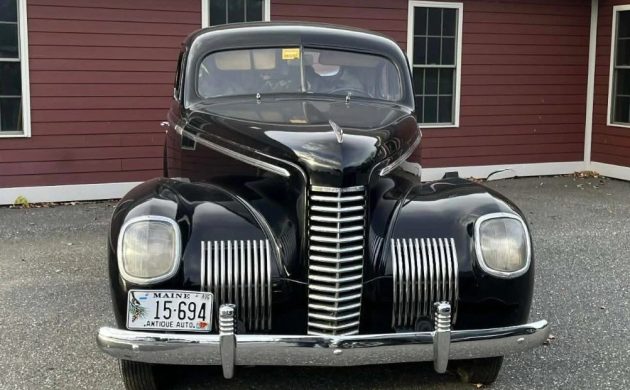
The “art deco” styling of the 1939 Nash certainly set it apart from most contemporary cars, at least from the front. Those new-for-’39 headlights are certainly distinctive, and they were used on all four series of Nashes in 1939, but were replaced by round lights in 1940. The chrome on this car certainly looks good in all of the pictures, although it’s hard to tell its true condition without an in-person exam or close-up pictures. The body is described as being “in good shape,” with the floor and trunk being solid. Scotty G. posted about a 1939 Nash Ambassador (an upscale model) coupe here in 2016, and even that unrestored car was going for more than this auction so far.
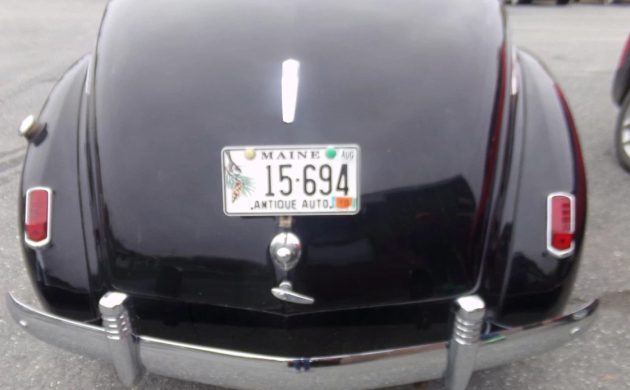
From the rear, the car also looks complete, and the bumpers certainly appear straight. I wish there were pictures included of the floor, inside the trunk, under the hood, and the underside of the car. I’m surprised there aren’t more pictures included in the auction listing, especially with the car listed as having 45,000 original miles and appearing so clean in the pictures we can see.
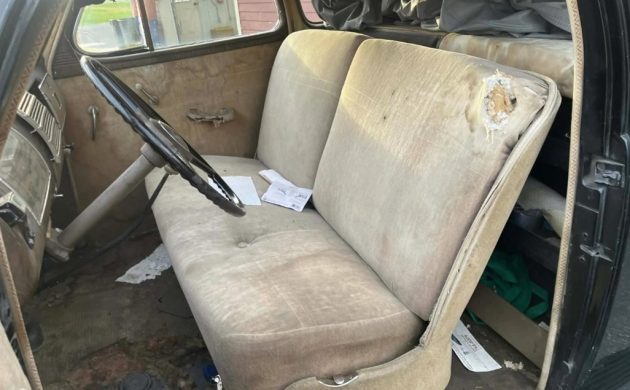
Assuming this is the original interior, it’s certainly due for an upgrade, but having this much upholstery, carpet, and door panels intact will help the duplication effort. There’s a long shift lever attached to a manual transmission-both three and three-speed+overdrive versions were available in 1939, and we don’t know which type this car is equipped with. 65,662 1939 Nashes were built, but unfortunately, production records were not kept by model, so we don’t really know how many Lafayette Special coupes were produced.
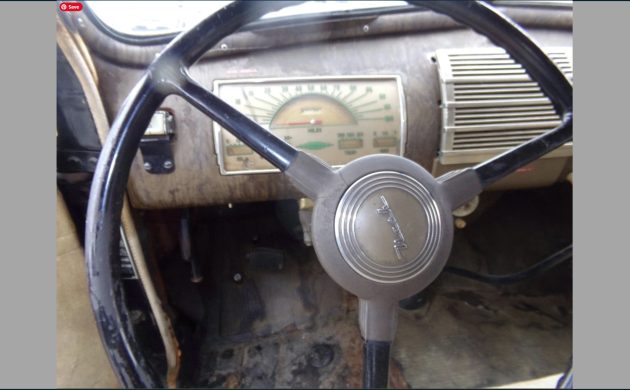
The art deco styling extended to the dash. It’s possible that the circular shape visible behind the steering wheel spoke on the right is a Weather-Eye control, but it’s hard to tell.

I was hoping this vintage Rochester Institute of Technology Tigers window decal would help unlock some vintage background information on the car, but it dates from 1995 to 2002, so it’s a comparably recent addition to the car. I’d love to know more about this charming pre-war car, especially how it runs and anything about its history. But what do you think?

1st thing that comes to my mind, how did this car ever escape becoming a Gasser drag car. Images show, however, the Nash wasn’t near as popular as the Henry J or Willys for some reason. I’m going with the war thing again, I just can’t imagine how these pristine pre-war cars even exist otherwise. This wasn’t a family mans car, and entirely possible, someone bought it new, put some miles on, and off they went. Don’t ask the seller, it’s clear they know little about the car, and $1525( going up in $25 increments) is a slap in the face and pretty clear nobody wants it. Before our very eyes, people, before our very eyes.
That opening side profile picture really highlights the beautiful shape of so many pre war cars, this one included. I would consider bringing the interior up to the same condition as the exterior, but really, you could just drive and enjoy it the way it is now too. I will say to Howards comment about 2 doors not typically being family cars, that my Dads father had a 1940 Chevy 2 door coupe similar to this, his brother, also with a family had a ’39 coupe. Maybe they were the exception to the rule.
I hope this is Nash gets enjoyed and stays on the road. Thank you Jaime I enjoyed your write up.
Growing up, my Dad always bought 2 door cars for our family car. After all the kids moved out, he started buying 4 doors. 🤔
My father also always bought two doors so the kids couldn’t fall out of the back.
Yep….thought it was a 1939/40 Ford…..nice car
This is a beautiful car and IMO it’s sad that cars like this get almost no love anymore. This car is a candidate for a major drivetrain swap, a slight rear-high stance, and wheels. But that’s a big hit to the wallet when leaving it just like this outside with a period appropriate upgrade to the interior makes for a great driver that gives a kind of satisfaction when driving that yet another muscle car can’t.
But what does it say that a dealer gives no info on its mechanical condition, and no engine or underside fotos. That doesn’t inspire confidence, so I’ve asked.
I sent the seller a message: “Does it run, stop, and drive?”
A: none of the above.
I’m out!!
Thanks Craig. I just mailed him the same question.
This is an auction that will be interesting to follow. It’s a really good design, but are there buyers actually willing to spend money on an orphan brand?
Running this on a no reserve auction with a low starting point is a risky proposition.
Steve R
My research tells me that the first non-round headlights were not introduced on an American car until after 1975. This vehicle definitely contradicts that. Someone correct me if I am wrong, but could this actually be it?
Good point. There’s also the Graham “Sharknose” as well.
Nice discovery! What is also interesting is both are 39’s.
One more!! I just remembered, the ’39 Plymouth as well. You’re right, ’39 seemed to be the year of square headlights.
Plymouth had them too
The last hurrah for little bulb with reflector headlights before round sealed beam headlights in 1940, at least for Ford, not sure of others. So, why not go for square designs?
In 1939, each Chrysler Corporation division (Plymouth, Dodge, DeSoto, and Chrysler) used a distinct headlight shape and integrated fender design:
• Plymouth (P7 and P8): Featured rectangular / convex square-shaped glass lenses (Rite Way/Corcoran-Brown style) that were uniquely integrated into the front fenders.
• Dodge: Featured round headlights cleanly faired into the front fenders.
• DeSoto: Featured teardrop-shaped (Almond) headlight assemblies smoothly molded into the leading edge of the fenders.
• Chrysler (Royal, Imperial, New Yorker, etc.): Featured distinct oval-shaped headlights that were fully engulfed and integrated into the fender contours
There was a brief flowering of sculptured headlights in the late ’30s – GM did not participate but Ford led the way with their ’37-39 teardrop shaped ones, Mopar and the independents got in on it and it was all over with the introduction of sealed beam headlights on the 1940 models. As you mentioned, ’75 was the first year for square sealed beams (actually quad in ’75, single squares not until the ’78s) but the next American car to have replaceable-bulb headlights shaped to fit the specific model was the 1984 Lincoln Mark VII.
This is why I love Barn Finds, all the camaraderie and collaboration in figuring these relics out. Our Dads could answer a lot of these questions!
The 70s era “non-round” headlights were sealed beam headlights as were the round ones that became standard on US cars in 1940. The non-round headlights you see on this Nash and Plymouth are just a non-round lense over a replaceable light bulb set in a reflector behind the non-round lense. The lense is not the headlight. Yes, the non-round headlight (complete headlight including the outer lense) was first seen in the 70s.
Makes sense! Thanks for the clarification, Terry.
That profile picture is very nice. Comparable to 39-40 Ford Coupes. All of them, this Nash and the Fords, were inspired by the 1936 Lincoln Zephyr coupe, the styling of which is credited to Bob Gregorie, no doubt with input from Edsel Ford. Edsel had spent time in Europe and always had a taste for the styling and design of European luxury cars.
The first car show I attended with my ’57 New Yorker was a Genesee Valley AACA meet on the RIT campus parking lot in ’79. I still have the “Look-Don’t Touch” placard that came in the registration envelope….and the NY’er.
Maybe the Nash was there too….
outside looks better than the inside.
With NO driveline information this auction will stagnate.. Hopefully a mechanically inclined DIYer will buy this and get it running and stopping again with the original power plant. As Craig said there are enough muscle cars out there that even if this car has to be repowered do it with a period correct engine. Then drive it, show it and enjoy this semi rare vehicle.
Lovely car. Art Deco was an earlier postcWW1 movement and wouldn’t be very marketable by 1939.
In 1930s USA develped its own version of expressing movement through art & design, Sreamline Moderne. Associated with consumer goods & products, this may be a better way to describe the more aerodynamuc US cars of the 1930s.
Are you familiar with the 1939 Delahaye 135? You can’t get more deco.
WOW!!! Really a very rare car! Surprised it was chopped up into a hot Rod ruining this sweet ride! Excellent condition…
“Chopped up”? What do you mean? This car is utterly stock.
Wow, this car would make a great starting point for a hot rod. And I do love the front and side views of the car. Too bad Maine is so far from Texas, or I might just be interested. Good luck to the bidders.
NO!!! NO!!! NO!!! This car is an ALL there original!! Preserve it as such… Since it has what I assume is a Nash built engine for which parts are unobtainable and probably NOT rebuildable? The only change I would make is IF it needs to be repowered go to a period correct looking MOPAR flathead 6 for which parts are plentiful.
SOLD for US $5,710 USD.
Beautiful car with gobs of potential. Sold for $5710. Someone got a real deal.
Now indicates sold for $5710. Great deal for somebody – this is a nice car. Goes to show if you have terrible photos, virtually no description and no reserve, you will get a lousy price for your car. Congrats to the buyer!
I absolutely agree ~ that is a $10K car all day. A new front seat, go through the brake system, and get it running. What a cruiser it would make.
The ad wasn’t great, but I think it’s more about a lack of interest. Cars from the 1930’s even ones with a stronger following have been falling for years. Look at mid to late-30’s Fords, a few years ago their prices were much stronger than they are now. Brands with a smaller following are falling at least as fast.
Hopefully the new owner enjoys it regardless of the direction he chooses to take it.
Steve R