

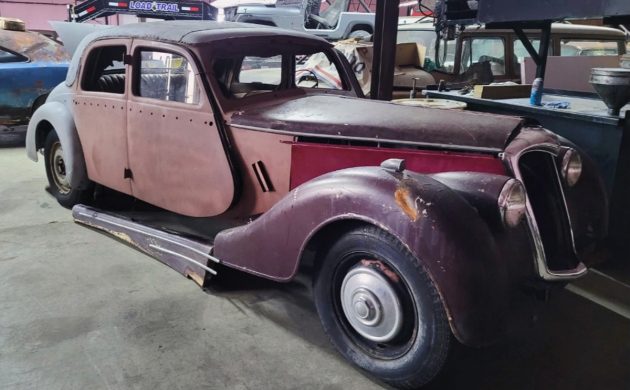
My challenge here at Barn Finds, with a mostly American and slightly past-the-age-of-restoration crowd, is to impress you with the remarkable Riley. It’s a tall order. Obviously, the photos are …. less than stellar. And perhaps for the Riley aficionado, this particular example might not be the best. But this listing offers the opportunity to explore the history of Riley and to understand how it fits into the sporting car realm. Riley was founded as a bicycle company in 1890; motorcars soon followed. The Riley RM was launched just after the war, in 1945. Rather than a model, the RM was a series: the RMA was a 1 1/2 liter saloon, the RMB was a 2 1/2 liter saloon, the RMCs were roadsters, and the RMD was a drophead. Production continued through 1957, and more than 28,000 were made. Here on eBay is a 1951 Riley RMB project car in a no-reserve auction. Bidding has reached $1234 (not a misprint); the car with its parts is located in Scottsville, Kentucky.
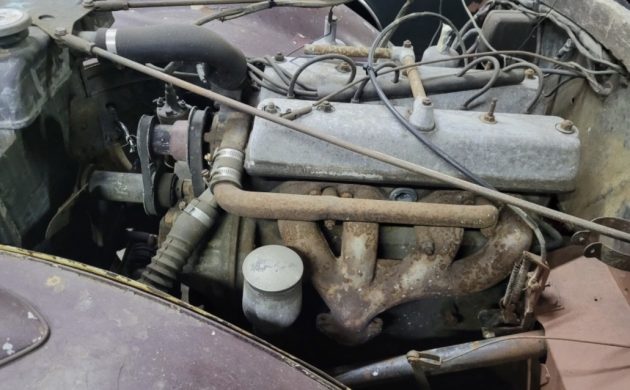
Either of the Riley four-cylinder engines was wondrous: constructed with twin overhead cams acting on short pushrods and breathing through twin SU carbs, the 2.5-liter “Big Four” made over 100 hp – a significant benchmark in the immediate post-war time frame. Even the 1 1/2 liter was good for 60 hp. Both engines rev freely, propelling their respective Rileys, if not quickly, at least in a sporting fashion. The gearbox is a four-speed manual; independent suspension aids handling. The seller notes that while his car rolls easily, he has not attempted to start the engine. The bonnet would have center hinges, with each side opening separately from a center panel section.
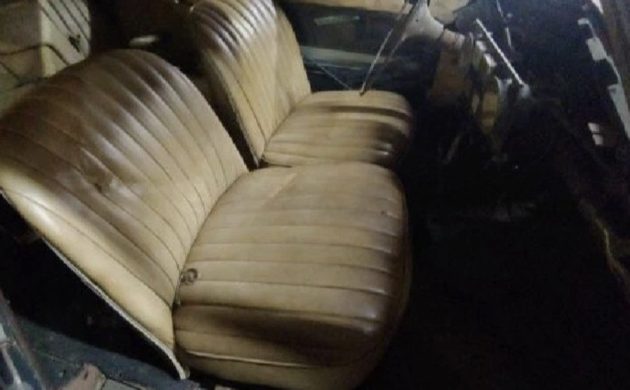
Riley provided its buyers with reasonably lush quarters, including a wood dash, individual pleated leather-covered seats in front, and a roomy bench seat in the rear. The roof was covered in padded leatherette, and the cars were delivered carpeted. The front doors opened suicide-fashion, hinged at the rear. This example is missing its split windscreen, though the seller says the car is “very complete”, with piles of parts in the trunk. Left-hand drive is a bonus – most of these cars were made to roam England.
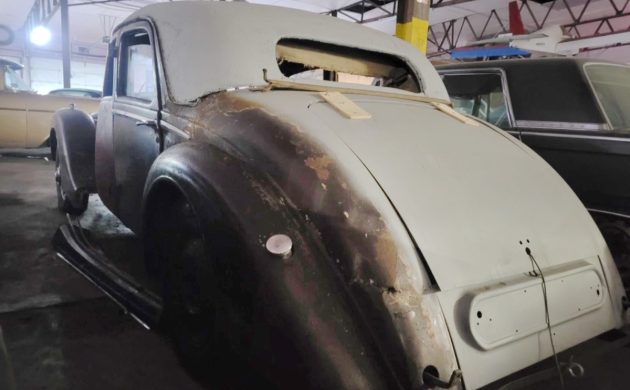
As noted, these photos do not do the car justice. Despite its pre-war design, the car’s lines were viewed favorably. Viewed in profile, the long bonnet balances the neatly tapered tail; this photo shows a well-restored RMA. If your heart is set on a Riley, try for a drophead coupe or a roadster – though even rarer than the saloons, the top-down experience in this swanky, long-bonneted, sporty machine will make you feel like the Great Gatsby. Prices for the saloons range around $10k; the drophead will cost twice as much, but it’s worth it.

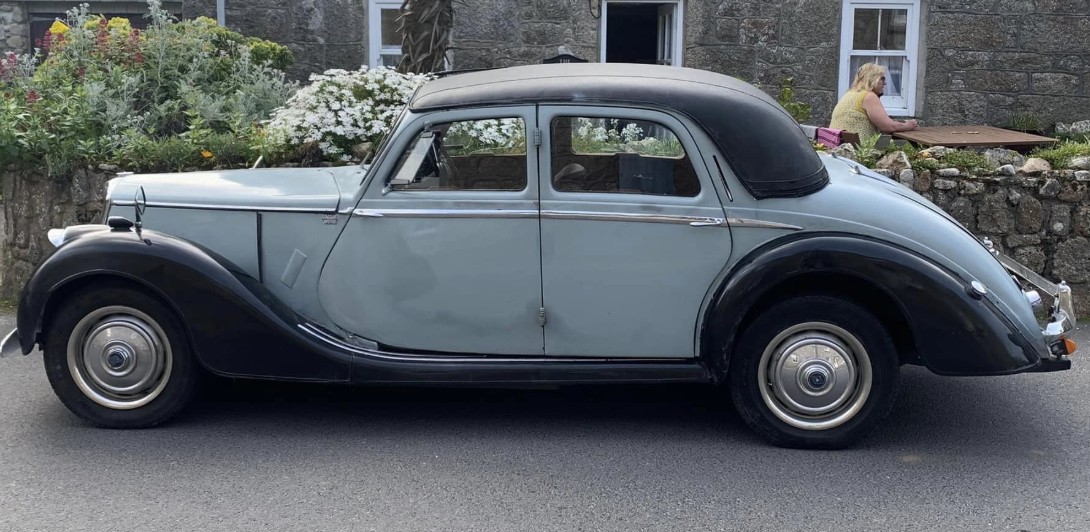
This is a handsome British car for sure. A 2.5 liter 4 cylinder with dual overhead cams that can put out north of 100 hp in 1951 in a production car is nothing to sneeze at. The restored “Saloon” that Michelle posted the photo of sure shows how beautiful this car once was. It’s always sad to see something as classy as a car like this become deteriorated. This is a great, well researched write up, thank you Michelle!!! Maybe someone can save it.
Thank you! … As far as saving it, I’ll bet its parts will live on in some more worthy recipient, and that might have to be good enough!
Overhead cams?
I thought that they were mounted high in the block.
Make: Riley
Model: 2.5 Litre
Model code: RMB
Year: 1950
Price new ($A): $1900
Engine: 2.5-litre 4-cyl
Valves: 2 x high cam, OHV, 8-valve
Bore/stroke: 80.5 mm x 120 mm
Comp. ratio: 6.8:1
Aspiration: normal
Power: 75 kW @ 4400 rpm
Torque: 182 Nm @ n/a
90-degree angled overhead valves[18] operated by twin high-lift camshafts moving rockers with short light stiff push-rods powered from the crankshaft by duplex roller chains[17]
Correct Gary. I think you will find that the arrangement allowed for cross-flow induction/exhaust and a better combustion chamber shape, possibly hemi.
Scrolling thru the latest, saw this and knew it was gonna be another classic from Michelle.
You’ve great taste in cool mechanicals ma’am and your homework is 100% with every one you’ve done.
Perhaps a Riley expert could talk about Riley’s racing history.
There are projects and then there ARE projects! You would really need to have to have a love for this car to take this on! Who will really know what it is anyway except for about .01% of the car people!!
I also hope someone takes on the difficult task of restoring this Riley. While I’m drawn more toward the sporting models — Imp, Nine and Sprite, for example — this is an attractive car and deserves something better than the scrap pile.
Parts may not be all that much of a problem, as there’s still plenty of enthusiasm in the Old Country. After all, when one example of an English marque is built, an Owner’s Club is started. Two, and there’s a Registry. Three, and there’s a Parts Scheme….
Riley engines are interesting in and of themselves. I seem to recall that they were the basis for the engines in the moderately successful E.R.A. (English Racing Automobile) racers. Twincam engines were pretty rare in England when Riley started building them; I think only the ALTA racers and the original Triumph Dolomite (something of an Alfa-Romeo 8C copy), of which only three were built followed suit.
The company came to a depressing end (as most U.K. builders have) as part of BMC , but that doesn’t lessen the appeal of the prewar cars.
Had to be you, Michelle!
As with the previous posters, I appreciate your efforts to save this sad car with your well-researched and written summary.
I´d endorse what @RayT has written. Riley is the stand out pre war English volume manufacturer, perhaps the only one which can hold a candle to more adventurous European competitors of the era.
In UK, these RMB mechanicals are desirable to build some very funky road-racing specials – supercharged in some cases. Then watch out!
This car looks sound, and LHD is certainly a rarity but I think the main problem with the RM Rileys is that they have wood frames to the body, which can rot (dry/wet/worm etc)…..Economic restoration is probably not realistic, but at that price the car could be very attractive to an EU special builder!
Riley survived , sort of , with BMC et al .
The Riley version of the mini , the Riley Elf , was in production from 1961 – ‘69.
Ridgecrest CA is the home of the huge China Lake Naval Weapons Center. I suspect an optimistic military person had this shipped across the pond when they were assigned to China Lake. In a previous life I visited there several times in a 1963 International Travelall and a 1951 Chevy panel truck but I won’t tell you why!
We had a BRG RMB from the mid 50’s until the 70s. Our RMB had hydraulic drum brakes in front and mechanical drums in the rear. Later there was a conversion kit to go all hydraulic. Very large, wide drums for the car size. Large wheels and tires for the rack&pinion steering with a huge steering wheel as no power assist to very direct steering The weak engine feature not corrected until the last series were babbit bearings that couldn’t handle long, high speed cruising in summer heat. BMC in Toronto did the engine rebuild with fitment of a larger fan. Dad drove my sister to her wedding in it. Whitworth series nuts & bolts. Last engines after hop up went into the Healey Silverstone. Roof prone to leaks.
Sold on 4/20/2026 for a high bid of $2,226, there were 12 bids from 4 bidders.
Steve R
Growing up as a kid in Bulawayo Rhodesia (Zimbabwe) in the 1960s one of my mates owned a beat out old Riley like this.
The suicide front doors, the fact that the door seals leaked in rain and soaked the carpets, and a loose exhaust joint all held a special fascination for us.
As a group of mates we went every where in this beast, and quickly found out it was a “chick magnet” :-)
It permanently stank of cannabis (personally not guilty sir!), and often the seeds would fall on the wet carpets. We were very proud of our instant garden of seedlings ! The owner Chris would transplant them into his parents garden !
But the leaky exhaust was really special. It added a sporty sound to it, especially the little pops and bangs between gear changes.
We had a number of bus stops in our suburb that were on steep downhills, and often in the afternoon they had “victims” in them. we would cruise down the hill with the car in gear and the ignition off, and as we reached the victims turn the ignition on. This produced a large backfire, and the “victims” would scatter running for their lives !
Oh the folly of teenage youths ……
Eventually the Coppers took it away from Chris and he had to fix the exhaust and have it re-inspected – we all chipped in because we loved that car .:-)….