

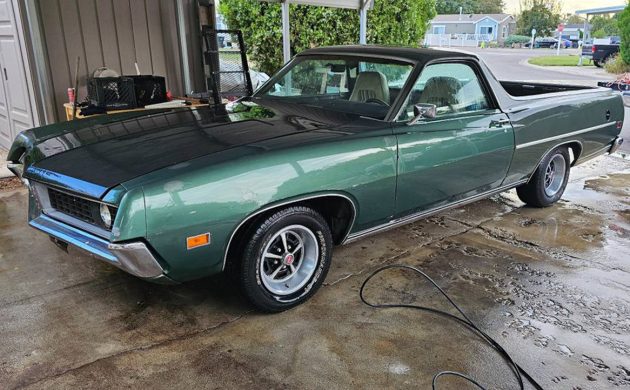
Ford’s Ranchero debuted in 1956, but long before its coupe utility body style graced the stage at the New York Auto Show, the company sold “utes” in Australia. The first Ford ute was designed during the depths of the Great Depression, when 22-year-old designer Lewis Bandt grafted a “tray” to the back of a Model 40 Ford sedan. Buyers bought “kangaroo chasers” as fast as they could be produced, appreciating the financial efficiency of a single vehicle for farm and family. The ute became a staple down under, with hundreds of thousands sold, attracting Holden and Chrysler to the market. (Despite Ford’s early start, anyone know what make is considered the very first “production” coupe utility and what year it was made?) Here on craigslist is this 1971 Ranchero project, located in Meridian, Idaho, and priced at $7500. Curvette – thanks for yet another great tip!
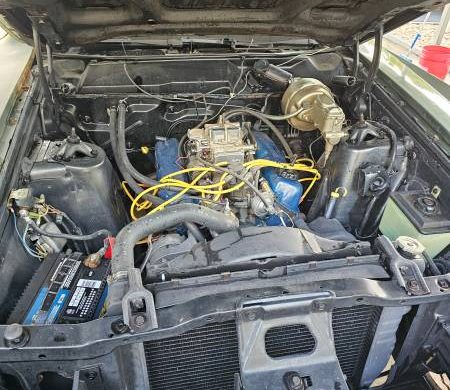
Like many American cars, the Ranchero gyrated through an identity crisis during its production run. First-generation vehicles sat on Ford’s full-sized platform, shared with the Courier, but 1960 brought a shift to the compact Falcon chassis. An about-face in 1967 took the Ranchero up the scale to the Fairlane’s intermediate platform, while the arrival of the Torino in 1968 triggered muscle-car aspirations. Suddenly, the Ranchero could go to the drag strip. Though the top-of-the-line 1971 Ranchero could be optioned with a 429 cu. in. Cobra Jet engine, this example currently harbors a 302 cu. in. V8. Extras include a four-barrel Holley, Weiand intake, long-branch headers and a C4 three-speed automatic. A great start – but the seller reports that the engine and gearbox need at least modest tinkering.
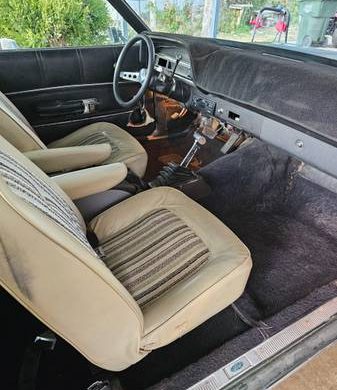
Inside, bucket seats are installed in lieu of the original bench seat – a great swap, though the upholstery needs to be cleaned and maybe refitted. A Cobra Jet dashboard, new floor pans (uh-oh), exterior trim and extra sheet metal come with the car. When these cars were new, four trim levels were available – the base model, the 500, the GT and the Squire (complete with faux wood siding).
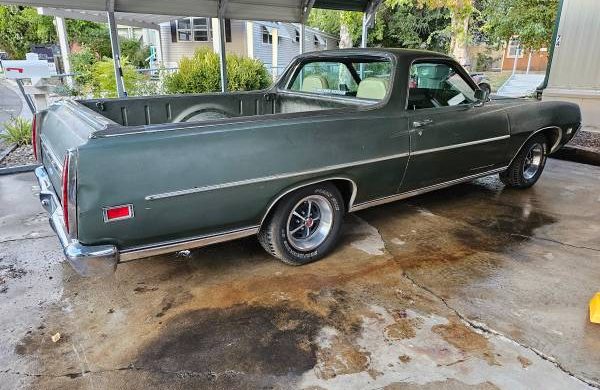
Just about all four corners of this ’71’s exterior need attention, whether due to dents, paint loss, missing trim, or misaligned panels or bumper bits. From the windshield forward, the ’71 Ranchero shares parts with the Torino; even aside from the common components, though, nearly every part can be sourced. I rarely care for engine swaps, but in this case, I would be mighty tempted; how would you finish out this Ranchero?

Interesting history and background, Michelle, but you do that well.
That this has replacement floor pans sets off alarms. Idaho doesn’t salt like its eastern counterparts do which begs for research of its past. Decent looking but knowledgeable potential buyers will know where to really look for problems.
What do you get when you own both an Elco and a Ranchero?
Da two utes.
Looked good in the first picture, but it goes rapidly downhill. Rusted out floor boards, the dash appears to be a mess, those awful buckets (find an original bench and put it in there!), and who knows what the seller considers “moderate tinkering”? After all, if all it takes is some tinkering, he’d have done it himself.
Where do you see rusted floor boards?
The Craigslist ad states that it comes with new floor boards (to install or already installed?) and that the car has some rust.
Fair enough. I missed that.
These are nice cars, but have a low resell value. I’ve had a couple Rancheos, including a 1971 GT with bucket seats, console 351C, 9” posi, Magnum 500’s and Shaker. When I tried to sell it there was very little interest, only low ballers called and made offers on the phone. Project El Camino’s were selling for more than my asking price. This Ranchero is too much of a project and won’t likely attract serious potential buyers.
Steve R
I am local to this car, I also know the owner. Let me know if you would like extra pics or video of it.
Well you have changed the trans shifter because you can see the 1 on the column n then 1 in the floor so what else is not original other than the bucket seats because it came with a bench in it
That’s a GT front end…most likely had the 351C & was blown…Bronze valve guides were installed at factory at 30k miles guide wear caused valve walk & incomplete sealing leading to hot spots & burned pistons etc.
302 is good work horse substitute 351W better tho.
No mention of rear end ….
buyer has his work cut out for him.
I had a ’71 Ranchero. (Wish I still had it) It was a lighter shade of green with black bench seat and interior. The inside was very nice with a small crack in the instrument panel padding. I installed a 5.0 (it’s original 302 was used up) but still used the original 2bbl carburetor. This was my daily driver. When the C4 gave up, I installed an AOD. With the stock 2.72? Rear gear it just loafed at 70 mph. It had always been a Central California car which is where I picked it up. No rust anywhere but the paint was really tired. I had aftermarket period correct wheels with white letter tires. It has been parked in front of the house when a wild fire took everything but the house (and it had some damage) There was no injury to the Ranchero, but a couple of weeks after the fire I lowered the tail gate to find several good sized former embers. During Hot August Nights while my car was parked out behind my place of employment a guy showed up to ask if I wanted to sell the car. He made me an offer that I couldn’t refuse. I wish I had refused! So since I’m a Ute fan I bought a Ford Durango.
All ya getting for 7 K is a motor and nice looking rims . Pass
Nice starting point
Provided you check the truck bed floor behind the cab for rust. That area can rust through causing leaking in the passenger compartment behind the seats. (Older Falcon versions can have the same issue.