

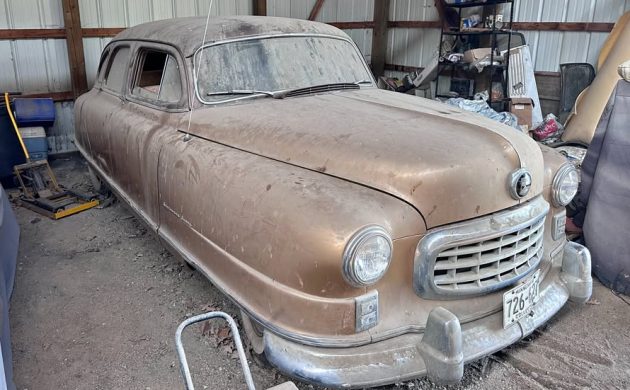
Some enthusiasts fear that the stream of genuine barn finds will slow to a trickle before drying up entirely. If this Minnesota barn is any indication, that may not happen soon. Plenty of cars are hidden beneath covers and tarpaulins, but this 1950 Nash Statesman Super needs a new home. Its owner recently passed away, and the barn’s owner wants it gone. It is an essentially solid, complete classic that has hibernated for around thirty years. I must say a big thank you to Barn Finder Zappenduster for spotting this promising project candidate listed here on Facebook Marketplace in Moorhead, Minnesota. The seller set the price at $7,200, and since it’s been on the market for eleven weeks, I wonder whether they might consider respectful offers.
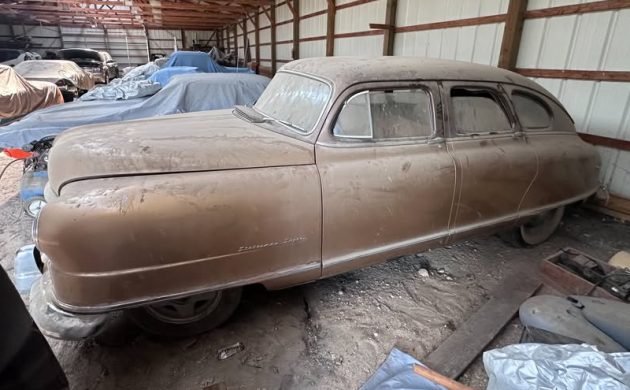
Nash released the Statesman in 1950 as its mid-range offering, slotting it between the Rambler and the Ambassador. The company adopted unibody construction, focusing on aerodynamic efficiency utilizing what it christened Airflyte styling. The Super was the entry-level variant, which is what the original owner selected when ordering this Four-Door Sedan. It has sat in its current location for about thirty years and is only moving because its owner passed away. Beneath the heavy dust layer is a two-tone combination of Seal Brown over Fawn Brown. Confirming the paint condition is impossible because of the dust, but the seller says this Nash is solid. I noticed what appears to be failing Bondo in one back door, and I think the driver’s-side rear quarter panel might be rippled. I see no evidence of rust, which is good news for interested parties considering a DIY approach. The glass looks okay beneath the grime, and the trim is intact.
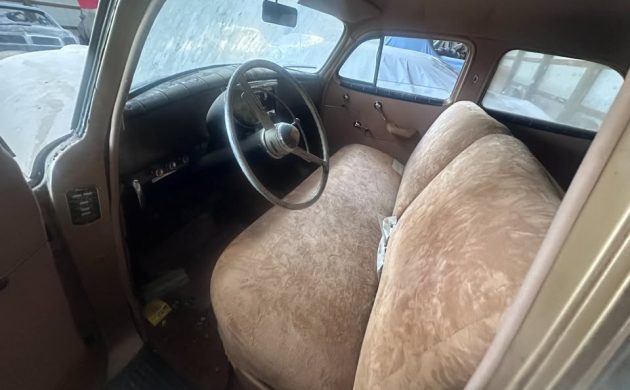
One aspect of this Nash requiring more time than money to present well is its interior. The photos are slightly inconclusive, but I can’t spot any ripped or split upholstery. The painted surfaces might require a refresh, but that appears to be the worst of its problems. Nash released a four-page Sales Brochure for the 1950 Statesman, extolling the virtues of the front seat. Owners could lower the backrests flat, and since they met the back seat base in that form, the company floated the concept that sleeping in a Nash was a viable alternative to a motel bed. I guess to each their own! This might be the entry-level Statesman, but it does feature a factory radio.
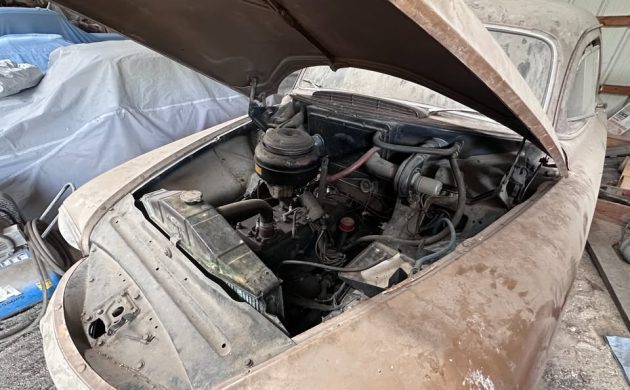
Nash enlarged its six-cylinder flathead motor in 1950, increasing displacement from 172.6ci to 184ci. It delivered 85hp and 145 ft/lbs of torque, with the latter peaking at 1,500 rpm, making the flathead remarkably flexible. Buyers could order an automatic overdrive transmission, but this Statesman features a conventional three-speed manual. The seller confirms this old beast doesn’t run, and I suspect it’s probably lain dormant since it arrived in this barn. The motor is stuck, but the seller has poured an unspecified fluid into the cylinders, hoping to get the motor turning for the new owner.
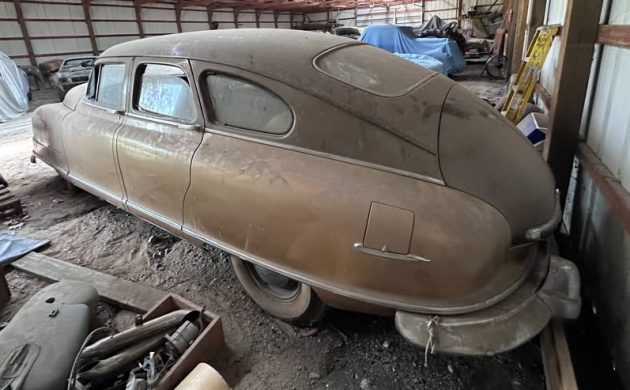
I am a big fan of the movie On Golden Pond. In it, Jane Fonda’s character talks about a car she rented that is ugly and breaks down a lot. Her father considers it for a moment and replies, “It must be a Nash.” I’ve always considered that line funny, but unfair. The reality is that cars like this 1950 Nash Statesman Super were no better or worse than any vehicles rolling off American production lines during that era. The company produced 60,090 Statesman Super Four-Door Sedans in 1950, but try remembering the last time you saw one on our roads. Because these classics are no longer common, our featured car is worth preserving. Are you up for that challenge?

Overall it does look pretty good, the body looks solid other than the back door issue Adam mentioned, no visable rust, the interior hasn’t been eaten by mice or worse. I’m not sure how damp the floor of the barn is though. It looks dry, which if it is thats a plus. I’ve always thought these were unique cars and have liked them since I was a kid. I hope this one can be saved. This just might clean up very nicely. Nice one Adam, thank you.
The flathead engine in this car was introduced in the 1941 Nash “600” and, aside from changes in displacement and accessories, is the same engine found in the 1964 Rambler American station wagon featured here recently. That engine found its last home as the base engine in the 1965 American. (It appears that this example lacks the optional partial-flow oil filter.)
The unspecified fluid poured into the cylinders may be Marvel Mystery Oil. No one knows what’s in it (it’s a mystery) but it frequently does a good job of unsticking engines that have been dormant for many years.
If this car has really been sitting unused for 30 years it’s going to be a lot of work to get it roadworthy again. I’ve done that job on cars sitting for half that time and it was pretty daunting.
These are good looking in their own unique way, but the sellers asking price is way too high. It’s a project thats been sitting for at least 25 years that will need everything. The process for this class of cars are falling fast, if not collapsing, compare this to the restored 1950 Nash featured on this site a few days ago. It’s being auctioned off on eBay with no reserve and is sitting at $5,800 with just over 2 days left. It will likely go higher, but how much is the question, unless it triples or quadruples, it begs the question, why should anyone start with a car in this shape anywhere near the asking price.
Steve R