

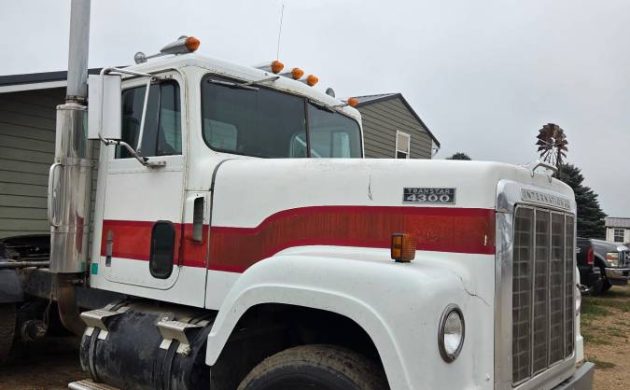
By the 1970s, International was renovating its business, shedding its light-duty truck lines to focus on medium- and heavy-duty trucks. The Transtar 4200/4300 series was introduced in 1971; production ran through 1984. This example is available here on craigslist for $13,000; it’s located in Slayton, Minnesota, and the tip comes to us courtesy of Jack M. – thanks! The seller notes that his relative bought the truck but never equipped it with a trailer; we’re left with the impression that it’s been a while since this rig ran.
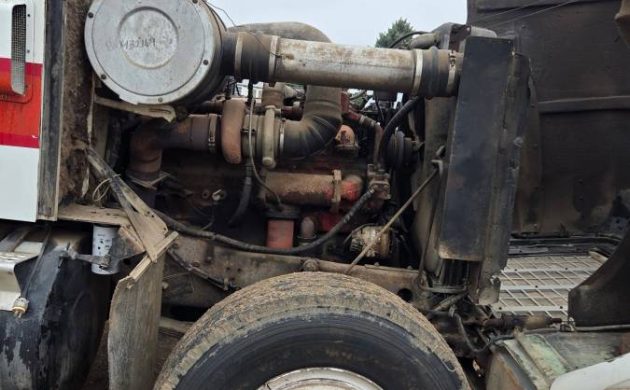
The engine is IH’s well-regarded DT466, a 7.2-liter turbocharged six-cylinder diesel, good for about 250 hp. Torque is prodigious at about 600 lb-ft at 1400 rpm. A range of transmissions was available, from Eaton Fuller six- or seven-speed manuals to Allison automatics. This truck was used for short-haul work and, according to the seller, has accumulated only 148,000 miles – if that’s correct, it’s barely broken in. Production figures aren’t available, but judging by forum participants’ glowing, and even affectionate, reports, this model was well-regarded.
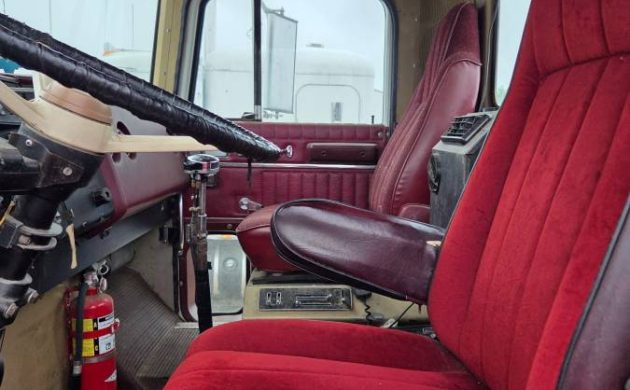
The interior is clean, but torn vinyl, dusty gauges, and worn door panels indicate that the mileage might be higher than we’re told. Better cabin accommodations could be had if the buyer chipped in for the “Eagle Broughm” edition: that bought shag carpet; deeply padded, tufted seats; and dark wood trim. The Eagle was also painted in custom color schemes, including the famous bird of prey splashed across its flanks.
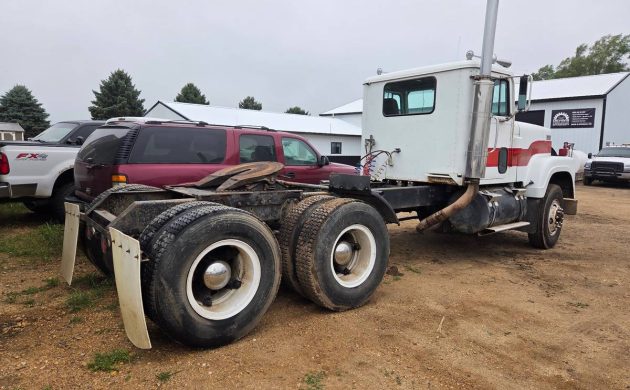
The truck’s exterior is a bit the worse for wear: rust is evident here and there, the paint is blemished, and the grille surround is dented. And we still don’t know if it runs! Values fluctuate between $2500 and $10,000 depending on equipment and condition. Tucking this one away to await restoration or recommissioning will require plenty of space; it’s not a prospect for the urban dweller. How would you use this truck if it dropped into your driveway in running condition?

Just about to turn for a spell, when BAM! Seeing this, at this time, makes me want to go to work,,,well, maybe not. Another well deserved thank you, as memories reel.
Okay, to be crystal clear, I by no means, mean to upstage the author in any way, the author is smart enough to know that,, I’m merely adding my .14 cents,,,,and here it is.
The 4200/4300 “Trashstars” were the workhorse of the local/regional trucking industry. They replaced the aging and not near as popular, Transtar 400s, and for the 1st time, big power was available, thanks to the bigger radiators. Speaking of which, this is not a DT466, it’s a BC290(?), sorry, and what looks like a 13 speed. This was the standard issue conventional, some had “shiny 290s( 300s) or 350s. Regardless, it was a stark improvement, and later CAT motors took it up a notch. My 1st trucking job, the guy was all Mack. His dad had the 1st Mack truck in Milwaukee in the 20s. The entire fleet( about 20 trucks) was Mack. In the late 70s, when I started, he broke the mold and ordered 4 new 4300s just like this. Naturally the drivers were thrilled. I never got one, however, and drove the Macks they moved on from. I can’t see the rear suspension, could be Hendrickson rubber pad( no springs) and will ride like an old grain wagon. “Wagon wheels”( tube type) will have to go, 11×22.5 tubeless bolt right on and front Budds, this truck will still haul the mail, and none of the legal shenanigans,,,yet.
There is a desire for pre-emission trucks, stated on the WS post, to skirt emission and DEF requirements, but that window is sure to close, nobody gets a free ride in the future. Naturally, this is nothing to go long distance with, even though many have, but for a “good ol’ horse” around the farm, I wouldn’t dawdle on this one.
As a side note, I think secretly, the author wanted to be a truck driver, no? Trust me you would have done fine, Lass. Thanks again :)
I still wanna be a truck driver. My secret is out!
Nice!!!! I drove many an International with the DT 466. My favorite setup was a tandem axle 22 ft straight job for the city stops. Why I liked it was the 10 speed Rockwell trans. The gear ratios were so close you pretty much HAD to slipshift it, you didn’t have time to use the clutch. And it had a great feel to it as well, nice and tight. Short throws, it was great. Definitely the fastest shifting truck I ever drove.
The DT466 along with a lot of other engines was available in larger Binders like this. I had seen a couple day cab local single axle trucks with the DT466. The seller states this has it in his ad.
Once again Michelle, thank you very much!!! And a huge thanks to Jack M. For finding this too.
How about that? Just about to minimize this page and go to work when I scroll down and see an old standby.
Lots of these still in service in the Chinook Belt. Trim is a little hard to come by but parts for the drive train are not a major challenge–yet.
Need to contradict you on the engine, Michelle. That’s a Cummins BCII 855 under that hood. Since I can’t see the left side I’m going to guess at JWAC (aftercooler) so it could be as high as 400 hp.
Columbus Vibrators and Peoria Rock Crushers formed the majority of the powerplants; I did see some with 2-Stroke Jokes but I have to say that Cummins reigned supreme. 350 or 400 hp, always with someone who had a drill to take out (tamper proof?) ball out of the throttle shaft and expose the DFWI screw.
Worked on lots of those back in the day. Very few problems until some jack-donkey came in expecting to fly to the moon. “Just a little tweak so I can make that last hill?” they’d ask/insist/demand/coerce. “Come on, you should be able to haul 80,000 lbs. over the Beartooth Pass and keep it in high gear.”
“Sorry, chum, a KTA600 can’t do that.” Actually I wasn’t sorry.
“Gee, it won’t pull a sick hooker of a p$$pot.”
“Well, you’ll have to accept just pulling a limp “noodle” out of a pail of lard.”
And on and on. I miss a lot of things about the repair business but that is NOT what I miss…
And to correct you is like peeing into the wind, but I must. On the ad images, there is a left side view, and it does not have the aftercooler, just the standard intake manifold. I was told to crimp the return line for more power, but never did it. It was part of the service, to check the return line. It was instant grounds for dismissal.
Aha! You know I clicked and clicked on those pics and it just showed the RH side. I stand CORRECTED, and thanks for that. It IS a straight turbocharged BCII, starting at 290 hp, but most of those I have seen in a Binder (or any other truck) without an aftercooler (and this age) were Formula 300/315 engines. Of course, by the time they ever showed up at our shop they were cranked up practically to NMD anyways. Afterall, what’s an aftercooler offer that you cannot do with a screwdriver anyways? Roll that coal…
Thanks everyone for the engine knowledge! I went with what the seller said, silly me!
Crimping the fuel return to actually installing a shut-off valve; I’ve seen both of them. I’ve also seen the boost line removed from the AFC on the fuel pump and a grease fitting installed with the pressure side of the diaphram filled with gun grease.
I had a customer with a 475 Twin Turbo. I worked on the fuel system and max’d things out (within reason) when I set it but that wasn’t good enough. He went from a #15 button to a #5; backed out the fuel screw and the AFC no-air screw until both of them popped out.
He was hauling grain on Super Bee’s and the coal those pipes were putting out was highly visible. I followed him down a 25 mile stretch of road and there was black dust on my windshield. The guy had the audacity to phone me and tell me that his truck had no power. I just told him that there was no shortage of fuel because I still had the dust on my windshield to prove it. I advised him to replace the turbos or re-educate his drivers on how to operate a big truck.
Never heard from him again. Come to think about it, I never saw that truck again. I often wonder what happens when someone finally realizes that he is expecting more than that engine can deliver…
We can always count on Geomechs for info and a great picture as well!!!
I can only imagine how many great photos you have.
Am I remembering correctly about Binder day cabs having a DT466 in them? If I’m wrong I’ll apologize now, step aside and let experts like Howard and Geomechs say something.
Again, great write up Michelle!!!
IH set a lot of store in its 400 Series, 466 in particular, and justifiably so; it was a great engine. Not a lot of power but it could work to the max and still be ready to do it again. I’ve seen it as a basic engine in the bay of a Paystar 5000, which is one BIG truck. Of course I have some doubts if it could actually pull it very fast. But then, back in the early 70s when the 466 was in its infancy, the standard engine in a Paystar and the F210/F230 was a Detroit 6-71 with 195 hp.
IMO the 400 series all but wrote the book on smaller, stronger diesels; it ranged in horsepower from 160 to 300 and was available in N/A, Turbo and Turbo/Aftercooler. The lion’s share of them held up very well although I recall a couple from the agricultural side, a 966 tractor (D-414) and a 1460 Combine (DT-436) that really had “YOUNG ONES.”
Both of them had #1 pistons fail in the pin holes while wide open and the rod went out both sides of the block, and down through the pan. The injection pumps were shattered, leaving only shards of the front of the housing and the camshaft; the hydraulic heads were held in place by the high pressure lines.
Hand grenade awards were highly deserved in both cases.
IH and to a certain extent, John Deere, paved the way for smaller lightweight diesels and weren’t really challenged until Cummins came out with its small line. The game was changed forever after that.
photo by 4hunt.
Geomechs and Howard have covered all the areas very well, I was also thinking 290 BC 1 or 2 and turbo with no after cooler was usually 290 in my area. my dad had a 315 with JWAC but it was BC4 lowflow,bit of a different animal. After a life time in this trade when you retire it seems impossible to view trucks like this and not want it, but what on earth would I do with it? Thanks Michelle.
PS Geomechs, you will never get any thanks for fueling trucks just complaints from arm chair mechannics but they never give up trying get or force you to do it.
Not much to add, Howard and Geo got the engine covered, 13sp, Hendrickson suspension, more than likely IH RA rears, put a wet line on it and it’d make a great farm truck,too ruff a ride for long distance.
That’s definitely a big can Cummins engine
Need pic of the other side of the engine
Id 🪪 tag with the CPL number is on the front cover in front of the PT series fuel pump
The 4200 badged trucks were Detroit Diesel powered
4300 were Cummins and cat powered
That’s definitely a big can Cummins engine
Need pic of the other side of the engine
Id 🪪 tag with the CPL number is on the front cover in front of the PT series fuel pump
The 4200 badged trucks were Detroit Diesel powered
4300 were Cummins and cat powered
Thanks for the input, but not necessarily. I read, and always wondered, what the difference was. Apparently, the 4200 has a “bumper to back of cab” length of 107″. The 4300 has a “BBC” of 117″. Not sure where that 10″ is, cab or hood, but no other differences. You could get any motor in a 4200, but a Detroit then was a very popular choice.
Educational commentary. 🤓 love it. Thx for the feature Michelle. Never too late to hit the road as a trucker 🛣. Good find Jack.
Again Howard and GEO have hit the high points!! Michelle another great write up.. GEO, Your second picture is an older R-230.. Era correct with Budd wheels on the steer and Dayton spokes on the rear. The front can be updated with stud piloted aluminum wheels by just bolting them on, and the rear can be updated with 22.5 by just changing the rims and tires, IF those tube type recaps on the back do not meet your needs. Depending on the price this truck will again do a great job on the farm hauling hay or to the grain elevator work. Since it is probably spring ride in the rear, do NOT even think about OTR work!! With some TLC it can also be a neat Hobby truck to haul your toys to shows. With antique plates and your OWN equipment on the trailer you would not need a CDL.
I’m just here for Michelle wanting to learn how to drive big trucks. I’d be more than happy to mentor that & not with any weird intentions. I genuinely think it’s a beautiful thing to pass on.
I have a 466 & 530 in Binder tow trucks, the 466 is in my 25-ton. She’s slow but pulls like a freight train regardless. The 530 is in my crew cab/equipment hauler & is a relative hotrod. A couple of T444Es also in my lighter stuff. Can’t kill ’em. I’d love to have this rig with a modern integrated tow truck bed.
I have NO problem with Michelle learning how to drive a truck, in fact I applaud it!!! BUT, today I doubt if she would enjoy it as a career due to all the new regulations and the younger people in the industry. Get a friend with a big lot to teach you and stick to Hobby trucks with antique plates which do not need a CDL..
Just being a “kind of outsider’ I enjoy all the comments but get lost on some of the jargon/abbreviations/slang. (Certified master tech that never turned wrenches, only directed repairs in a medium duty dealership) I’m lost as to the term ” after cooler”. Can Geo, Howard or Jim please explain the reason/need or maybe I’m not even thinking of turbo charging?
Please help an old confused interested guy.
Hi, Wayne. One disadvantage of boosting the intake airflow, using a turbocharger, or other means is that air, under pressure, warms up; consequently expanding. Expanded air naturally contains less oxygen than cooler, more dense air.
In a straight turbo’d engine the air in the intake manifold can rise to over 200 degrees; so what they do is try to cool that air down. One of the first things engineers adopted was a “Jacket Water After Cooler,” or JWAC, which is essentially a radiator-type core within the intake manifold. It contains coolant from the cooling system which successfully gets the intake air down to 180 degrees.
A little short note here: You may hear the term, “Intercooler.” It’s exactly the same as an aftercooler. Some engineers called it an intercooler because it was INSIDE the intake manifold. However the majority of engineers used the “Aftercooler” moniker to show that the intake air is cooled down AFTER the turbocharger.
Of course, in the effort to get more oxygen into the engine, engineers routed the intake air through a core mounted in front of the radiator where the intake air could be cooled down to within 10 to 20 degrees above ambient air temperature. That device is called an “Air-to-Air-Aftercooler,” or “ATAAC,” for those who like to use acronyms.
Now there’s always the extreme side of this. Some guys on the Truck / Tractor-pulling circuits built aftercoolers that allowed contestants to put ice in there to cool the air down even more. Then some trackstar decided to really tweak the brass monkey’s genitalia by using dry ice.
Some people are just not satisfied.
Bottom line: It’s all part of a way to get more hp out of the same displacement…
GEO, Thank you for this excellent explanation..
I keep saying that Geomechs seriously needs to write a book. Maybe a several at this point. He’s also a great teacher too. Always learning something new from him.
I actually got started on the book. I’ve got one ahead of it but I hope to have this one done by Thanksgiving…
Thanks guys! I’m very dialed in on turbo charging. Have been installing turbo systems since 1977. (Gasoline engines only) And infact in the middle of a custom install at the moment. (Although stalled due to other non-automotive reasons right now) I just wasn’t dialed in to the “truck term ” for boosted/charged intake air. My last”personal driver ” install was on a Fox body Mustang 2.3 4 cylinder. that I ran 17 psi of boost AND 9.5 compression before boost. I ran that as my daily driver for 3 years before I swapped to a V8 with no issues of failures.
Thanks again!
Geo, if it’s a paperback, not digital, put me down for a copy right now amigo 📖