

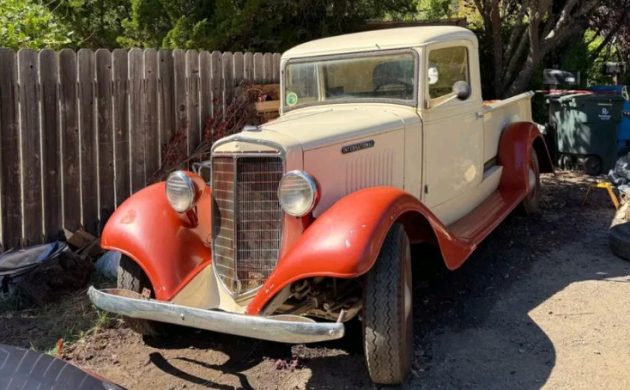
A running, driving pre-war International pickup is rare enough without this one’s exotic origin: it was owned and used by Southern Pacific Railroad in Sacramento from new. When the rail company retired it, an employee who had driven it regularly purchased it. The current owner bought it from her estate. It came into his possession with copious documentation. This is a C-1, with the V-shaped grille and wing-like fenders. Just a few months after this truck was produced, International updated its styling, rounding the grille and teardropping the fenders to make the D-1. Find this prewar pickup here on Facebook Marketplace for $11,000. It’s located in Guerneville, California. Thanks to T.J. for the great tip!
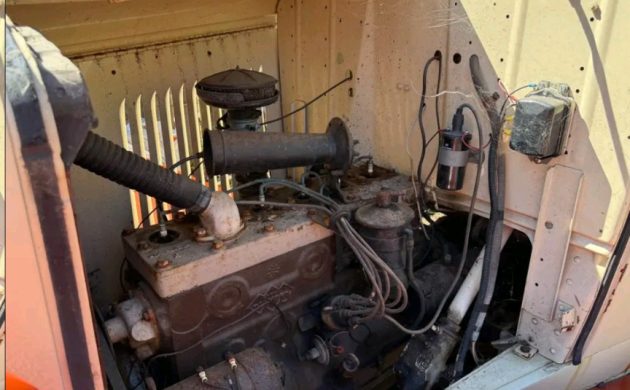
Mighty spacious in here: the engine is International’s redesign of Willys’ 213 cu. in. L-head six-cylinder, good for about 78 hp. Three diamonds can be seen embossed on the block. The gearbox is a three-speed floor-shift manual, and hydraulic brakes had finally made an appearance by ’37. The seller notes that the truck needs a new battery. Though today the average driver might tear his hair out attempting to navigate our roads in a stock, pre-war truck, entering the light-duty market saved International from financial ruin wrought by the Great Depression. Its first contender was a rebadged, re-engined Willys truck, the C113, sold under the International nameplate as the D-1 in 1933. (Of course, this causes no end of confusion since International called its 1937 redesign of the C-1 by the same name – D-1.) While this cooperative approach saved International, it wasn’t enough to rescue Willys, which entered receivership in 1932. While Willys revamped its product lines, International was left with the light truck line, and the C-1 was launched.
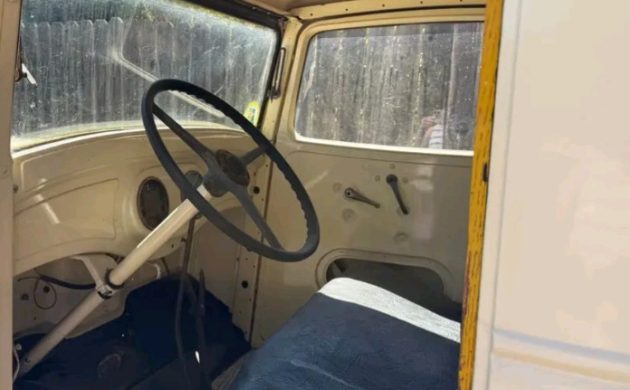
The interior is a reminder that we’re considering a functional vehicle produced during a depression – it’s about as bare as can be. That said, this example is well-tended. This truck comes with plenty of documentation from Southern Pacific, as well as a few parts and tools.
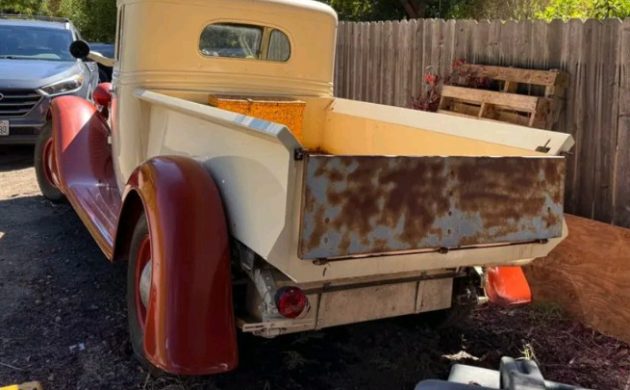
In prewar times, bumpers, tail lights, wipers, sunvisors, and other accessories we take for granted today were largely optional, if available at all. This truck has a single taillight and no bumper. The original toolbox used during its working years is still in the bed. Considering the value of this truck leaves me wondering a couple of things: did the railroad insist that the truck be repainted when it was retired and sold? There’s not a trace of “Southern Pacific” anywhere on this truck. And is the rail provenance valuable? Let us know what you think in the comments below.

Certainly a good buy for this beauty…
This is one neat old truck. And a great history too to go along with it. I didn’t kmow International redesigned the Willys 6 cylinder. This one really needs to be saved and preserved. Or if it was able to be restored to how it looked when it was new would be tremendous.
I can say without reservation, International had the most confusing model designations though the years. The C series was the last of the “old time” look, and for the 30s, was considered a modern truck. Juice brakes weren’t the 1st, the 3 speed and 4 speeds still a crash box. D series had a synchromesh 3 speed( 2nd&3rd) and simplicity was the rule. The only thing I see, is perhaps a larger fuel tank, and not sure what the RR used it for. Obviously, not for much. Like a fire dept. or forestry, I’m sure there are still some of these in sheds, but got to be getting thin. What a great find.
Plumb cool truck!!! I see its purchase is pending. With all of the stated documentation and stated originality, if it doesn’t go to a museum, I hope that it goes to a new owner who will appreciate what he/she is buying. Fantastic find!
Good write up, Michelle. Your research on these trucks is thorough. Unfortunately there is a lot of information available that isn’t accurate, which necessitates the need to make a slight tweak to the designation(s).
International wanted to get into the pickup business but it was being very cautious due to the depression. Willys already had a pickup so a deal was struck with Binder to badge the Willys as an IH. The model designation was D-1.
At the same time International took the engine and tweaked it into a larger (213 CID), calling it the HB. In about 1934 IH went to full-length water jackets and called it the HD.
I haven’t the foggiest idea about the HA or HC, or if they even existed. It makes about as much sense as going from D-1 to C-1.
Officially, the C-1 came out in ‘34, got an all-steel cab in ‘36, with the major change coming in ‘37. But this style was C-series.
Binder had a habit of attaching the year’s designation to the date the title was validated, which was still in practice into the 60s. In reality the D-series was introduced in 1937.
Now for more confusion: The light truck for the D-series was the “D-2.” International decided upon that so as not to confuse the new D-series with the old series.
Please don’t think I’m attempting to trifle with your writing. When I retired from the repair business and joined an International dealership that has a sideline specializing in old International truck parts, I found out how much I didn’t know, and got my backside handed to me by several customers.
This is a welcome sight for sore eyes. Only thing that would be better is to park it at my place, before some hack decides to ditch the rolling chassis for a Chevy S-10.
That’s a Green Diamond under the hood. It even sports the newer style water pump. Upgrading to a GRD was common practice over the years. Most of the internal engine parts are the same; the HD engine would’ve run shims on the main and rod bearings whereas the GRD does not.
Thanks so much for fixing my flounderings in the IH arena! I have a tough time with these older vehicles sometimes for just the reason you say- there’s a lot of incorrect info out there. Worse, bad info propagates throughout, so like if one guy has the wrong facts about an engine, that will get picked up by some auction catalog, and then incorporated into Wikipedia,…. It’s insidious! I try to corroborate across sources but that does not always work.
You’re welcome. International can be difficult. I’ve tried to track parts down for clients and find out that the truck they have hails from Canada. And somehow the truck is in Texas (well, you featured a Western Star truck that was a long way from Kelowna BC.). Like GMC and Pontiac, I found out that International has Canadian variants.
Ditch that worthless chassis for an S-10 so you could drive it anywhere.
That’s what a Looser would do –
Pretty close to a personal attack, but I’ll let it go because I’m not a “Looser”. 🙄
Hang loose!
Personally, when you get one of these up to 70 mph they’re not easy to handle. Get a crosswind and they are downright dangerous. My BIL has a ‘36 Dodge that is just fine until you hit that magic 75. Your steering suddenly seems to have disappeared. In short they’re not designed to travel at the speeds that so many people expect.
I have a ‘35 Ford pickup, which spent its life as a farm truck. The frame is sprung and has broken and been poorly welded at least three times. My plans for it are to get a TCI or Fatman rolling chassis and replace the frame. I’ll probably keep a flathead V8 but I just might talk myself into using the ‘53 Mercury engine I have, and sidelining the LB. Then again, an acquaintance has shown up with a pristine ‘35 frame.
So what do I do?
35 frame is a message from the Truck God’s…
This has providence, doing anything but bring it back to original paint would be sacrilegious.
Provenance.
Leave it original! You don’t see enough like this today.
To call something “worthless” that others hold dear seems no less a personal attack to me – have a good day
Anyone can restore one. It takes a real man to cut one up. A chassis is something you “hold dear”? LOL! Sounds like you’re having a bad day.
No hot rod conversion, I hope.
Well my 34 international truck is a hot rod unfortunately for the realists out there. I got it from a guy that started it and gave up. It was just a cab and original frame boxed basically a rolling chassis four link rear 350 chevy 4 speed T10. I made the rear truck box and tailgate. I tried to find parts when I started but nobody knew where to find anything or it would’ve been back to stock with updated suspension but when I was almost finished with the redo and fabrication oh many things that I was working on when I found 2 complete 34 to 37 international trucks sombody was selling in Oregon but I wasn’t starting over. So it is a hot rod and drives great on the old frame boxed sway bars gas shocks and coil springs it’s saved and fun would love to share a photo but to be a member and share photos it costs a small amount but I’m not interested in that. Just saw the add and wanted to comment and say they should all be saved and be driven just don’t put it in a garage or museum to collect dust they are ment to be driven and enjoyed by all. I get waves and thumbs up every time I drive mine and people seem to like it just fine. The box I made looks great people are shocked that its not original it looks the same as the rest of the truck weathered patina and all.
Your project is exactly what hot rodding is all about. So many discarded hulks given new life with a new powertrain. Where I’ve always drawn the line is when people have taken a complete, restorable or restored vehicle and modified it.
I have seen it happen many times and, even when I was in 2nd Grade, I bristled whenever I saw one butchered. I sometimes think that ol’ Boyd was taken before he could destroy another classic.
Taking a shell of a car, little more than a bucket of rust, and making it driveable and practical in modern traffic I can understand. It is mercilessly cutting up and deforming a car that has some good potential that I can’t understand.
Oh, the denial is huge with this one kemosabi,,and probably no bigger tipping point than right here. The older ones, that are fading fast, naturally want it kept original, however, truth is, there is merit for the upcoming generations, and our society for that matter, that have no use for a vehicle like this. It’s the styling that will be admired, and an update makes it useful again, and perhaps again. I see the anguish in some folks replies, I of all people hate to see it go, but eventually, we just have to accept it. Just look at some of the creations on images of these restomoded, they’re simply beautiful. Practical? Heck no, but like this, it will sit and collect dust,,,again.
Well, I believe in saving them all no matter what it should or could be if they aren’t too far gone. You can’t find parts that are decent you do with what you have. And if it turns out to be a restored resto mod them to each his own. The point is love it or hate it it’s still here and drives appreciate that sombody took time and at least saved the old iron from the scrap yard. I have a 34 C1 that is saved from the scrap yard so its better in my hands than overseas made into a blender or worse.
70 to 75 mph in a 1936 vehicle?! Seriously? I know I’m the slowest guy on the road but that is certifiably insane.
I had a ‘57 IH Pickup. It wouldn’t go 70mph if you dropped it out of an airplane. It was a great truck, and would go pretty much wherever you wanted- at 45mph- 55 if you were on the way to the hospital.
I’ve owned several ex railroad trucks, all with hyrail gear to use on tracks. I’ve also bought equipment from Southern Pacific. RR stuff would inevitably be painted one color – even in 1937 – something such as orange, yellow, dark blue, white or maybe in the old days, brown. Milwaukee Road painted their trucks red. Anyway, this truck is not wearing its original paint scheme.
Save or change. I understand the desire to keep it original. Modernizing the chassis and driveline will bring it out for more people to appreciate. Twenty years ago I attended the Street Rod Regoinals in Kalamazoo. Walking around I was shown a ’35 Ford Phaeton. First thing he said was that the purists would object to being hot rodded but at least it was restored.
If the vehicle does not have history or Providence, ‘hot Roding’ it might be acceptable, but I feel hot roders should stick to mutalating incomplete or non restorable examples, there are plenty out there. This one is a museum piece and should not be modified for any reason.
My sentiments exactly. It frustrates me to no end seeing people take a complete, original vehicle and throw useful irreplaceable parts into the shredder.
I ruined a customer’s day a couple of years ago. He happened upon a fully restored version of this truck. But he wanted a street rod, on a Chevy S-10 chassis. He told me he tried to sell the original chassis for over a month and couldn’t get one bite; so he had it shredded.
I rubbed his nose in it! I told him that he could’ve sold the engine alone for $10K; people would’ve showed up in person before the ad was finished. “That chassis could’ve brought you $15 to $20K!”
He sounded pretty sick when he hung up. But I didn’t care. Like I told my sister after she turned 70; “When you’re 50, it’s like Jo Dee Messina said in her song—Your Give-a-Damn’s busted—close quote.” “When you’re 70, it’s LEFT the building.”
Still provenance.