

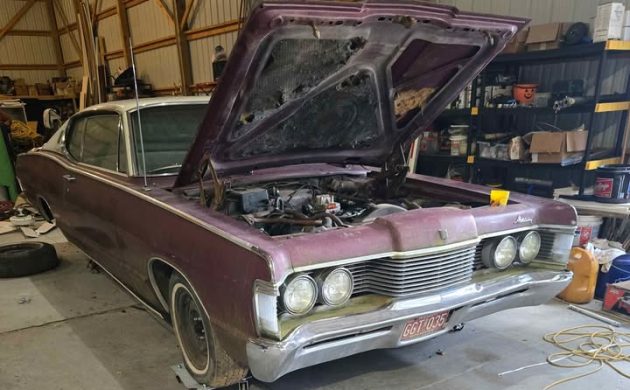
The other day, I was opining on the subject of fallen flags like Pontiac and Oldsmobile, so today I thought I’d change direction and focus on Mercury, specifically a 1968 Monterey two-door hardtop. This particular example is in Washington, Missouri, and is in true barn/garage-find condition. It’s said to run, but it looks shaky, so let’s investigate further. This big fastback is listed here on Facebook Marketplace for $4,500, and we have Zappenduster to thank for this tip.
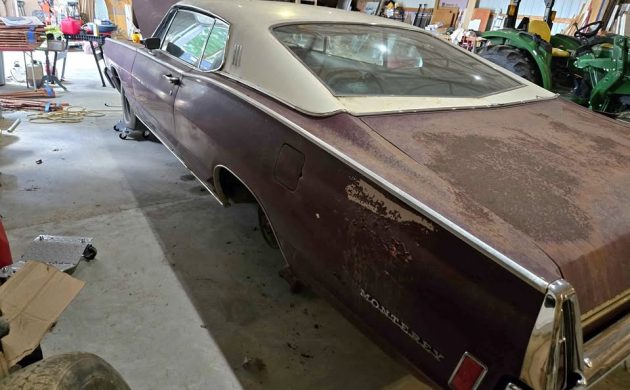
It wasn’t long after Pontiac left this earth that Mercury, too, got the vaudeville hook. Their demise wasn’t really a surprise, as they had been reduced to just a cosmetically altered Ford; we were still feeling the effects of the 2008/2009 recession, and the bankruptcy of GM and the Chrysler Group – it was a tough time to be in the domestic car biz. Rolling back to 1968, we find Mercury managed a respectable eighth-place finish in the great domestic automobile production race with 360K units. This Mercury hardtop is one of 15K Montereys assembled in ’68, the entry trim level that also included a four-door sedan, hardtop, and a two-door convertible. Perched above the Monterey were the Montclair, the Parklane, and finally, the Marquis/Brougham series, offered as a two-door hardtop (Marquis) or a four-door hardtop/sedan (Brougham). What I didn’t realize about Mercury’s ’68 lineup is that the two-door hardtops, excluding the Marquis, had such a radical slope to their fastback design; there was no notchback alternative.
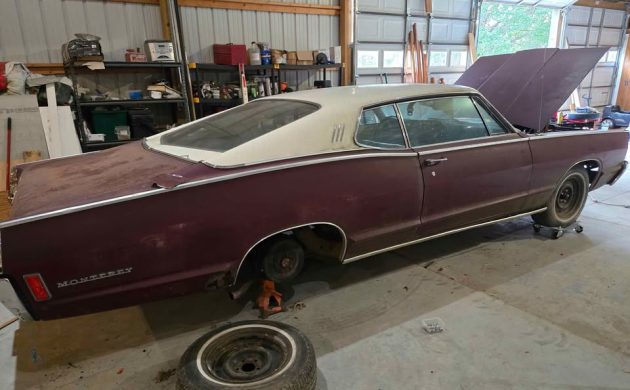
This car’s listing says little, but the pictures tell the story – this one’s tired and dusty. There’s plenty of light surface rust (years in the sun?), and the overall integrity of the body is unclear – except for the lower passenger-side quarter – there’s a mouse hole-sized rust cavity going on there. While the trim is all intact, the bumper’s chrome finish seems thin – but maybe that’s due to accumulated garage mung. All in all, the body looks straight and free of crash damage.
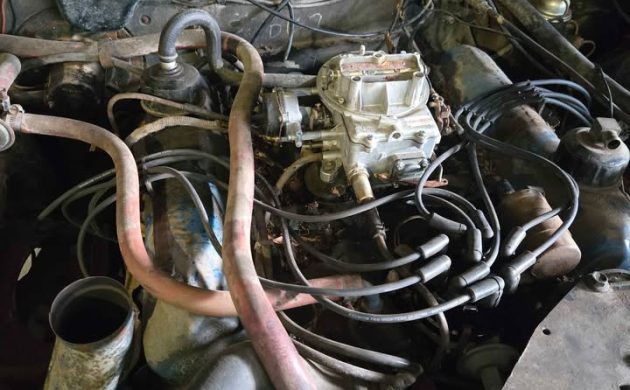
The laconic listing does make one statement: “motor runs; needs brakes.” The engine’s particulars aren’t disclosed, but the two-barrel carburetor indicates it’s a 390 CI V8 of either 265 or 280 gross HP (the compression ratio is the difference). And speaking of that carb, it looks either new or thoroughly rebuilt. A three-speed manual transmission was still standard equipment on ’68 Montereys, but not surprisingly, this Merc has a Merc-O-Matic automatic.
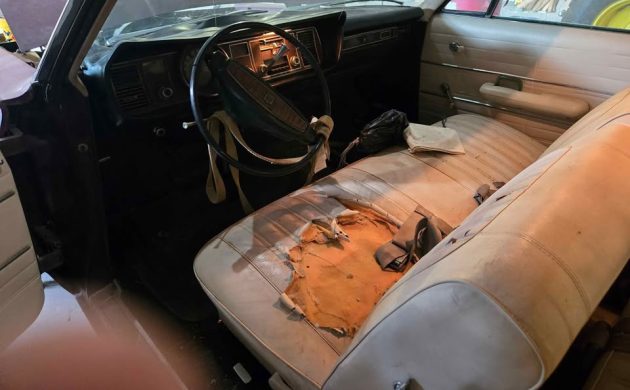
The front seat upholstery, what’s left of it, is certainly problematic – it’s hard to make an appraisal of the rest of the environment. The back seat, typically, looks OK, but the dashpad, over top of the instrument panel, has a bit of a swale to it. I’d assume the innards are going to need a rework.
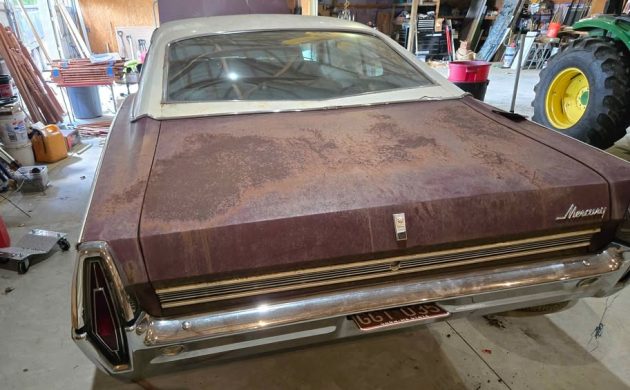
We don’t see full-size Mercurys of this era very often; their ’68 production volume was very slim compared to their Ford counterpart (360K vs. 1.7 million units), and in some respects, perhaps it’s surprising that Mercury lasted as long as it did. I’m not sure who the likely buyer for this Monterey would be, but it would be a sharp-looking car, fully restored, wouldn’t you agree?

…for those Australians who may have wondered where Ford got the frontal styling for the 1976 ZH Fairlane & Marquis, witness the 1968 Mercury.
Lots of these out west. Nice, big cars, if you like nice, big cars.
A friend of mine had one very close to this. His was powered by a 410, which was essentially a 390 with a 428 crankshaft. Just slightly over square (4.05 x 3.98). Out west some ran 390s, but I’d have to say 410s and 428s dominated the Mercury scene
The local International dealer always had a Mercury car, and a rather loaded one at that. MEL engines then 410 and 428 power. He drove a Travelall for work but his wife always drove that “love barge.” Usually blue.
I often wonder why some people get so steeped in a particular brand. Paul, the IH dealer and Cody, the Mercury dealer, were sworn enemies but every 2 to 3 years, there was a new Mercury on Paul’s driveway, with a chrome “Cody’s Mercury” badge on the trunk lid…
I really love the Fastback roof line on this 68 Mercury 2 Dr Hardtop. Body seems to be in good, rust free condition. I have a 65 Mercury Marauder Montclair, so I’m a bit partial to these year Mercurys. They can move like a same year Thunderbird and behave like a Lincoln. Very fair price for this one.
Well I got so excited about the Fasback roofline on this Mercury, that I missed the part about the mouse sized rust hole on the passenger quarter. Not the end of the world, but still missed it. These 390s are great engines and hopefully this one doesn’t need a complete rebuild. I upgraded to front disc brakes and rebuilt the rear drums on mine.
not a lot of good info or pics but i could be a good cruiser if it did not need a ton of money.
I do not think I have ever seen a Mercury fastback?? This looks like a reasonable price for a multi talented DIYer to build himself a great car for some happy cruising and local show events.
I don’t know it needs a full restoration, but would be a nice cruiser cleaned up and road worthy. Upgrade as you can, 4bbl and cam at the least with a 4spd in the pipeline.
I always hear that the frames on these big mercury/fords need to be inspected to verify worth. If all good I’d consider it, though a bit far from me. Price is a bit high as well. Half the ask would make more sense, it is running.
Cool cruiser.
Your not going to find this year Mercury 2 Dr Hardtop anywhere in this condition for $2500, unless it’s from a friend or family member. That’s just dreaming.
I guess that depends on the condition of the frame underneath. But go ahead, call me a dreamer cause that’s what we’re doing here, dreaming.
Nice Mercury.
Didn’t Steve McGarrett drive a black one of these in the original Hawaii 5-0??
McGarret drove a Mercury Marauder 4 door hardtop for several seasons on Hawaii 5.0, so they changed styles thru the years. It was a long, multiple year series. I read about some guy who bought one of his Mercs, but not sure what year it was and did a complete restoration. I’m sure some of those he had came with the big block 428s with all the bells and whistles.
Poor Mercury! As I recall, GM got mandated to kill off Pontiac, Saturn and Hummer, after they took the 30 pieces of silver from Uncle Sugar. I never figured out why Ford axed Mercury, though I’d heard that the division was being ran by a woman who was more interested in interior design than automobiles. But I guess it’s a moot point since the Blue Oval decided to cede actually “car” manufacturing to the Asian’s.
I prefer the fords of this vintage. But this does make for a nice alternative