

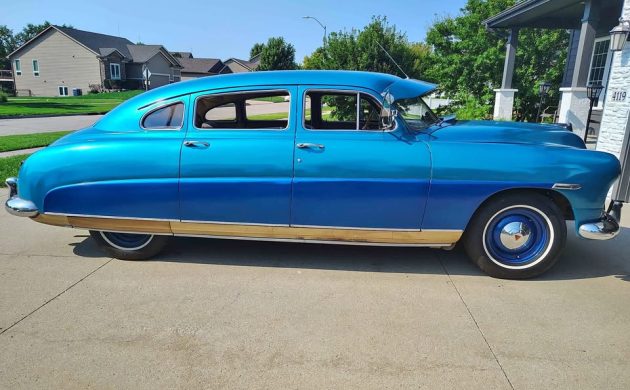
Hudson’s Step-Down innovation was a post-war first from an American carmaker – the Big Three were still limping along with pre-war designs. The modern styling attracted plenty of customers, infusing Hudson with cash. The long, low construction was also a boon to NASCAR, where racers were always looking for an edge. The lineup began with the Commodore and the Supers, and evolved to the entry-level Pacemaker, the racy Hornet, and the Wasp. But development costs, along with difficulties maneuvering the Step-Down frame into new designs, eventually forced Hudson toward a merger with Nash-Kelvinator, forming American Motors Corporation in 1954. Here on facebook Marketplace is a 1950 Pacemaker, listed with a price of $8000 and located in Des Moines, Iowa. Thanks to NW Iowa Kevin for the great tip!
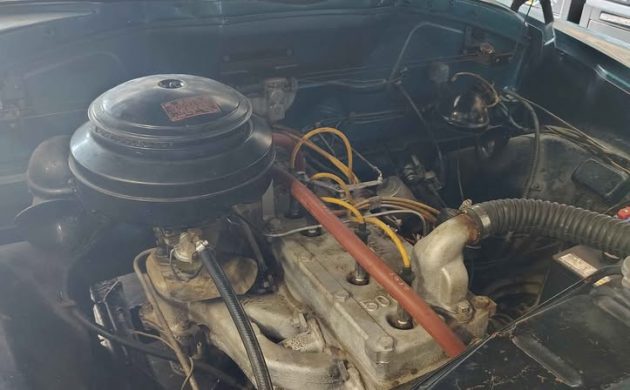
The Pacemaker arrived with Hudson’s 232 cu. in. six-cylinder, rated at about 112 hp. The engine is paired with a column-shift, three-speed manual; third gear is sticky until the car warms up. The meager horsepower had to stand against a 3660 lb curb weight, which was at least 400 lbs heavier than the company’s largest pre-war models – a byproduct of the Step-Down frame design. And even this comparison is unfair: the Pacemaker sat on Hudson’s shortest wheelbase at 119″. This example’s odometer reading of around 44k miles is all she’s traveled since new, according to the seller. The car is still operating on its original 6V electrical system and wiring harness. On the other hand, the brake hoses and master cylinder are new, the wheel cylinders have been rebuilt, and the sway bar links were replaced.
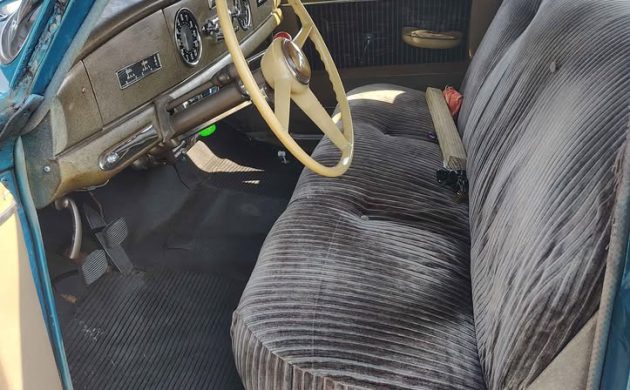
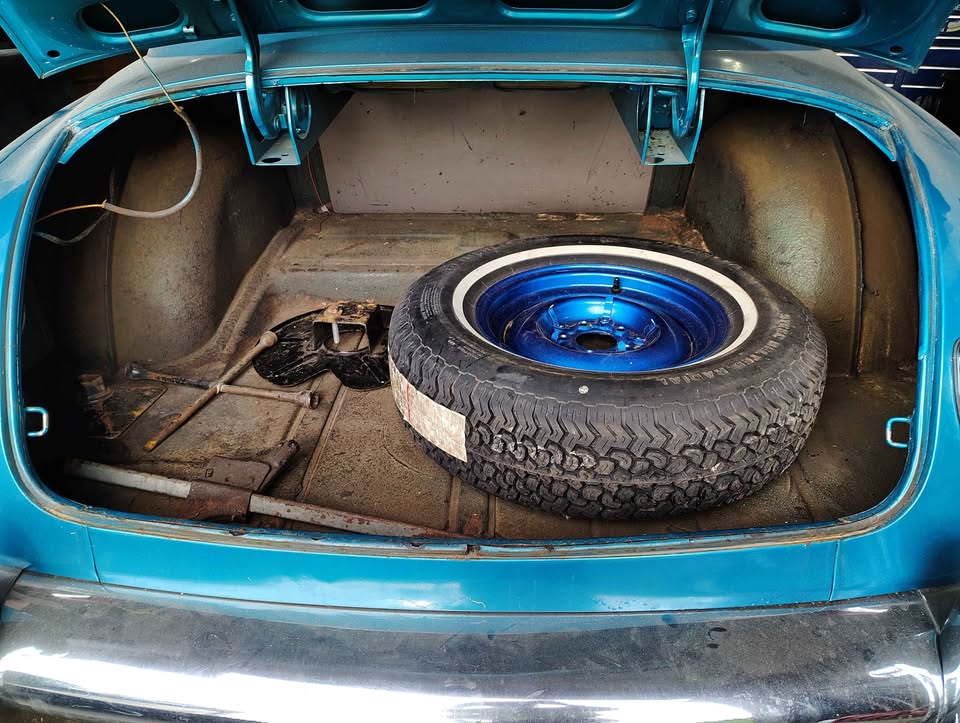
The interior shows wear, but none of its components are unbearable. The upholstery is loose, the door cards are rough, the rubber mat is torn in places, the trunk is surface-rusted but still contains the spare. Despite the car’s advancing age, the seller has kept it clean and presentable.
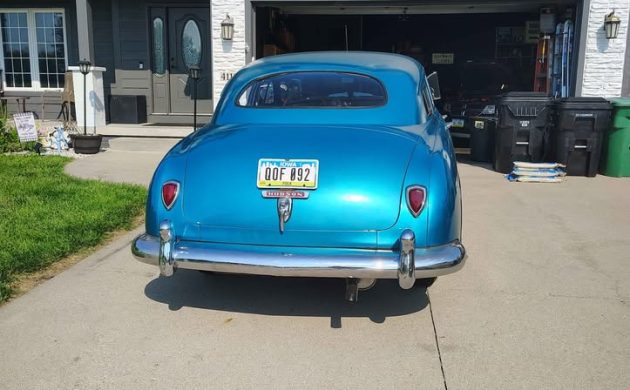
Hudson’s Step-Down styling resulted in a wider car with more headroom than body-on-chassis construction. Crucially, the geometry of the car resulted in a low center of gravity and excellent cornering ability, generating success on the track. While the Pacemaker sold well at first, the Hornet was the company’s NASCAR champion, and its sales cannibalized Hudson’s other models. This tidy car could be kept as is with a few upgrades to render it more usable, or it could be turned into a hot rod – the fate of many a Hudson. Which road would you follow?

That opening side profile shot just made me say “Wow”!!! I hope it doesn’t become a hot rod. I was glad to see it still has its 6 volt system as well. And looks like they’ve kept it roadworthy too. Very nice looking step down Hudson. Thanks Michelle!!!
On the outside, it looks like you could fit 3 Pintos inside of it. On the inside, it looks very cramped.
Americans used to be thin.
Experience in play here. I have a ’50 Commodore, and there’s almost five and a half feet inside the door panels. Three widettes can easily fit. Speaking of upholstery, this I am certain is – compared to my original, though slightly fancier color scheme – original. The pictures of the seats and matching door panels – along with an apparently unblemished headliner attest to the cars low mileage and lack of wear. Along with that opinion, you will see necks bending toward this car at any stop light. At a recent Cars & Coffee, a comment was made that I brought more chrome with me than everyone else there.
I don’t know the term “stepdown.” What does it mean?
The floor pan was recessed within the frame, so you “stepped down” into the car.
“Step up, step in, step down, step on it!”
Different from unibody ? Still has a frame, right? Overdrive?
Mean looking machine, love it!
I have many miles in a step down Hudson. Driving and as a passenger. I miss the experience quite often. But, the right deal has not presented itself to me yet to buy a other Hudson. I sold my last one in 1969. The doors sills are actually higher from the ground than the floor of the car. So in most cars you open the door lift yourself foot over the door sill and up into the interior. On this car, you lift your foot up to the door sill but step down into the car. The seats are lower, you are lower and the majority of the interior is lower because of the lower floor. At the time and to some extent even today. The lower center of gravity made for a very stabil and good handling vehicle. Driving a step down Hudson is a, unique and pleasant driving experience. It has it’s own feel and feedback from the road. The difference is quite a revelation just as an XKE (or even an XJ6) leaves you with a whole new appreciation for what is possible in car feel, ride, response, attitude, overall experience. Don’t misunderstand, a, Hudson doesn’t even come close to a Jaguar. Just another feel/experience on 4 wheels. BUT a step down Hudson can still really get you around a corner! It might be a little scary if you have never cornered hard in a Hudson. But she will still hang on pretty well.
Does the previous owner (still sitting in the back seat) have to stay with the car?
There’s plenty of room in the trunk for him and a few others.
Creepy and bizarre picture eh?
Make no bones about it… he stays. Just dead weight.
growing up in the 59s any kid aware of cars considered Hudson, Nash and Studebaker as old foggie (pronounced fohgy) cars. Now that us kids from the 40s and 50s have gotten to the “foggie” stage in life the Hudsons and Studebakers from the era look a whole lot better (Nash hasn’t climbed out of the pit yet). Nice car and yep, I’d put on my old man hat and enjoy being seen in it.
I have seen this car. It was for sale in Centerville, Iowa a year or so ago. The paint on it is not very good.
Seal Beach, CA, had these as police cars. Looked scary in black and white!
What’s the story on the corpse in the back seat? Is that the original owner?
Back when these were new, I never saw a Hudson this colour. On any car of this vintage, BEWARE OF ITS HAVING BEEN SMOKED IN!
Hi Harrison!
Nice to see you. The movie “Fido” , a zombie movie that takes place in the 1950s has a Hudson in it in this color. It’s probably not original, but sure looks nice in this color. Also a 1950 bullet nose Studebaker convertible in burgundy and a 1950 Chrysler in kind of a blue gray.
Hudson offered a vast array of hues, and allowed custom color schemes when ordered. Some combinations were indeed strange. Original ? Hardly surprising !
My grandpa bought only Hudsons
until the company closed in ’57. And my earliest memories of all things automotive centered around his ’52 Hornet sedan with
twin H power with a 3-speed with OD. It was really sharp wearing a
2-tone blue paint job and all that
Chrome. On the inside, it had your typical big cushy seats that
looked as though they would swallow a small child whole. The
ride was floaty and the engine would run tirelessly all day long
sipping very little gas. Grandpa
traded the Hornet in for a new ’58
Ford wagon in the fall of ’57–big
mistake! Even though he had the
car Ziebarted, it STILL started rusting to pieces 6 months after he bought it! That was it for him with Ford products. He traded the Ford in late 1960 for a left over ’60 Impala wagon and never looked back. He drove nothing but GM stuff til the day he died in
1973. And if my memory serves
me, I think Tex Avery at MGM studios that poked fun at the new
cars for 1950. And Hudson was
one of the cars they singled out for some good natured robbing.
It showed a man getting into the
Hudson and falling down into a
bottomless pit. So yeah, I like
Hudsons. They were reliable cars
that were soundly built. And as I’ve said before, if I’m gonna build
a hot rod Hudson, I’d build it from
the shell of a car that someone would sell for parts. This car is far too nice for that. I’d buy this
car, drive it and enjoy it for what it
is while building the Honkin’ Hudson from Hell complete with a tricked out 500 cube Caddy V-8
mated to an M-22 rock crusher 4-speed and handling enhancements galore. 2 door, 4
door, it doesn’t matter. Just as long as I could blow the doors off
a new Mustang, Camaro, or Trans
Am driven by some pimpley faced kid that thinks he has the hottest car in town. And to be safe about it, I’d run it in the street class at the drag strip. That way, I could shoe my competitors
a face full of Hudson as I blow them into the weeds!
You haven’t been keeping up on the latest technology in muscle cars, eh?
Go get ’em, Tiger Ken! 👍👍
I sold a red ‘50 Pacemaker awhile back for $10k, which was a bargain in my opinion. Great entry level cruiser. Very comfortable, good handling cars. Every car in the universe doesn’t need a SBC or an LS crammed into it. Drive and enjoy, improve it as you go along- or not. Don’t forget to check the clutch fluid- these have a fluid clutch. GLWTS
Consider that this Hudson appears very nice in the photos, almost as if a two tone in the side shot. So, for a driver, no paint job needed which would cost three times the asking price. If it runs smooth, other than the sticky third gear, this seems like a deal. There was also a big six engine of 300 + with two carbs, so this one is not going to have much acceleration.
Personally I would have to go the hot rod route but I would store the original drivetrain so it could go back to stock . I love the looks of the car but the meager horsepower wouldn’t work for me .
What I wouldn’t give to have a Hudson someday.
I would love to have the top-of-the-line 1948 Hudson sedan, in beautiful low mileage entirely original condition, with ashtrays and lighters never having been used. Wonder what one like that, an almost “showroom” total survivor, would cost? I’d even go for one of the 1941, 1942, 1946, or 1948 Hudsons.
The early and mid ’40s Hudsons drove just like a Ford, Dodge or Chevy. Only they were screwed together better. I had a ’47 Club Coupe. So I have driven both. The real difference in ride and handling came with the “step down” design. 2 different universes in car classification. They might have been 2 different car companies in comparison.
Thank you for explaining this distinction. I was speaking only of LOOKS, and I always liked the 1941-1947 Hudsons and their matching trucks of those same years. But I have never experienced a step-down Hudson, except to have seen lots of them on the roads, watched them last a long time, and then witnessed their gradual disappearance. From all that I am hearing, I need to own a step-down Hudson. As Hoke reported, “Finest car that ever come off the LINE! Here’s your NEW one: if Daisy don’t TAKE to it, I might let her RIDE in this one from time to time.”
“Mighty NICE o’ you, Hoke.”
“Well… we Do what we CAN.”
I have many miles in a step down Hudson. Driving and as a passenger. I miss the experience quite often. But, the right deal has not presented itself to me yet to buy a other Hudson. I sold my last one in 1969. The doors sills are actually higher from the ground than the floor of the car. So in most cars you open the door lift yourself foot over the door sill and up into the interior. On this car, you lift your foot up to the door sill but step down into the car. The seats are lower, you are lower and the majority of the interior is lower because of the lower floor. At the time and to some extent even today. The lower center of gravity made for a very stabil and good handling vehicle. Driving a step down Hudson is a, unique and pleasant driving experience. It has it’s own feel and feedback from the road. The difference is quite a revelation just as an XKE (or even an XJ6) leaves you with a whole new appreciation for what is possible in car feel, ride, response, attitude, overall experience. Don’t misunderstand, a, Hudson doesn’t even come close to a Jaguar. Just another feel/experience on 4 wheels. BUT a step down Hudson can still really get you around a corner! It might be a little scary if you have never cornered hard in a Hudson. But she will still hang on pretty well.
Dlegeai, kind of a mix of frame and unibody. More on the uni body side. Most people thought/think that Chrysler was the leader in uni body design. They were one of the firsts. But in my experience, Ford with the ’58 T-Bird really perfected it. You can open both doors on a ‘58,59 T-Bird cut out the floor including the door sills. So that you could walk between the right and left door and the doors will still close properly. I have seen it done! I have never seen another unibody car that could do that and the roof not buckle. Now maybe some newer cars could do that. But, not many.
Yeah, Big C, these new muscle cars are okay, but for me, nothing
beats the direct approach– a beast of an engine bolted to a 4-speed tranny behind it and brute force U joints along with a hoop
in the drive saft tunnel to keep the driveshaft IN IT’S PLACE and
under the car should you lose a
U joint from the more than 500 FT
LBS of torque that monster of a
Cadillac mill will put out with the
proper tweaks. And these new cars have so many computers and sensors in them that if just one of them took a 💩, your $60K
muscle car becomes instant yard art
and I haven’t even got to the repair bills for all those electronic
doo-dads they use these days. If
you wanna build a REAL muscle
car, build it old school. That way,
if something decides to take a 💩, all you have to do is take yourself down to O’Reilly’s or AutoZone, buy the stuff you need
off the shelf, and fix it yourself and save thousands of dollars in
repair costs. That’s how we did it
nearly 60 years ago. Sometimes,
the old ways are the best ways.
And yeah Harrison, I do like the Hudson pick ups too. The last one I saw was at the first Street Rod Nationals in Peoria Illinois back in 1970. It wasn’t finished yet, but it ran a healthy 383 Magnum and a 727 Torque Flight
tranny out of a totaled police car!
Now I dunno if this is true or not,
but the owner was telling people
that he was running 440 HIPO cylinder heads on the 383 to make it run like a raped ape. Hype I guess? Dunno for sure.
All I know was I had a damned good time over there before going
to play a package 📦 show in
Muscatine Iowa that Saturday night!
This is a very nice car at a great price, this car would be a prod asset to any collector these orphan cars are getting harder to find and are part of our history…