

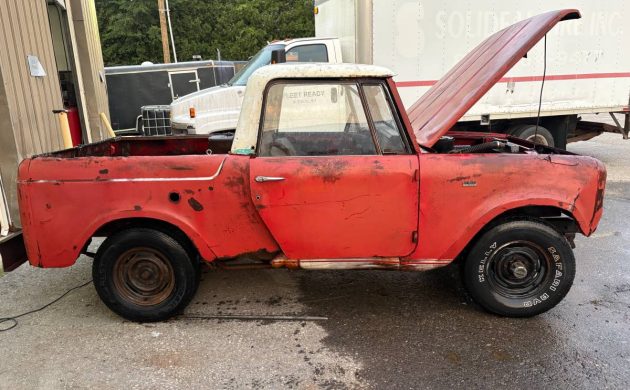
International Harvester launched the Scout as a competitor to the Jeep CJ-5 in 1960. While the CJ-5 still outsold the Scout, IH’s new model carved its own niche, expanding the SUV market. IH design chief Ted Ornas famously sketched the uncomplicated, boxy Scout while in his kitchen – styling that endured throughout a production period stretching over two decades and two generations. This first-gen Scout is a bit down on its luck: rust has nibbled at its sheet metal in every corner, it doesn’t run, and the title is missing. On the other hand, it is a 4WD, and it’s only $1500. Find it here on craigslist, located in Hudson, New Hampshire. We have Zappenduster to thank for finding this derelict Binder.
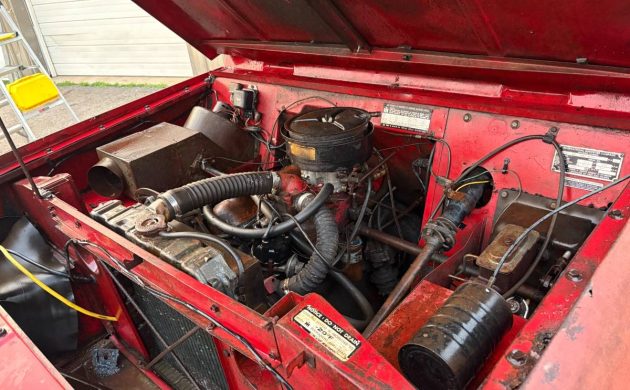
The first Scouts received one of two Commanche four-cylinders, but as the Bronco and the Jeep upped the ante in the engine bay, so did IH, providing both sixes and a few V8s over time. This is one of the four-cylinder options, good for about 103 hp. Engine swaps are popular; a V8 would look great in here, and the way the market is today, you’ll be paid for that modification. The standard gearbox was a three-speed manual coupled with a twin-stick Dana transfer case, but a four-speed was also available. I believe the seller when he indicates his Scout is “all original” – other than the accordion hoses and new clamps, this engine bay looks untouched. Curiously, this Scout’s VIN decodes to a Traveltop, but it’s clearly a half-cab.
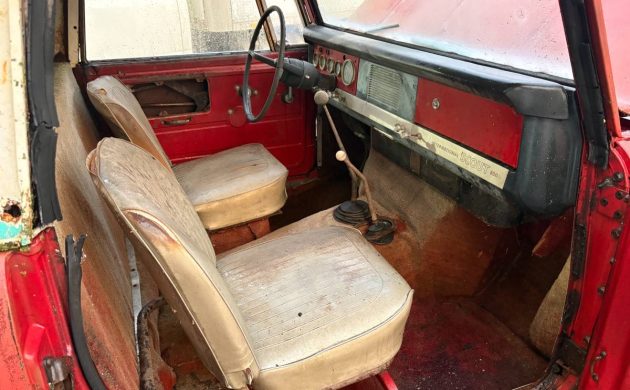
The cabin isn’t as awful as some I’ve seen; at least the floors aren’t rotted out. The transition from the 80 to the 800 afforded buyers a few extras – bucket seats, padded dash top, and a few more gauges. But the buyer still had to check a box in order to get a heater/defroster. The windshield was now fixed with the wipers mounted at its bottom, while the 80’s glass could fold flat and the wipers were mounted up top. Overall, if you’re after a vintage feel, either model will supply that in spades, but the 800’s jaunty bucket seats put it a notch above.
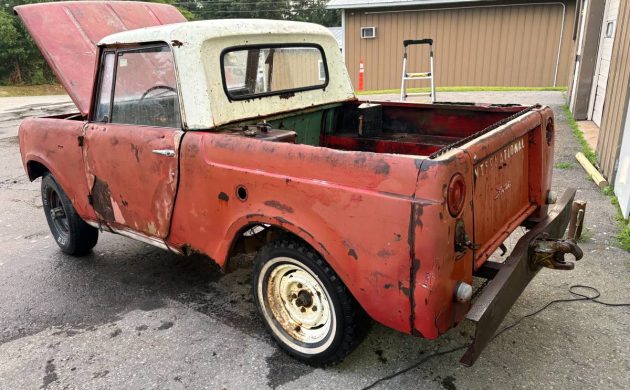
The availability of Scout sheet metal has improved over the last few years, thanks to vendors like Super Scout Specialists. Ten years ago, you’d scrounge for some time to find decent used panels – or simply resort to buying an extra Scout as a donor. Scouts remain less expensive than their rivals from Ford and Chevy, and this problematic example is particularly cheap, though for good reason. Despite its defects, I’m certain this Scout will find a new home, if even with a professional who will resto-mod it.
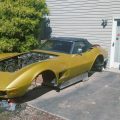

That one is a thrasher. The seller needs to lower the ask to $50, and they’d be lucky to get that! Hard pass.
That rear bumper with the Pintle hitch looks like it means business. I’m wondering about the Travel – Top / Half – cab situation with this one. The front of the bed ( near the cab) is a completely different color, greenish then the whole rest of the truck. Was it converted at one time? The International ( and Pontiac) Half a V8 always looked odd to me, like somethings missing. I’m sure it was an easy path for them to take to develop a 4 cylinder by taking what they already had and loping off 4 cylinders. Michelle has a good point of dropping a V8 in this one, it would fit for sure. Thanks for the research and history of the Scout, and also explaining the differences between the 80 and the 800 too. Hopefully someone can deal with the missing title situation.
The V8 swap is not as easy as you’d think. That “half a V8” 4 cylinder sits at a different angle, so a V8 swap involves some serious firewall mods in addition to everything else needed fo
Good writeup, Michelle. You got the 80 and 800 nailed down very well.
The Scout was definitely an inspiration of Ted Ornas. Here’s a collection of his first sketch to some of the design inspirations.
The Scout was definitely a homerun for International. It was good, right out of the chute. Interesting that our local dealer was extremely cautious 66 years ago. He ordered five, which all showed up on the same shipment. But before he got them unloaded, they were all sold. He had to beg one new owner to hold off taking delivery until after the dealer’s annual customer appreciation day/open house so he could show it off.
Scout’s continued popularity has helped the aftermarket. You can get a lot of stuff for them. Rod bearings for that 4 cyl. engine are going to have you apply for a second mortgage on your house though. Trouble was, that was about the only application for that bearing, so price follows availability. Personally, I’d much rather see the entire engine in that bay instead of just half.
Thanks! I didn’t have space to note: IH Scout production ran pretty far behind demand for a number of months after introduction. People really wanted ’em.
I’d keep it original and keep the 4 cyl, if it runs.
$800 to $1000. It checks a few boxes for me. But, New Hampshire is too far away.
Google states that current market value for a 1966 Scout in project or poor condition starts around $5,000, so I guess $1,500 isn’t that bad after all.
Wow, and I thought the ones that I started with were rough…This one definitely started as a TravelTop, you can see the bolt holes in the top of the rails, and, obviously, the bulkhead doesn’t match colors. Gas tank moved up to the inside corner of the bed may show other issues. This one’s a pull the body off the frame, if it doesn’t fold up & collapse, see if the frame is likewise rotted to death or buildable. Single stick for 4×4 and hi/lo range denotes a later model 800.
$1500 would be plenty for what’s here if it were accessible…and New Hampshire isn’t exactly convenient to get to.
I had a yellow one like this 50 years ago. It had more rust. I didnt pay much for it. i think I drove it home and never on the road again. Lived in a cottage by Lake Michigan and only drove back Into the woods for firewood. I’m sure the floors were solid so George (over 100# GSD) wouldn’t get any injuries.
Michelle
Didn’t you go to Monterey?
Doesn’t run, what you can see has a lot of rust, no title, in a remote area. This suggests parts car more than project.
Steve R