

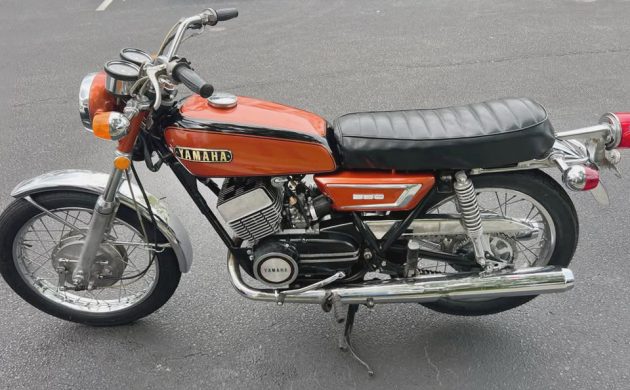
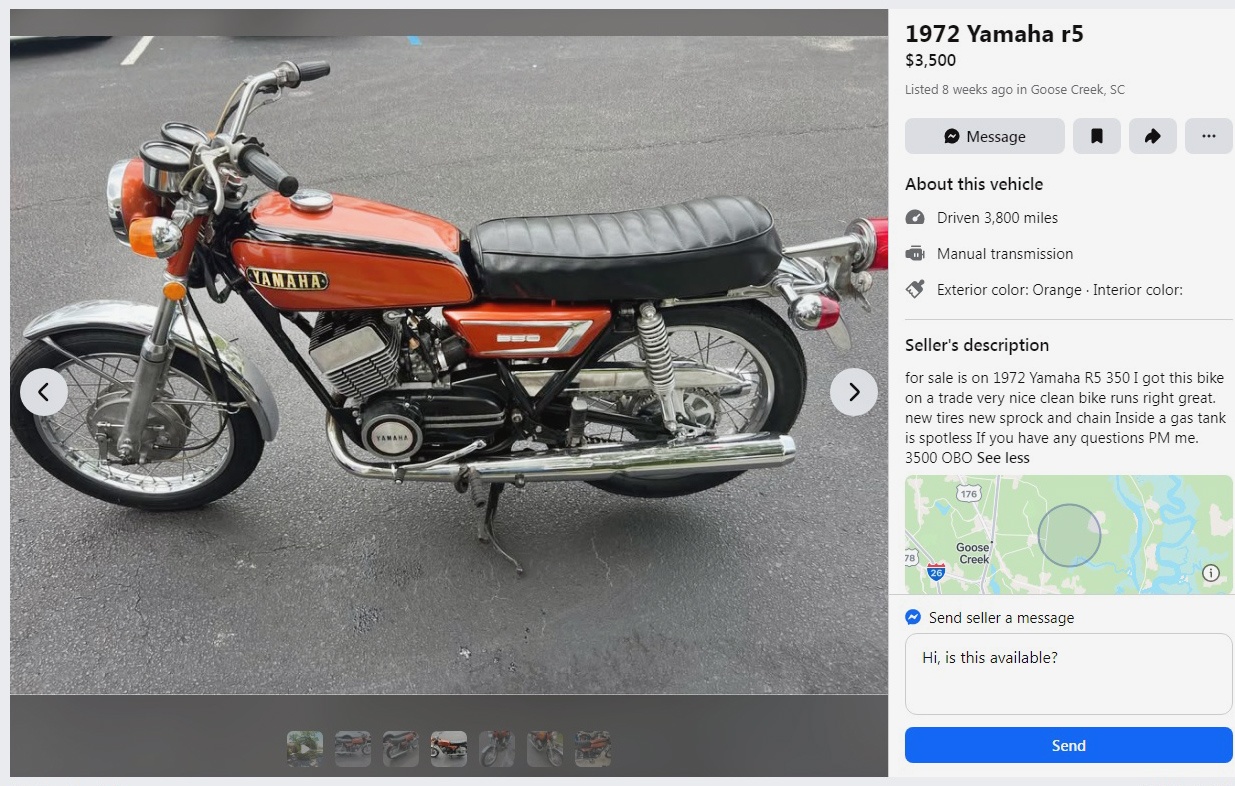
Yamaha scholars, or just mega fans, can tell what year a Yamaha R5 350 is just by the colors, as they only came in one color scheme for each of the three years of production. The street version of the R5 is an offshoot of Yamaha’s legendary road racer, the RD56 250, with more than one Grand Prix win under its name. This 1972 Yamaha R5-C 350 is listed here on Facebook Marketplace in Goose Creek, South Carolina, and they’re asking just under $10.09 per cc, or $3,500 or best offer. Here is the original listing, and thanks to PRA4SNW for the tip!
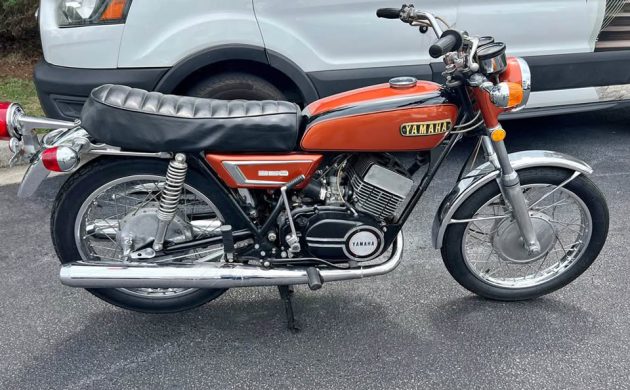
Yes, that’s more than this bike cost new, just for the record. I love the or best offer part; that means less than $10.084 per cc! And even at $3,500, examples this nice regularly sell for more. JP’s – John Parham, founder of J&P’s Cycles and founder of the former National Motorcycle Museum, which closed after he passed away a few years ago – R5-C from his collection sold for over double this price, and it didn’t appear any nicer than this one. That museum was a mind-blower, but sadly, being in the middle of Iowa, visitation wasn’t enough to make ends meet, and they had to close. It was a huge loss for motorcycle enthusiasts.
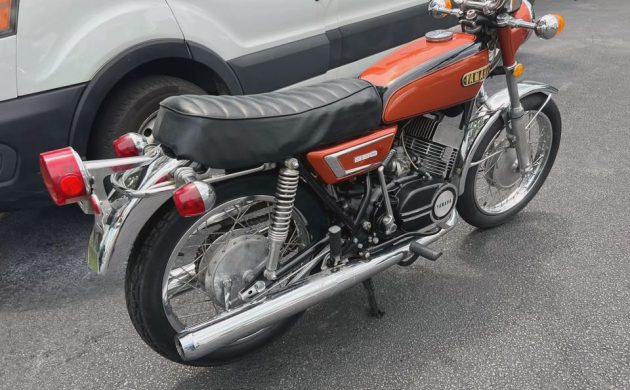
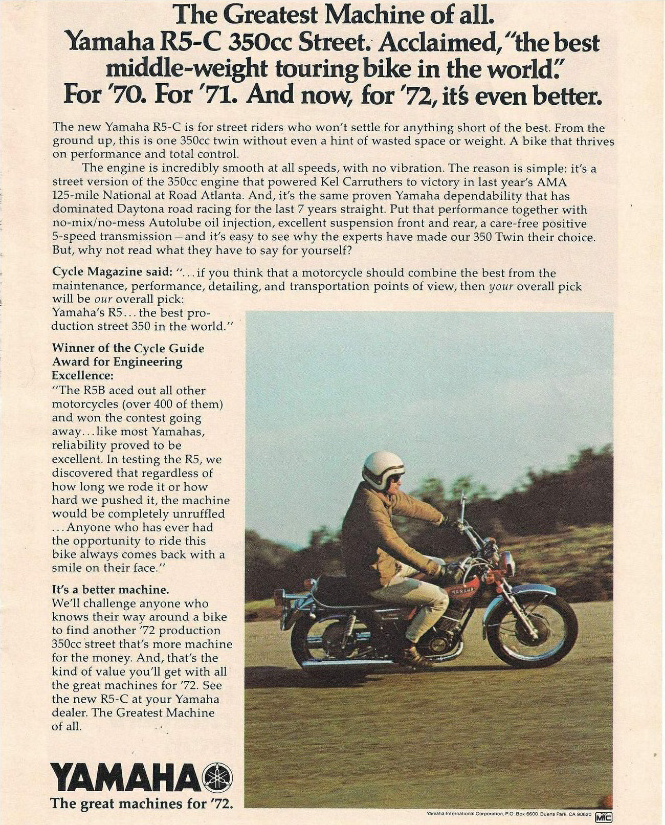
The first R5 (R5-A) came out for the 1970 model year, and they were Metallic Purple and White. Then the R5-B 1971 model was Mandarin and White, and finally, the final model was the R5-C in Mandarin and Black, as seen here. Unfortunately, this one is wearing a replacement seat cover. It looks a little loosey-goosey, and I’d 100%, without hesitation, find an OEM-looking one with the YAMAHA letters on the back and have my upholstery guy (don’t we all have an upholstery person?) put it on. I couldn’t live with the loose-looking sides like that. Here’s a fun ad showing the ’72 R5-C. At 335 pounds, this one weighs more than twice what I do, but still handles like a bike weighing less.
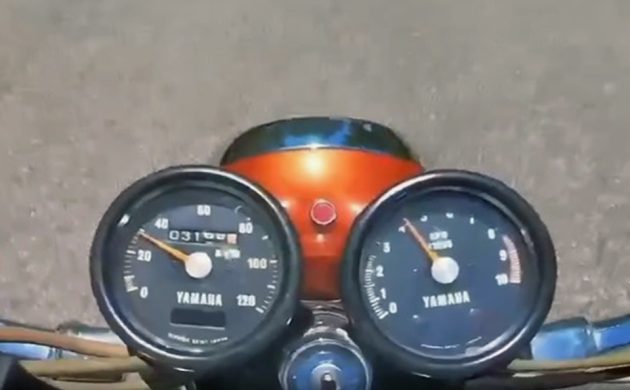
The seller doesn’t mention a new seat cover, but they do mention that it has new tires (always nice) and a new sprocket and chain. Rear sprocket, I’m assuming. My brother and I changed sprockets on our late-60s Yamaha YL-1 Twin Jet 100 like most people change their socks. I could change it in a half hour easily, about the time it took me to put new brake pads on my 1991 Dodge Spirit or change the oil, or do almost anything in the pre-computer era for vehicles. Ahhh… memories. This photo of the gauges is a screenshot of the seller’s driving video. Please check it out to hear the sweet, sweet sound of a two-stroke named pretty much the best 350 on the globe by every magazine and almost every rider at the time.
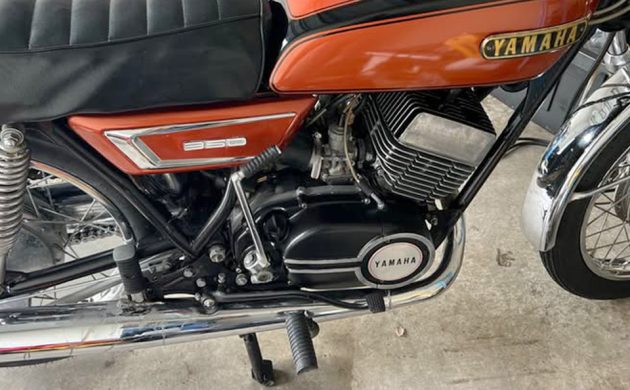
I love Yamaha’s black engines, and this one is no slouch. It’s a 347-cc two-stroke air-cooled twin with 36 horsepower and 28 lb-ft of torque, screaming through a 5-speed manual, sending power through that new chain and sprocket to the rear wheel. Autolube oil injection makes sure things stay slippery inside, and kick start makes sure your right leg will be a bit bigger than your left. The seller says it runs great, and this is another gem I’d love to have if I wasn’t clearing out the SG Museum of Oddball Vehicles and Other Random Stuff (i.e., a couple’a storage units). Have any of you owned or ridden an R5 350?

My unreliable roommate back in the early 80’s (we were about 25yrs old) had a similar used one for about 6 months. He would ride from our place in San Francisco, across the Golden Gate Bridge to San Rafael, even in the rain as I refused to lend him money for a car (he was always late on his rent share). He finally moved away to Memphis. Good riddance.
My first road going bike that was actually licensed to be used on the road. I loved it. Very quick little bike. Later I put expansion chambers on it, and had the ports worked over and the carbs re-jetted. It became a lot like riding an early Kaw 500 triple. Power was either on or off, and when it was on the front wheel was in the air.
Similar characteristics with the Kawa 500 H1. The second most dangerous and fast bike after the Kawa at the time. Drums in front slippery Japanese tires all around, it was a recipe for disaster.
Yep, I’m in that same club as you JW. I got one of these in the early eighties as a teenager. Road it stock for a while. Then had a local guy known for his engine work on these port the heads. Rejetted the carbs, expansion chambers and did away with the air box. Just like JW said, front wheel was in the air when that power band came on. Very fond memories and this one looks beautiful.
I have to say that looks a very reasonable price. I’m glad I don’t live anywhere near there, or I would be going to look at it. Which too often ends up with me buying.
A widow in our neighborhood rode one like this to the state govt office she worked at on practically every work day for many years, not something expected by her coworkers.
Best way of starting the day off right with a ride to wherever the day takes you.
Re: video, bawk, bawk, OPEN ‘ER UP, MAN!! They shifted right when the power was a comin’ on,,,sigh, anyway, what a neat bike. I know, my usual stance hasn’t changed, but bikes like this simply don’t exist today, save for at the bottom of those big piles of motorcycles some have. Aside from the Suzuki, this was about as good as a 2 stroke was going to get. I believe these were the last of the Yamaha 2 stroke road bikes and switched to the 750 triple, with outstanding success. These are fun bikes, PLENTY of power, but not much in the way of a road bike. You’ll have Asian seat butt in no time. Not to say some tried, you could always smell them dripping of oil fumes at a gas station. Sadly, I don’t see much interest in these today, it’s a great find.
I always found UJMs much more comfortable than H-D sit up and beg style.
I had a CB650 which had it’s stock 1.5 hour seat. Went from that to a BMW 900 that I could rode all day long. But did I hate the seat on that 650. I rode a buddy’s Goldwing for a weekend and It’s seat was great.
I currently own a 76 RD400, had a 77 RD400 in college along with a 73,74, and 75 RD350’s. Did amateur road racing on all except the current RD. Used to work in a Yamaha shop so I worked on quite a few R5’s like this one. All were reliable, quick, simple, and fun. A racing version of this won the Daytona 200 one year against bikes twice their size. Very nice bike, wish I had space in my garage. Very reasonable asking price.
I was 15, my step dad brought one home in the back of the El Camino. If I wanted it I had to get a job and pay for it. I wanted it. Got a job. Took my driver’s test on it. “Hey, where’s your car?” “I only got a bike” “Ok, run it up that hill and back” Passed. Sadly the thing started not starting, Belched smoke until warm. I’m a kid, I don’t know why. Yamaha dealership didn’t know how to fix it. Spent a lot of money. Had to trade it in on a car to get to work. Been working ever since 1978 all because I got in debt on that damn bike. It was fun to ride when it worked. I bet it was something simple but I don’t care anymore.
My first modern bike was a 250 YDS-3. It was nice. This would ne nicer!
Runs right great. New sprock.
I love the helmet cam video on this ad.
This one has been for sale for a little while and shows up in my FB Marketplace quite often. Every time it does, I take a couple of minutes to enjoy that video.
Reminds me of the DT400 I had, which was replaced with an XS750 Triple.
Yes….this is the year early to the RD’s with the reed valves. Nice ones are still showing up and his ask isn’t out of the ball park. Mine aren’t so mint but I really didn’t care….own some 1973-74-75 and a 1977.
I bought a 71 R5, orange and white like a Creamsickle, it was fast. I was a novice, I remember reading about speed shifting and thought I’d give it a try one evening. I wasn’t holding on with my knees, and when it jumped out from under me my ass slid back, it was all I could do to try and reduce throttle and keep from falling off the back at the same time.
I bought the same bike a few years ago, it was in great condition, but I never rode it much, and ended up selling it, can’t keep them all, and I have too many vehicles and bicycles.
Scotty, that seat may just be a seatcover, so the buyer might get lucky and there is an original seat under there that could hopefully be repaired.