

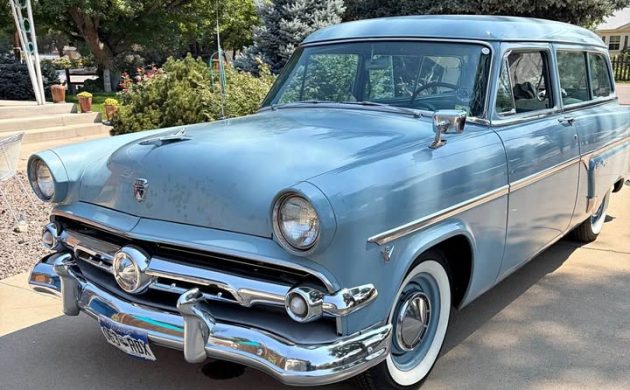
Ponder the two-door station wagon for a moment. Like many of a certain generation, I grew up riding around in station wagons – always the four-door variety, never a two. And I thought the two-door versions were neat but unusual. “Not very convenient!” was my father’s response to such a body style. Why, oh why, then, did we have such a creature? Let’s examine this very sharp 1954 Ford Customline Ranch Wagon and see if we can figure that one out. Lakewood, Colorado, is where you’ll find it, and it’s listed here on Facebook Marketplace for $16,900. A tip of the hat is due to T.J. for this discovery!
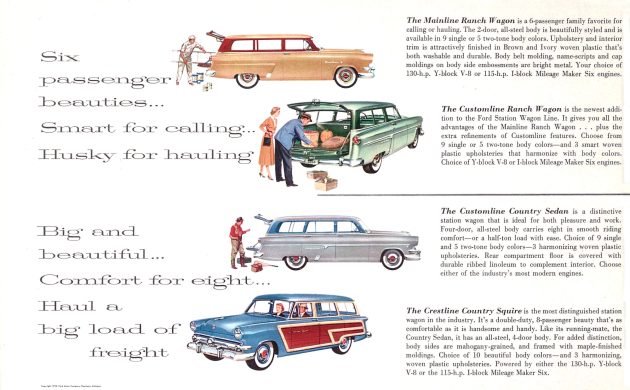
If, for example, you go back to the earliest Ford Country Squires, they were top-of-the-line and two-door-only in body style. Later editions adopted four doors, and the two-door variety was relegated to lower levels, such as this ’54 Ranch Wagon. Over at GM, both Chevrolet and Pontiac went the two-door route with their Nomad and Safari, respectively, but they were trying to inject some sportiness into what was usually considered a suburban appliance. They too, however, maintained low-man-on-the-totem-pole variety two-door wagons too. Around 1960, the entire concept of the “shooting brake”, as English versions were known, just faded away from the domestic scene. So, why a two-door station wagon in the first place? And why demoted to the entry level? I recall reading that the two-door design was considered a safety approach in that the kiddies couldn’t open the rear door while in motion and tumble out. This was in the era before seatbelts, child seats, and rear door lockouts. This lines up with the ’67 to ’72 Chevrolet three-door Suburban, where there was no driver’s side rear door – supposedly a more controlled approach to child egress. As for the two-door’s entry-level status? A budget-conscious move? I don’t know; that’s all I got on the topic, but I’d appreciate hearing your thoughts on the matter via the comment section.
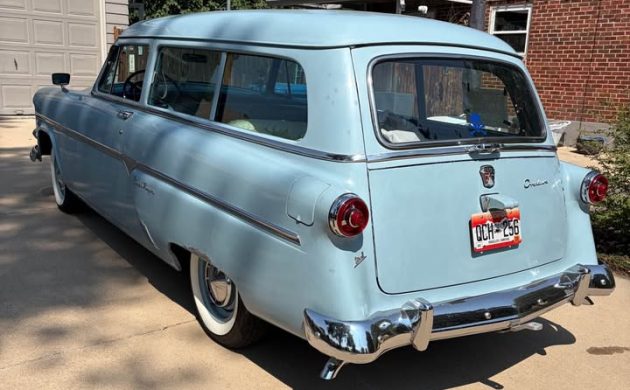
For 1954, Ford assembled 44K two-door Ranch Wagon station wagons – all were either in “Mainline” or “Customline” trim. Our subject is the Customline variant, which wears a bit more of the shiny stuff and possesses nicer upholstery. The seller tells us, “I am the second owner and have owned for 20 years. This car was parked in 1972, and I worked to get it going and have been enjoying it for 20 years.” I’d suggest he’s been taking excellent care of it for twenty years too – it looks great. The chrome and stainless trim sparkles, and the finish, a pleasing and relaxing shade of blue, has nice depth – no word on its originality. Rust? Fuggetaboutit!
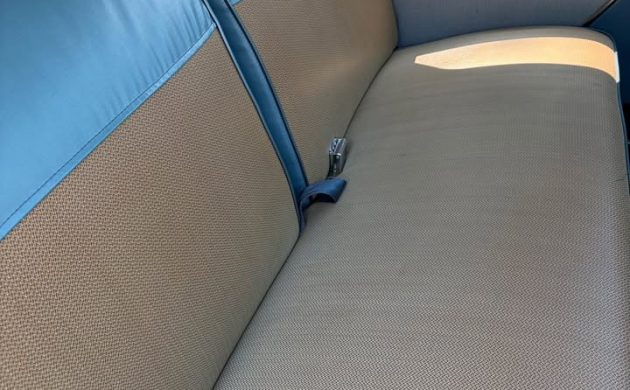
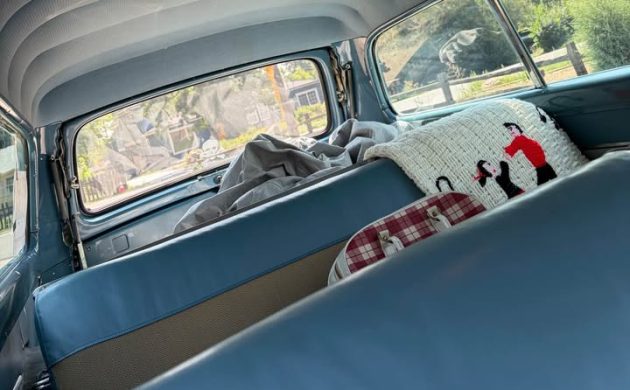
Regarding the interior, the listing states, “Original upholstery reframed and in great shape.” I’m not sure what “reframed” means unless it’s a way of saying reupholstered, but then that wouldn’t be original. Or does it mean that the seat frames have been replaced? I dunno, an inquiry would need to be made. Whatever the case, the interior is as nice as the exterior. The listing claims, “driven 64K miles,” though there’s no authentication of that recording. But if that’s the case, it helps explain the interior’s pristine condition. The instrument panel and headliner check out as fine too.
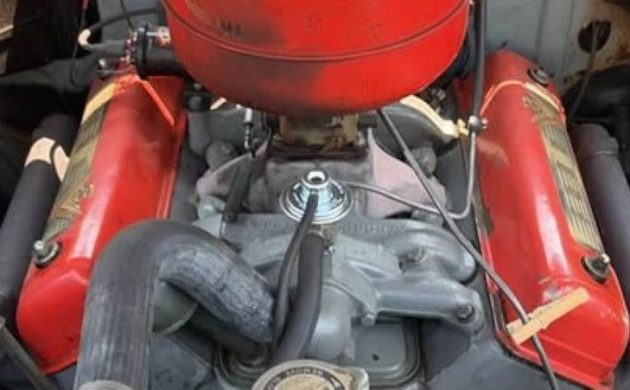
The seller claims that the Y-block V8 under the hood displaces 292 CIs, but my understanding is that engine wasn’t introduced until 1955, and a first-year 1954 Y-block measured out to 239 CIs; an engine swap perhaps? The seller mentions nothing about running or driving characteristics other than noting a three-speed manual transmission with overdrive is part of the powertrain.
One of the nicest aspects of this car, in my estimation, is its original bearing. I know hot rodders like to get a hold of these and go for a moon-shot of modifications and custom touches, but it’s really enjoyable to experience one of these two-door wagons, in native form, as Ford intended it. Let’s talk price. At $16,900, what’s your thought: priced right or not quite?

My mother had a 1953 Ford Ranch Wagon with the 239 cu in flathead, she used to haul us kiddies around in it and always said she really liked that car. We got T-boned at an intersection in Chicago when we were visiting my Grandmother, and other than knocking our heads a little bit, we were not injured – that car was a tough bugger.
My father’s first new car was a 53 Ford Ranch Wagon too, with this exact same light blue color. I was about five then. I remember him driving us thru deep snow on Christmas Eve with chains on. We weren’t sure to make it home that evening in the dark. Then, in 1967 my first car was also a 53 Ford tudor with the flat V-8, purchased for $50 in Ohio, also with the same light blue but with a white top. In 1969 I drove to CA, returned to PA, back to OH. Sold it to a football played for $115. He drove it home to Detroit and shortly after wrapped around a pole.
The Fords in ’54 ran the 239 Y-block. Both Y-block engines had that forearm burner of a crossover exhaust going from left to right. Dual exhaust manifolds were available on police and emergency vehicles only at first, but duals eventually became available.
I found out that on trucks you couldn’t use typical dual exhaust manifolds; the left side exited right on top of the steering gear. If you were lucky enough to score a set of Ram’s Horns for a Thunderbird then you got the makings of a good exhaust system.
I’m sure this is running a swapped-out engine, like a 292. Anything from a 239 to a 312 could drop right in without breaking a sweat. Personally a 239 was just fine; sure it could barely chirp the rear tires but it still revved out well, and it held its own. Well, it wouldn’t take an Oldsmobile 303.
I’d like to have this car come to my place, but my better-half, although she wouldn’t say anything outright, wouldn’t be overjoyed over it. She just doesn’t like station wagons…
We had a ’54 Ford “Ranch Wagon”, Two-Door, with a 292 c.i. V-8
and a three speed stick on the column and overdrive.
Beige with red trim.
Dad bought it off the showroom floor at a Ford Dealership.
It may have been late ’54 as it was a 292 V-8 which was the reason he
purchased it. Drove it for many years. Never had any problems or issues.
“We had a ’54 Ford “Ranch Wagon”, Two-Door, with a 292 c.i. V-8”
Interesting, but ’54s didn’t have the 292, at least not from the factory, as it wasn’t offered until the ’55s and then only in Mercurys, T-Birds and the Ford “Police Interceptor” package, which wasn’t sold to the public. Regular Fords didn’t get the 292 as a production option until the 1956 models.
That’s a bargain price for this car in this condition. IMO
Those factory lightly tinted windows are the bomb.
Something tells me not to ” forget about ” the rust .
I love 50s Fords like this. When I was a boy, these cars were known to rust quickly. A careful examination is essential.
I was always a fan of the 2dr. wagon. Plymouth and Jeep were the first all steel wagons and both only came in 2drs. at first. What I find kind of surprising is that GM didn’t offer a 2dr. wagon until ’55. Then it was bottom barrel handyman or top of the line Nomad or Safari. Full size 2dr wagons continued at Chevy until 1960 and 1961 for Ford and Plymouth. Studebaker and Rambler had some neat ones too. Then for some reason Chevy decided we needed it again in ’64 and ’65 with the Chevelle 300 (good luck finding one of those today, mucho, mucho bucks). I do think Chevrolet missed a great chance to bring back a real Nomad in ’64.
This Ford here looks like winner 2dr. wagon, V-8, stick shift, what’s not to like. And at this price somebody will buy this. I’m not up to date on current prices, but I think that ’58 Ford wagon from yesterday was overpriced @ $34,000. This looks like twice the fun at 1/2 the price.
Great but I would have bought the flathead when new. More proven tech at the time. They make such a nice sound. Over all, such a great ride! Even without the flattie, wish she were mine!
The flathead was not an option in 54.
Flathead not available in 1954 for Ford in the US, but Canadians got one more year.
I agree, for what it’s worth. I grew up around cars, at my family’s several used car dealerships and at repair garage near my home, where I worked part-time as a teenager.
I recall that no one during that time had anything positive to say about the new, overhead valve engine in the ’54 Fords.Those engines had valve-train issues, owing to clogged oil-feed channels, causing sludge buildup and premature wear. They also tended toward overheating, especially in summer, which contributed to the wearing of both rod and main bearings. Finally, they tended to leak oil from their rear main seals.
By comparison, Ford’s flat-head engine, discontinued in ’53, was considered robust, its bugs having been identified and corrected over almost 20 years of production.
Unless you bought a Canadian ’54 Ford you got an OHV 239 Y-block V8. The last year Ford offered the flathead V8 in the USA was in 1953. The Canadian market didn’t get the OHV until 1955.
This is a steal. If I was anywhere near it, I’d be on it.
The neighbors had 2 daughters my age and older… the mom drove a blue one just like this…. I rode to first grade wiith them… aways liked Fords…
Drove one of these 54 models same color as here in mid 70s when I was a park ranger in Nevada. Carried a Sparkletts10 gallon-water bottle to routinely stop and fill leaking radiator. Headliner was in tatters. Would light off a can of Sterno to set on floorboards In winter as heater did not work. Park super sent word down that I no longer had permission to park in employee parking when I came to HQ as it gave off disreputable vibe to public; maybe that park was not paying employees a living wage. Good and not so good times:)!
Wasn’t there a 272 engine and those times
Yes, the 272 also came later but not sure when. So, there were at least four different Y blocks in the 50’s into the 60’s.
The 272 was first offered on the 1955 models.
cool wagon. looks to be a nice survivor. the blue is a bit too plain jane for me.
And Australia they made the Ute also very cool
I am not even a Ford guy and it’s
just too good! Deal find and write up
Two door wagons were used as “”sedan delivery” vehicles when they lost rear side windows. I have a 1965 Falcon SD.
I would like this, except for the fact that we had friends in 1954 who bought a brand-new Crestline sedan with the new Y-block: nothing but troubles and headaches! 1953 Fords, however, remained a common sight on the roads until close to 1990 — and so many of those were just this colour, and mostly Customlines.
Ad has been updated on the “reframed” seats. Apparently a typo by the seller; should’ve been “refoamed”.
Thx!
JO
your right in 1954 it was a 239 1955 a 272 and in 1956 292 tbird v8 and later that year a 312 tbird special v8
I stand corrected
Cool car. Dad always bought 2 door wagons until they weren’t available in full size cars anymore (or maybe because we had grown up a bit). I remember his ‘bathtub’ Nash, his Studebaker Scotsman & his ’59’ Ford Country Sedan (all 6 cylinder). I’d love to have any of them today. I don’t really have room for anything more though. Unless I can sell the wife’s car. 😀
I own the twin of this but 4 door Country Sedan, color, interior and drive train. I NEVER thought I’d see one the same as mine and in like condition. Being a 4 door wagon most didn’t survive. I purchased mine from a friends family estate. Their father owned it since 1975. Mine still has the factory directions on how to use the dash clock hanging from the wiring under the dash. I don’t have FB so I can’t see the ad, but wondering if it has the 3rd row seat. I was fortunate that the owner had that hanging in his garage as those seats are removable and don’t just fold away.
I checked out the photos and the Facebook video again. There is no view of the tailgate open at rear, but no third row seats are seen. I don’t think a two door wagon would have a third row, only one with four doors as possibility.
Dave, with only two doors, how would you climb into a third seat?
Exactly, and if a child got there the exit in emergency would be tough.