
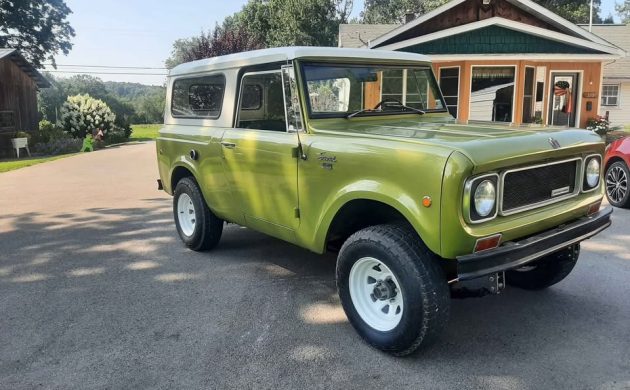
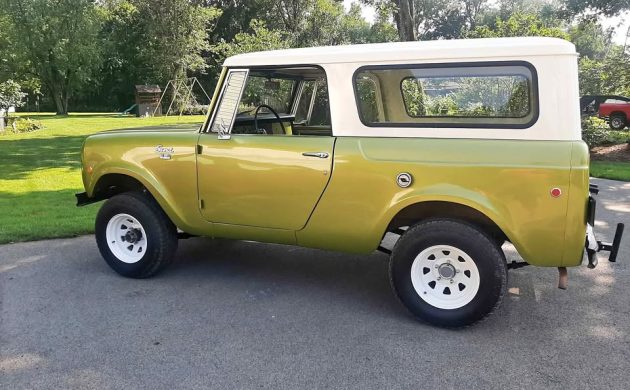
It’s not every day you stumble across a 57 year old Scout that hasn’t been cut up, lifted into the stratosphere, or left to rot in a field. This 1969 International Harvester Scout 800A, currently listed here on Facebook Marketplace for $19,500 in Cabot, Pennsylvania, looks like a genuine time capsule from the era when International Harvester was transitioning from “farm implement” to “recreational legend.” The original Scout, known as the Scout 80, was built by International Harvester from 1960 to 1965. The second generation, called the Scout 800, was produced in three sub-models: 800, 800A, and 800B. International Harvester produced the Scout 800 from 1966 to 1967. The Scout 800A was available from 1968 to 1970, while the Scout 800B had a brief production period from August 1970 to March 1971. The subsequent model, the Scout II, succeeded the Scout 800B and was produced from 1971 to 1980.
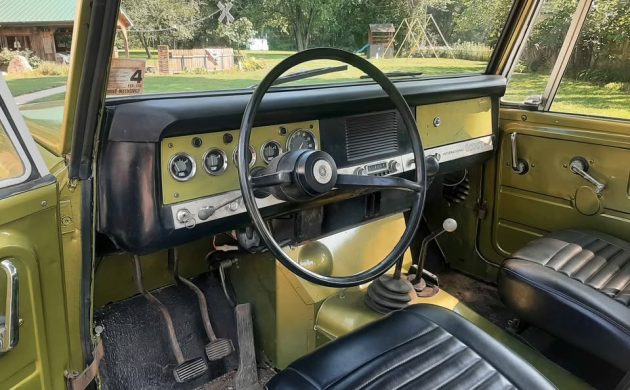
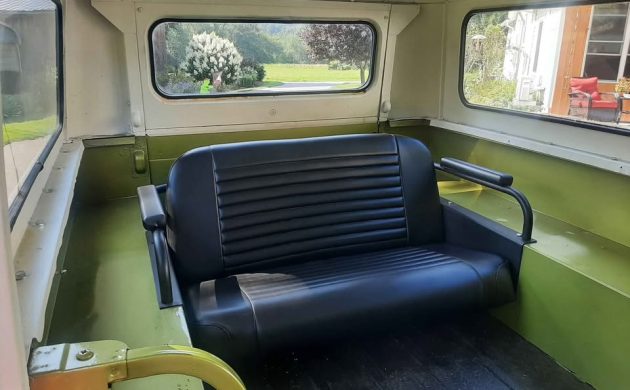
Inside, the cabin is refreshingly simple. You’ve got the low-back bucket seats and the metal dash that reminds you this vehicle was built by a company that mostly made tractors. The instrumentation on the 800A was an upgrade over the earlier 80s, featuring clearer gauges and better heating controls. Everything in the photos suggests an interior that hasn’t been messed with, right down to the original steering wheel and the twin-stick-style transfer case setup. The listing does state that this Scout has a 2″ lift kit.
Pop the hood and you’ll find the dependable 196 cubic-inch inline-four engine. While many collectors hunt for the V8s, the 196 is a favorite among Scout purists for its simplicity and surprisingly high torque for its size. Essentially half of a 392 V8, this slant-four was built for durability and fuel efficiency on the trail. Rated at approximately 110 horsepower and 181 lb-ft of torque, it provides more than enough grunt to move this lightweight 800A through rough terrain. The 800A was a pivotal model because it brought more refined comfort and hardware. Paired with a floor-shifted manual transmission and the Dana 20 transfer case, this drivetrain remains one of the most reliable setups International ever offered.
Documentation is everything in the Scout world. To be 100% sure about the specific Willow Green paint code and the other equipment, you’ll want to find the Line Setting Ticket (LST). On a 1969 model, you can usually find a small copy of this “build sheet” attached to the back of the glove box or inside the cowl. If it’s gone, you can still order one from the Wisconsin Historical Society to verify every factory code on this rig. At $19,500, this is priced as a “high-quality driver” that’s leaning toward a good deal. If you’re looking for a 4×4 that stands out from the sea of Broncos and Blazers at the local car show, this earthy ’69 is a top-tier candidate.

Sure seems to be a lot of green going around lately.
This one is a nice unit! About the only place I see trucks like this are at shows, or over at my boss’s collection.
These were well built and could take anything you could throw at them. I was never all that fussy about the 4-cyl. engine but there really wasn’t much wrong with them. Some parts are a little time-consuming to find, such as the rod bearings. They’re wider versions of the V8 versions and sometimes overlooked by many parts houses. Mains, rings, gaskets, pretty easy to come by.
As I have said many times before, I’m quite partial to having the whole engine under the hood. That’s just me; if it’s a six, OK; but if it’s anything else, let it be a V8. Just the same, this would look good on my driveway…
Have known the owner of this Scout forever. Great guy who knows Scouts like no other. His family owned a Scout dealership in Cabot, PA from 1962-1980.
1961-1966 Scouts with the 152 4 cylinder will barely get out of their own way.
This Scout with the 196 4 cylinder will keep up with traffic.
Having been listed on FB Marketplace for 27 weeks – maybe it is overpriced? Looks nice, otherwise.