

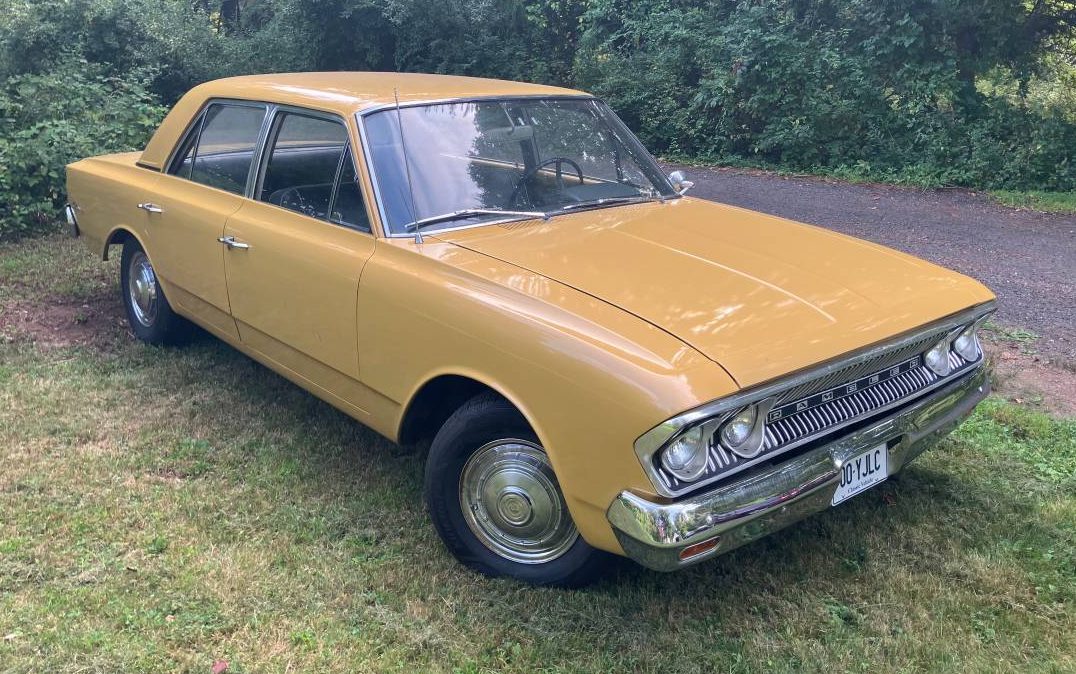
The other day, I was watching a YouTube video from Orphan Car Garage, a Massachusetts dealer, that featured a black 1963 Rambler Classic Six 770 Sedan for sale. I couldn’t look away, because the 1963 Classic had such clean lines and such a trim size that it was almost ahead of its time; it’s really an attractively simple design. Then, Barn Finder Tony Primo sent in this base-model Classic Six 550 Sedan, so we can compare two versions of the same basic car. While the Classic may look better in black (to me, anyway), this very solid-looking Rambler will appeal to those who prefer their American Motors products mustard-colored (the seller calls it “Mean Mr. Mustard”). It’s for sale here on craigslist in Guilford, Connecticut, with an asking price of $7,000.
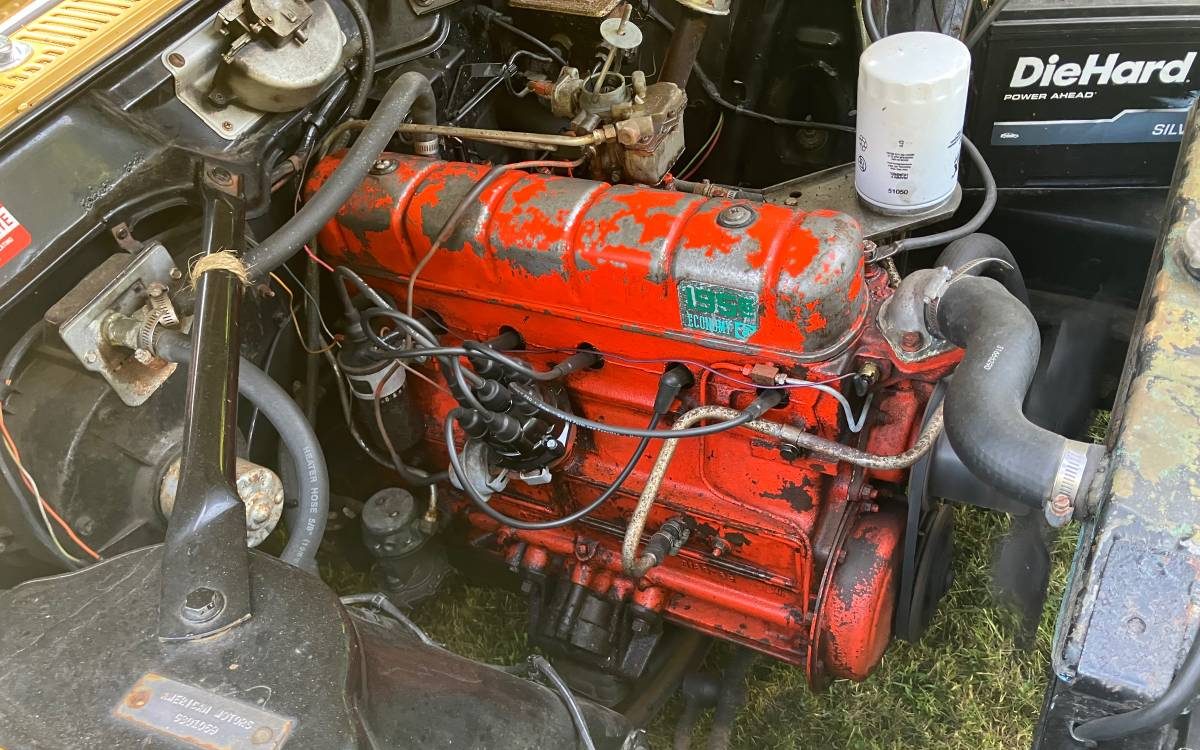
While the Classic was available with AMC’s 287-cubic-inch V8, there’s little doubt that most buyers of the basic 550 were perfectly happy with the base engine, this 195.6-cubic-inch inline six, which put out a not-bad 127 horsepower (and it was at least better than the American’s standard 90-horsepower flathead six). This Classic has the standard three-speed manual transmission, and the seller says that it’s “surprisingly good on gas.” Diehard Kenosha fans might know that a diecast aluminum-block 195.6 was optional for thirty extra dollars on the Classic 550, but it wasn’t ordered on this example. You can barely see it at the top of the photo, but Ramblers also came standard with dual-circuit brakes, several years before most other manufacturers did.
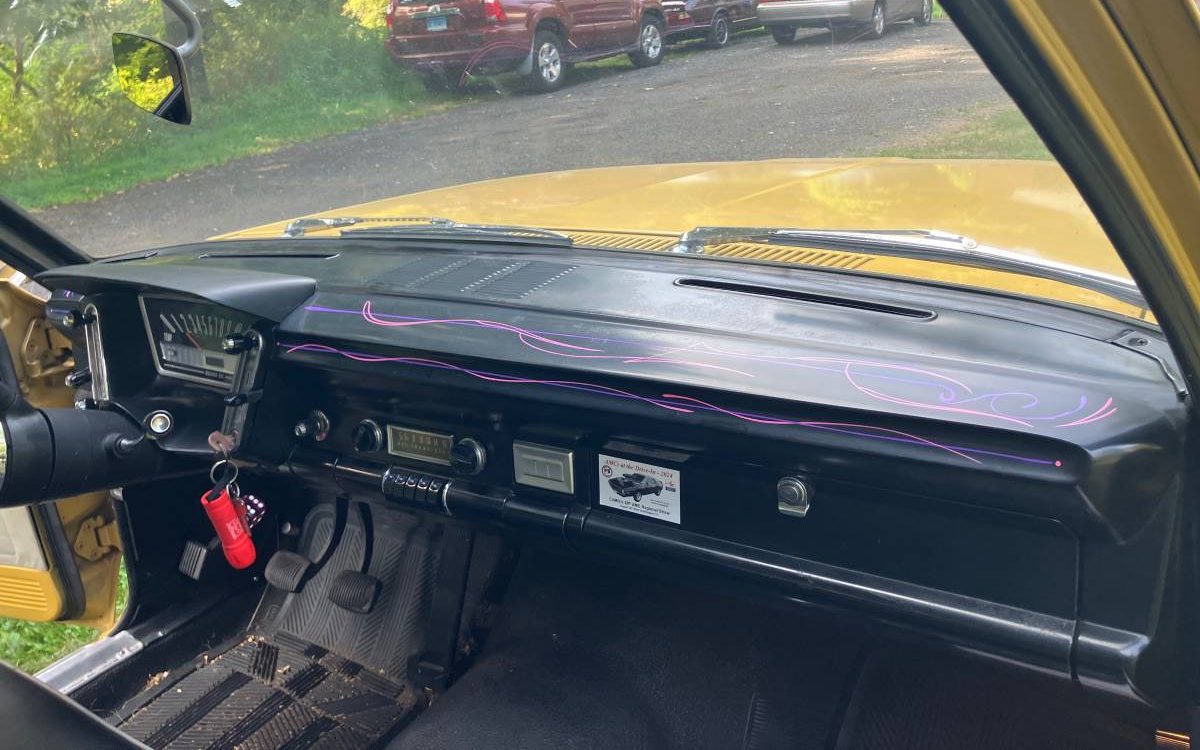
Apparently, the Classic’s paint and interior were redone by a previous owner who rented the car out to the film industry, and in the case of this taxicab-plain Rambler, I have to question the pinstripes on the dashboard. Still, they’re fairly innocuous and easily remedied if the new owner finds them out of character. The paint itself “looks great at [ten] paces” but has some flaws.
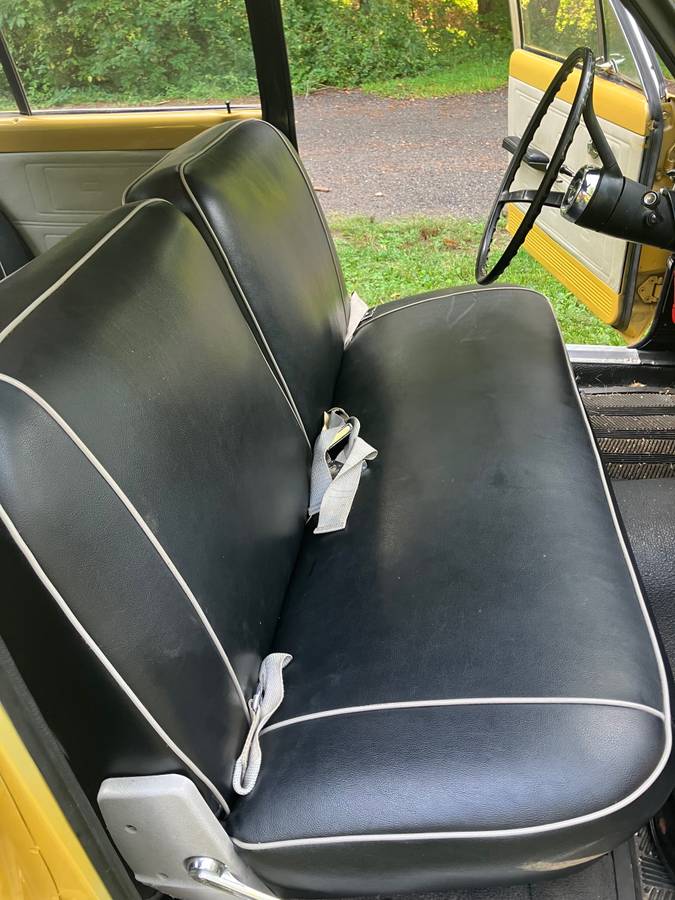
The seat was reupholstered with nondescript black vinyl with white piping, which will be easy to keep clean but a little hot on a sunny day, but that’s what blankets are for.
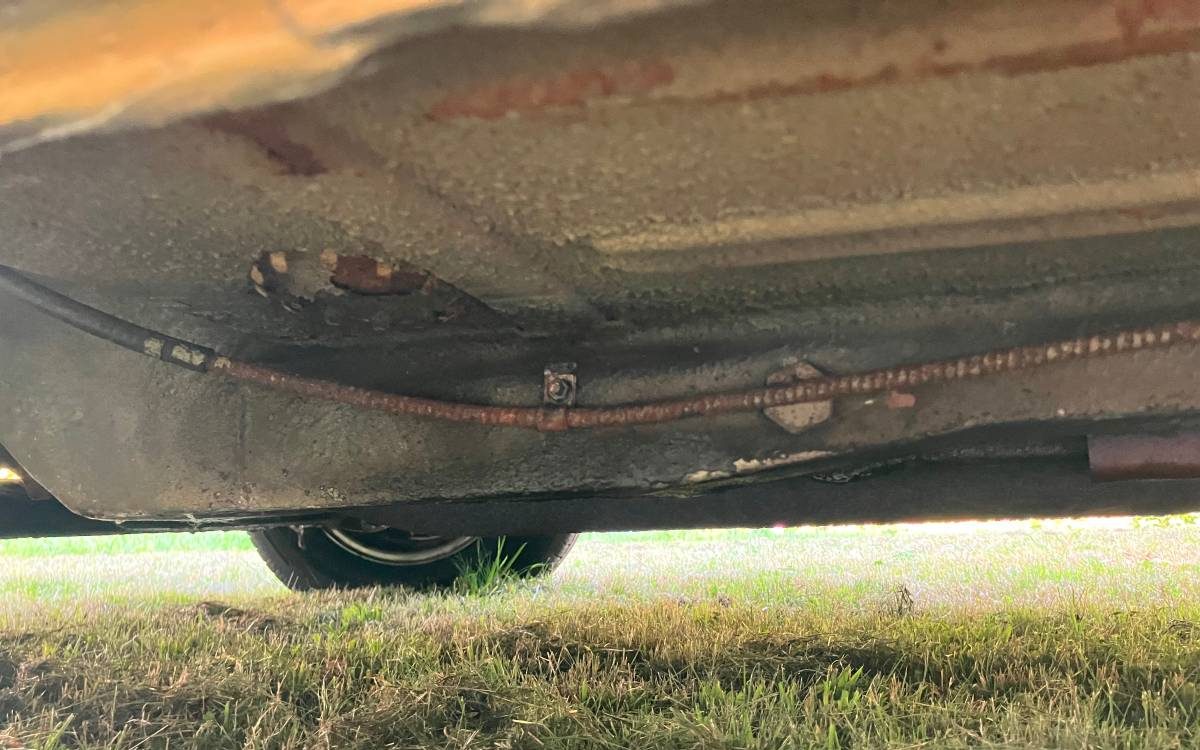
For a northeastern car, the undercarriage looks absolutely pristine; I’m guessing the car came from somewhere else (Hollywood, perhaps?).
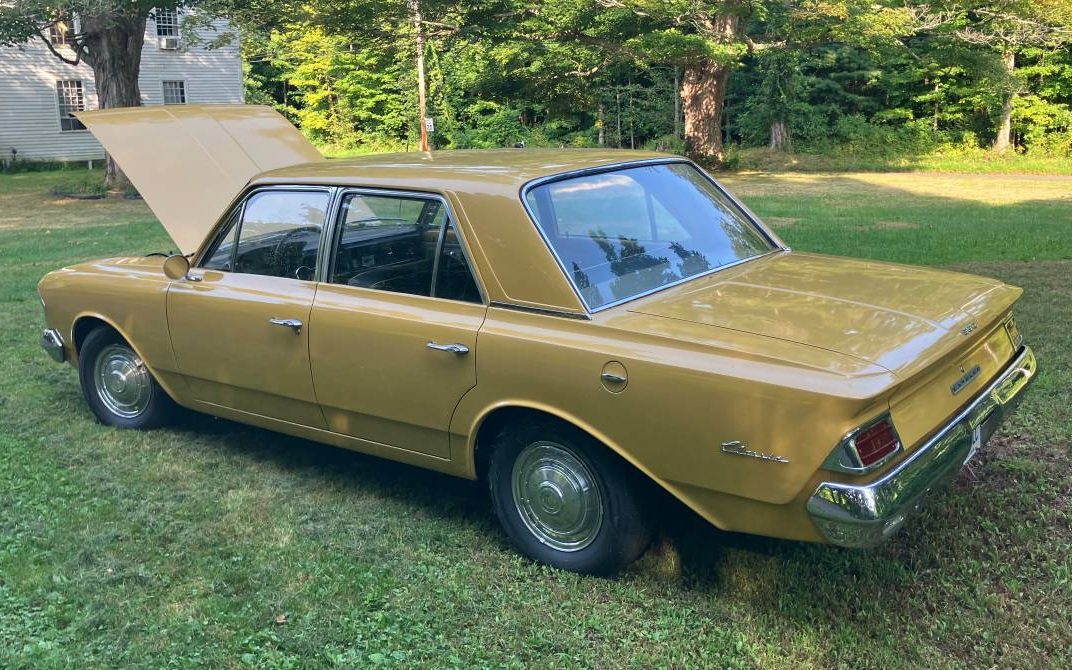
Although American Motors was well-known for releasing some outlandish designs, the 1963 Classic was not one of them. This might be a s-t-r-e-t-c-h, but I get a faint Mercedes-Benz vibe from it, but in a more American idiom. If you’ve got one lying around and want to trade for this Classic rather than spend seven grand, the seller is also interested in a Marlin, so keep that in mind if you just happen to have a Marlin in the garage. After all, diehard AMC folks tend to settle for nothing else.

Huh, I’m a diehard fan and thought all OHV 195.6s were aluminum. See, you can learn new things at 71. Car of the Year, CAR OF THE YEAR,,,,but did little for sales, it was still a Rambler, and I say this everytime, with all the neat cars in ’63, apparently MT owed old Roy a favor. Still got the trunnions and someone doesn’t know how to adjust the choke, again. It’s an odd color, I can’t find on the color chart, did a good job though, nice car, but, but, but,,,,the stick will kill the sale. My nephew, who just bought an unbelievable find I can’t go into yet, but it has a column 3 speed, he’s 42, and never shifted a column 3 speed. It is a glorious day to gloat.
On the other hand, I’m 49 and the clutch broke the other day in my three-speed ’65 Dart. I drove home shutting it off at lights and starting it in second-gear (and gently guiding it into third at the right speed).
Back in 1970 I borrowed a ’61 Falcon wagon, standard shift, from the family I babysat for. As I drove down the street & I shifted, the arm broke off- I was holding it.
I don’t remember what I did, but I felt quite bad. They were dirt poor.
When 17 (too many years ago) in my ’55 Chev convertible. I had just entered Lake Geneva WI on a hot summer Saturday afternoon. For those who have never experienced this traffic phenomenon, you have missed one of life’s greatest traffic jam. I pushed in the clutch pedal to gear down for the traffic and the clutch stayed engaged and the pedal went to the floor. I was able to time the speed correctly to slip it out if gear and stop. Then I had to start it in gear to get going again. All the way through town I had to do this. What seemed like forever I finally emerged out the other side of town. Now having to shift without the aid of the clutch. (Vacuum shifting?) Luckily, once I got to Williams Bay (my final destination) I was able to reattach the spring that held the clutch fork to the counter shift. And it never happened again.
Not quite as easy a fix in my case, Wayne. It looks like the pressure plate levers are stuck about halfway down, so I have a clutch kit waiting for me to install this weekend.
Hi Howard, At least you didn’t learn your “aluminum Rambler engine” lesson the hard way like I did. My folks were Rambler fans and owned at least 2 new ones. Mom bought a beautiful black on red 2 door hardtop 287 V8,stick and overdrive Classic that was a stunner. So later in my young adult life I thought a used Rambler wagon was a sound idea and parted with more than I should have to secure it. Disaster. That aluminum block six (who knew) only lasted one fairly short trip and was toast. :-( Terry J
Sorry but all 196 engines were not aluminum. They were standard on 770 models but you could option the cast iron engine at no cost.
It’s all about “the transition”. In 1963 this Rambler Classic would have been considered by many of us as a low cost, not anything to consider car. But then “times changed”. Here we are in 2026, so many cars look like carbon copies no matter whose nameplate is on them, overloaded with gadgetry and subscription services, require a six year loan if buying new. Somehow “the transition” took place and now this Rambler has become a desirable and easy to use and maintain automobile. I wouldn’t want it then but would love it now, of course like the Rambler I’m 63 years older and possibly had a change of opinions.
The AMC Rambler was completely restyled in ’63 , gaining a very attractive body. Even the bare-bones no trimmed units like this one are handsome, especially the grill. With the no-carpet rubber matted floors, plain Jane seats and do-it-yourself shifter, it doesn’t get any more basic than this. This one does have a radio anyway. My dad liked no frills cars too, he would only drive Valiants and Darts outfitted the same way. If I was permitted to only own one car, I’d take this because I know it would always run and get me there and back.
This was my first car at 18 in 1976. I bought it for $20. It lasted the whole summer. The best part was the completely reclining front seatbacks, which effectively made for a bed inside the car. That, and the lovely Julie made for a very nice summer.
I borrowed a Rambler station wagon for prom. The back seats folded forward and the front seats folded back. Practically a king size bed! Woohoo!
The color of this car reminds me of the mustard yellow on a Volvo I had. I hated that color too. But the Volvo saved my life in an accident with an 18 wheeler.
The color looks to me a lot like FIAT’s Positano Yellow. Still not crazy ’bout it. Like the car, tho’. My mom had a ’64 two-door, two-tone white/black with red interior. Automatic with too-low shift points (AMC, economy, doncha know) and could have used fore/aft sway bars. Nice car tho’.
Wayne, Yes it has nice lines, repainted, polished up, etc. Frankly it would have looked great in gold, and it would gain attention. Paint looks like an Earl Scheib paint job. I hate to think of the condition before this rebirth. I Aalways liked the 63–65 Ramblers. They were a bargain because they cost less than any Chevy, Ford or Plymouth, and came dressed up, while the big three decided that a little chrome, nice wheel covers and a radio was like giving the customer what he was actually paying.
We’ve heard that story before, does “Mrs. Kahrs” know about “Julie”?
looks like a taxi
My first car was a ’63 Classic 770 wagon and was also my first project car. My dad and I rebuilt the motor, my mom and I reupholstered it, and my girlfriend’s dad and I repainted it. I loved everything about that car, except the upside-down oil filter at the top of the engine. It was impossible to change the oil without making a big mess!
No, I didn’t know that I wanted it, but I think now maybe I do. Ramble on.
I love it. My first car was a 64 Plymouth wagon. It had a slant 6 with 3 on the tree. During high school, I worked for a department store that sold appliances, and when a single small appliance needed to be delivered, I drove his 63 Rambler wagon, it had the same drivetrain. That little car was fun.
I love the placement of the oil filter on that motor, but…wasn’t it a little messy to change??
I’ve heard it said that the oil drains back into the pan, so the filter has no oil in it after the engine is off. We all know how messy removing a filter that’s oriented underneath can be…
Makes sense, thanks Rex!
Actually, I think it was more of an oil cleaner, as opposed to a full force oil filter adopted later. And yes, not all the oil drained back, and was a mess, but the motors were usually oily slugs anyway, and nobody noticed. For many years, oil filters were an option, and these were better than nothing.
I took driving lessons and test in one of these cars. Definitely not considered a “cool car” but well built and functional.
What an interesting color. I don’t know how long I’d like it, but I’m so sick of gray, black, silver etc… I think my grandparents had a 65 Rambler wagon. I rode in the back part when I was 4. He replaced it with a beautiful 69 Rebel that was dark green. That got totaled on an ice patch. He then got a 74 Matador in almost the same green. They gave it to me the the New Hampshire Salt ate holes in the frame. It was a cream puff. Only had 70k and the oil looked as clean as corn oil. We had 68 Rebels then a 74 Hornet. .