

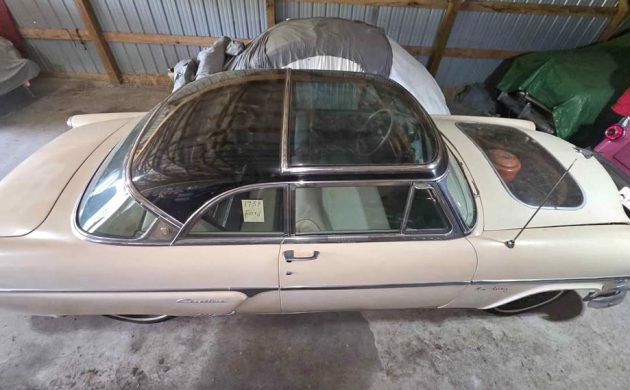
If the listing images are accurate, this 1954 Ford Crestline is genuinely special. It is a Skyliner, an already rare classic. However, it appears to have one of Ford’s “Demo Hoods,” which raises the stakes considerably. It carries the hallmarks of a survivor-grade classic, and with the owner deciding that it needs a new home, he has handed the sales task to his son. I must say a big thank you to Barn Finder Pnut for spotting the Skyliner listed here on Facebook Marketplace in Hodgenville, Kentucky, for $35,000.
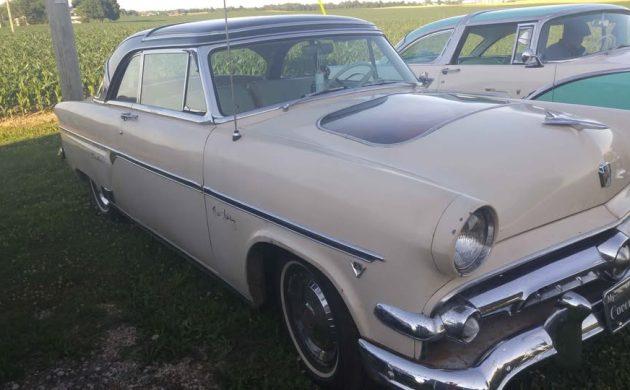
Ford introduced the Crestline as the range-topping variant of its passenger car range in 1952. The company tweaked the styling in 1953, but the 1954 model year brought something dramatic and new. It released the Skyliner variant, a 2-Door Hardtop with a tinted acrylic front roof section. It created the illusion of driving a Convertible while providing the weather protection of a typical Sedan. The concept sounds great in theory, but there was one significant fly in the ointment. The acrylic panel was tinted, but didn’t effectively filter UV rays. As a result, life aboard a Skyliner could become unpleasant on sunny days as Mother Nature roasted the occupants. The top isn’t the only expanse of acrylic, with this car featuring what I believe might be an original Demo Hood. Ford produced these to showcase its updated 1954 engine range in a showroom setting, and various figures suggest how rare they were. One thing is beyond doubt: the company directed dealerships to remove the hood before the car left the showroom and replace it with a standard panel. Some dealers complied, some didn’t, and some later on-sold them to people who had already purchased a ’54 Crestline. The listing suggests the deal includes another hood so that the new owner can rotate between the pair, depending on their tastes. This car is a mixed bag: while its Raven Black paint looks nice and holds an impressive shine, the Sandstone White cloaking most of the panels looks more tired. Plenty of chips are visible, and one shot suggests rust developing in the passenger-side rear quarter panel. Therefore, I would strongly recommend performing an in-person inspection. These faults may also have contributed to this Ford remaining on the market four weeks after being listed.
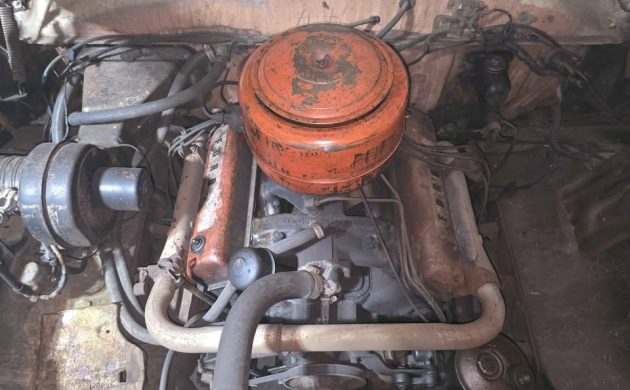
This shot reveals what motivated Ford to produce the Demo Hood. The venerable flathead V8 had served the company faithfully for many years, but Ford introduced the significantly more modern, powerful Y-Block for the 1954 model year. How much better was it? The 1953 239ci flathead delivered 110hp and 196 ft/lbs of torque. This Crestline’s Y-Block shares the same capacity, but places 130hp and 214 ft/lbs of torque at the driver’s disposal. The result was a dramatic performance gain and improved fuel economy. This Crestline teams the Y-Block with a three-speed Ford-O-Matic transmission and power steering for an effortless driving experience. Frustratingly, the seller doesn’t indicate how well this classic runs or drives, but I would expect nothing less than a turnkey proposition from any ’54 Crestline in this price range.
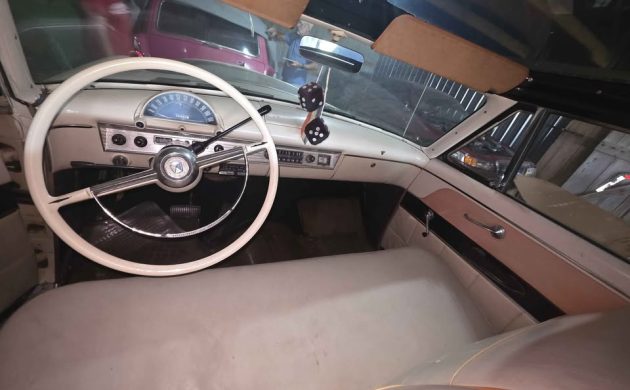
Trimmed in what I believe is a combination of Coral and Ivory vinyl, this Skyliner’s interior is tidy without being overwhelming. I believe that the front seat wears a replacement cover that lacks the buttons found on the original. A few minor trim pieces may be missing, and some upholstered surfaces look slightly tired. There are no major problems requiring immediate attention, but I would probably expect a higher standard for a ’54 Skyliner costing $35,000. The fuzzy dice are the only additions to an interior featuring a pushbutton radio and a clock.
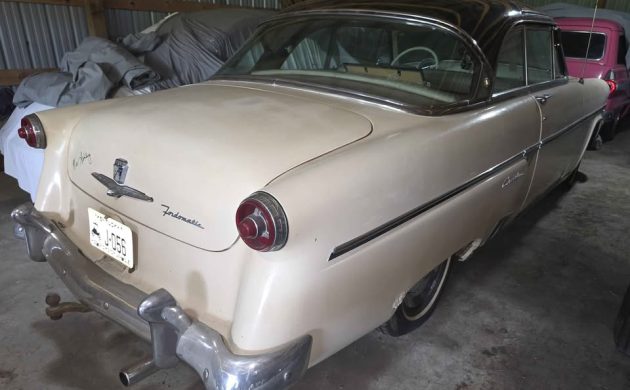
This 1954 Ford Crestline Skyliner is a relatively rare beast, with only 13,144 examples rolling off the line that year. If it does feature a genuine Ford Demo Hood, that makes it more desirable, which raises a point to ponder. The classic world has harsh realities, and one is that rarity doesn’t necessarily equate to stratospheric value. This is not the first 1954 Crestline Skyliner I’ve seen at Barn Finds, having featured this car in 2020. Its presentation was superior in all areas, but its strongest attribute was the price. Our featured car will cost its new owner $35,000, but the other was priced at $25,000. It is easy to argue that six years have passed since then, but I found an immaculate example with a Demo Hood that sold a year ago for $25,000. That makes me believe that the seller is being optimistic, but do you agree?

It’s cars like this is why I love getting on Barn Finds and looking at all the listings just to see what’s out there. I’ve been a huge Ford guy for all of my 73 years, Fords and Mercurys were all my dad ever owned. I’ve owned my share. I have never seen a Demo Hood before. The green roof panel, yes I’ve seen before, but not a hood. I’m surprised my dad didn’t own one, with both hoods. I could see him out behind the garage putting on the Demo Hood just to go show to one of his buddies. Great writeup Adam, and I agree with you, rare does not always mean you can jack the price sky high. There’s probably a good reason not many people bought one.
This is really interesting. The only car with a glass hood I’ve ever seen a picture of is an Early Rocket V8 powered Oldsmobile. I’d like to see more of the ’55 Crown Vic sitting next to it!!! I’m thinking that price is a bit of a reach though.
I was about to write it about the Rocket’s Olds hood too.
I’m in the same boat…. I’ve never seen, or even heard of, a Demo Hood. Which makes this car interesting. Good job Adam.
Gotta wonder how many people were burned over the years by that exhaust crossover pipe!
I’ve seen a few of these over the many years I attended the Fabulous Fords Forever at Knott’s Berry Farm in California back in the 1980 – 1990s, but those were restored and looked great under the Demo Hood.
Years ago there was a guy in my Corvette club who had both a 54 Skyliner and the Mercury version, the Sun Valley. He had one of the cut out hoods for his Skyliner. He claimed Ford made about 175 of them but I have no idea if the number was correct or where he came up with that number.
The 54 Ford and the 49 Olds weren’t the only cars to wear a clear hood. Chevrolet had a plexiglass hood (decklid?) made for Chevrolet dealers to use to display the rear mounted engine of the “new” 1960 Corvair. I have no idea how many of these hoods Chevrolet had made in 60, but it seems that a good number of them may have survived because I’ve seen a few Corvairs with them at shows over the years.
I wonder how much weight the acrylic panel adds to the hood?
I had no idea there were all these vehicles with ‘see through’ hoods. But now that I think about it, I remember in the mid 1960s the infamous Hemi Under Glass. That was a little different because someone, (I’m sure a smart BF reader could give more info than I have) someone took a 1966? Baracuda with the fastback rear glass and put a hemi V8 in the back seat, hence, Hemi Under Glass. It was basically a show car that toured drag strips and popped wheelies for a quarter mile. Those were the good ol days.
The “Hemi Under Glass” wasn’t quite the same thing as the production cars with see thru panels added to the hoods to display the engine. The Hemi Under Glass had a rear mounted Hemi engine under the stock glass fastback rear window of a 1965 Barracuda.
The Hemi Under Glass was a drag car built and owned by George Hurst of Hurst Performance, with input from Hot Rod Magazine and their editor. When they first attempted to race the car the radical rearward weight bias caused it to do extreme wheel stands. Instead of trying to correct it’s (very popular) wheel stands, they decided to use the car for exhibition wheel standing passes instead. A “window” was added to the floor so the driver could see where he was headed, and hand levers were installed to individually control the rear brakes as a way to steer the car.
Hemi Under Glass toured drag strips around the country doing wheel stands in between regular race rounds. It was driven by “Wild Bill” Shrewsbury, and others over the years. The popularity of Bill “Maverick” Golden’s “Little Red Wagon” probably had a lot to do with Hurst’s decision to adapt the Hemi Under Glass for wheel standing.
I would never own a Skyliner, for the very reason you mention: sweltering inside the thing on a sunny day. Besides, these roofs LEAK, after the rubber seal ages!
This being the first year for the Y block V-8, it is not considered the Early Ford V-8, according to our club which includes the flat V-8 from 32 to 53 (54 too in Canada), but it is collectible of course. Here in Pennsylvania a few years ago the Hawk Mountain chapter (near Reading PA), that had been very active previously, disbanded. Next week our chapter in Bucks County near Philadelphia may decide to only meet on the same evening with the Model A club. So, the only PA club left with much activity will be near Pittsburgh. We are aging out. Prices for these should be coming down along with demand.
Hello, Dave in PA! I know the feeling.
Here are some classic cars that had plexiglass “demonstrator hoods”, basically dealer-only promotional items:
a) Oldsmobile Pioneers (1949–1951): Oldsmobile was the first automaker to use these marketing tools. To showcase their revolutionary new “Rocket” overhead-valve V8 engine, GM shipped a substantial number of these specialized hoods—which featured two clear Plexiglas insert windows—to dealerships across the United States.
b) Chevrolet Showrooms (1955): Chevrolet followed suit to market their landmark 265 cubic inch small-block V8. While a specific production count does not exist, it is heavily rumored that one of GM’s three famous 24-karat gold-plated “Golden Chevrolets” built to celebrate their 50-millionth vehicle milestone was equipped with one of these clear plexiglass display hoods.
c) Cosworth Vega Exceptions (1975–1976): Beyond the standard marketing inserts of the 1950s, GM specifically fitted exactly three Cosworth Vega models with full clear acrylic Plexiglas hoods to showcase their twin-cam engine, including Cosworth Vega No. 001 retained at the GM Technical Center.
d) Studebaker (1951): In 1951, Studebaker introduced its highly advanced, overhead-valve V8 engine for the Commander line. To aggressively market this engineering milestone, Studebaker distributed a select number of see-through promotional hoods to major dealership showrooms.
Source: MotorCities National Heritage
There is a black ’54 Ford in our town that has a real demo hood. It isn’t a Sunliner, but it has more than a Y-block to look at through the hood. The owner installed a 429 big block!
That is the only ’54 Ford I have ever seen in person with the demo hood.
I’ve seen at least one at a show. It’s too bad, with a window in the hood, that the engine isn’t cleaned up.
I’ve never seen one in person. But I watch the old show “My Classic Car” hosted by Dennis Gage. He had one featured on the show. Great car and would be a hit at any Cars and Coffee.
This Ford Crestliner glass top is a true and beautiful rarity that is seldom seen. Great car but the seller is Lost In Space thinking he can sell this car in as is condition for $10,000 more than it sold for a few years ago without doing a thing to it . No damn wonder the car has not sold in questionable condition at best. Good luck cause he’ll need it. Hard pass.
What’s that ugly U-shaped pipe connecting the valve covers?
Thanks for all the homework you did on this one, Adam!
The pipe is a cross over pipe from left exhaust manifold to right side manifold that is stock for the single exhaust system. Yes, it is ugly, especially this example.
There were several vendors at the Canfield Ohio swap meet ten years ago and there were ten or so demo hoods between them. Worthless in my opinion, why not just open the hood?